How to Apply Fiberglass Over Marine Plywood

With the boat upside down, it was time to put the outer covering of fiberglass fabric over the marine plywood hull planks. Glass fibers are very strong in tension and resistant to abrasion. When embedded in epoxy on the inside and outside surfaces, it creates a strong, stiff and relatively light weight composite structure.

The photo below shows the hull bottom after placement of the glass fabric. The corners have been filled with a thickened two part epoxy filler that were sanded to shape. The back edge of the bottom surface was left as square as practical, for the most efficient water cutoff at planing speeds.
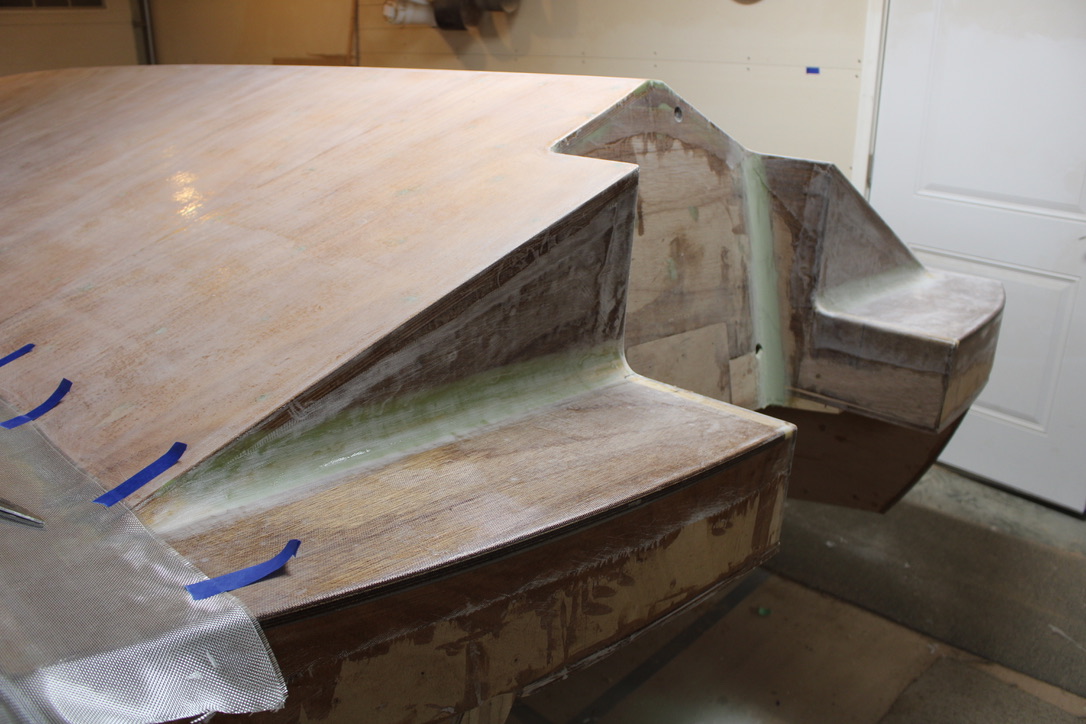
Experts disagree on two main methods of adding the glass fabric: laying out the fabric and then applying the epoxy or brushing a coat of epoxy on the wood first. Since the fabric catches on sharp or sticky things and deforms easily, I prefer to carefully lay it out over dry, sanded surfaces, primarily in one plane, as shown below.

A 36″ wide layer was rolled out and taped, overlapping the previous finished areas. With a smooth under surface, small changes can be made to smooth out wrinkles for the best possible fit.

The downside to this method is that the epoxy must penetrate the fabric, and fully bond to the wood underneath, or risk delamination later. The surface needs to be fully wetted and transparent, but not so much extra that would make epoxy flow zones. The application begins, rolling epoxy from top down, working out wrinkles as we go.

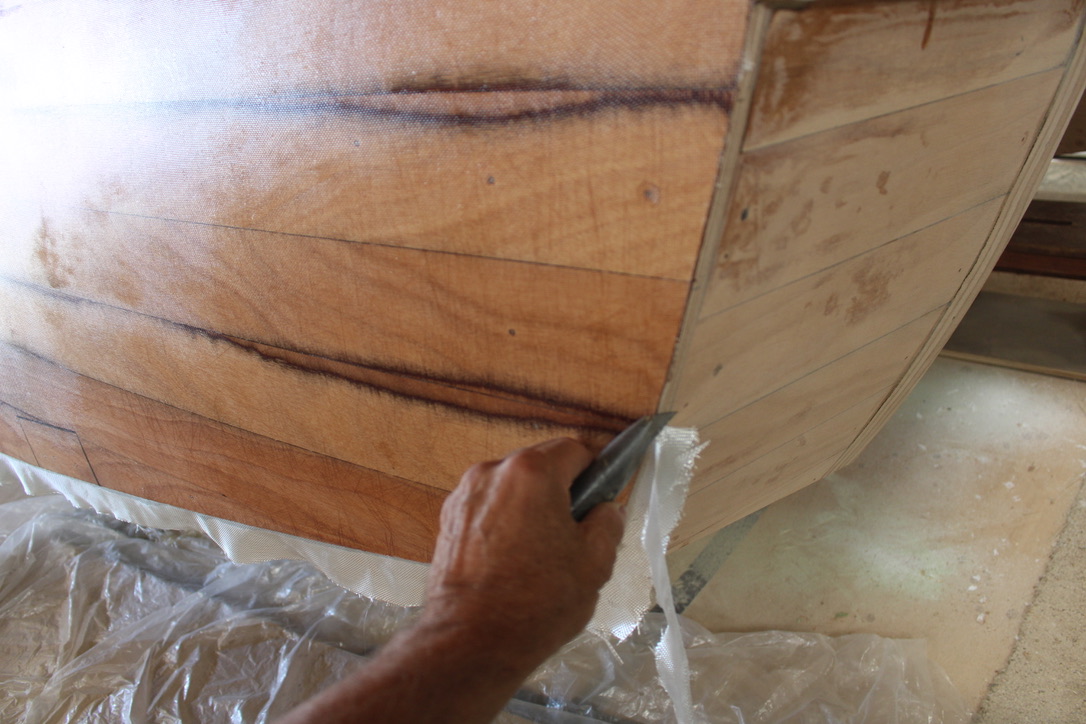
When the epoxy has set up to the stiff, not sticky stage, before it gets hard, the edges can be trimmed with a sharp knife.
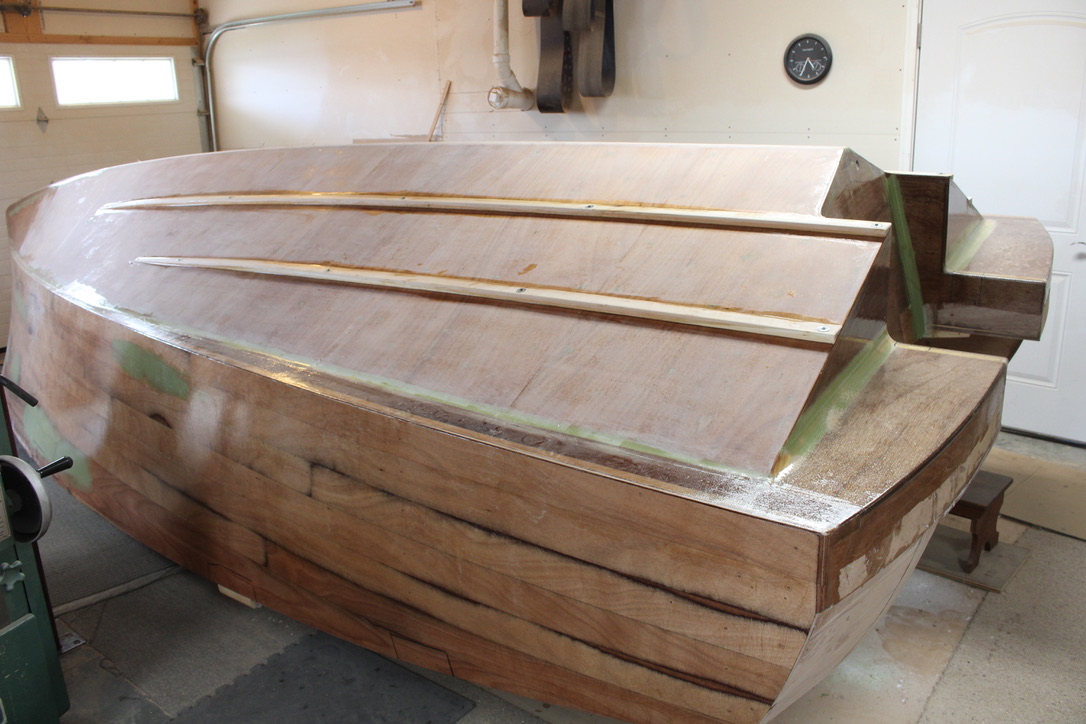
Next strakes were added, and rough sanding all over with 80 grit to allow best primer and paint adhesion. The hull planks of 4″ tongue and groove marine plywood show through on the sides. The dark lines show where the top ply layer was sanded through, and the green where low spots had been filled for final fairing.
My shop is not equipped to spray paint , so the boat was loaded on a flat bed trailer and slowly hauled five miles to get professionally painted. This is on the return trip, preparing to lift the boat with the four heavy duty winches mounted on the temporary posts.
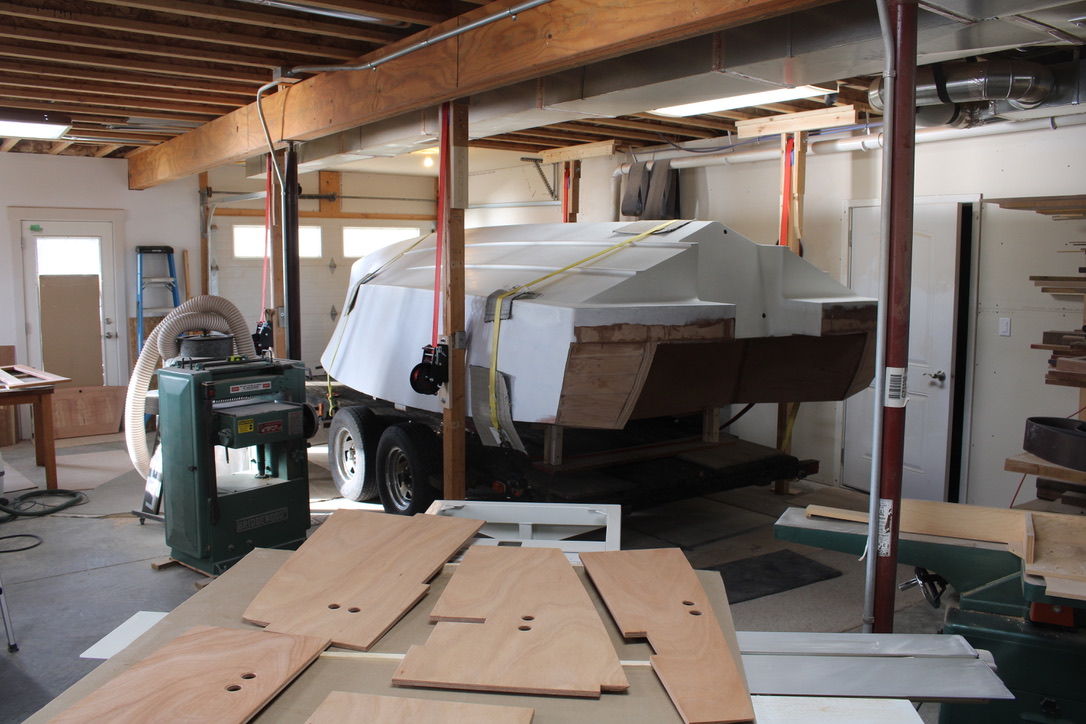
There are many ways to slow down a big project like building a boat, which happened but it is off and rolling again, passing this significant milestone. Work on the bottom is completed and following a final flip, this boat is intended never to be upside down again.

Building a Strong Ski Post: Key Considerations and Techniques

How strong does the post have to be?

No commonly available data can tell exactly how many pounds of drag a ski pole must pull. So, it becomes another one one of those challenges in building a boat that requires some thoughtful estimation. For a skier, the drag weight has to be in the range they can actually hang on to, which I will guess to top out at something a bit above their body weight.

Pulling tubes, however, is a different story, which is why most of the ski post retailers say not to pull a tube. My grandkids have never understood that logic, and have been known to jump five riders on two tubes. If they lean back, it can almost prevent the boat from coming up on plane.

A typical ski rope is made with a 1600 pound max of tensile strength, and in combination with a 2-3/4″ Mastercraft aluminum pole, is not likely be the weakest link. So, the mounting frame work, which will be centered between the seat back and the front of the engine well must be “super” strong.

Creating Front to back stiffness

I started by adding inner and outer support plates to the triangle frames which had been dowelled to the bottom boat longitudinal beams.

Making the top plate

The third piece of the vertical leg was added on the inside of the front sandwich. Then three pieces of Baltic Birch plywood were laminated and epoxied into place at the top of the legs.

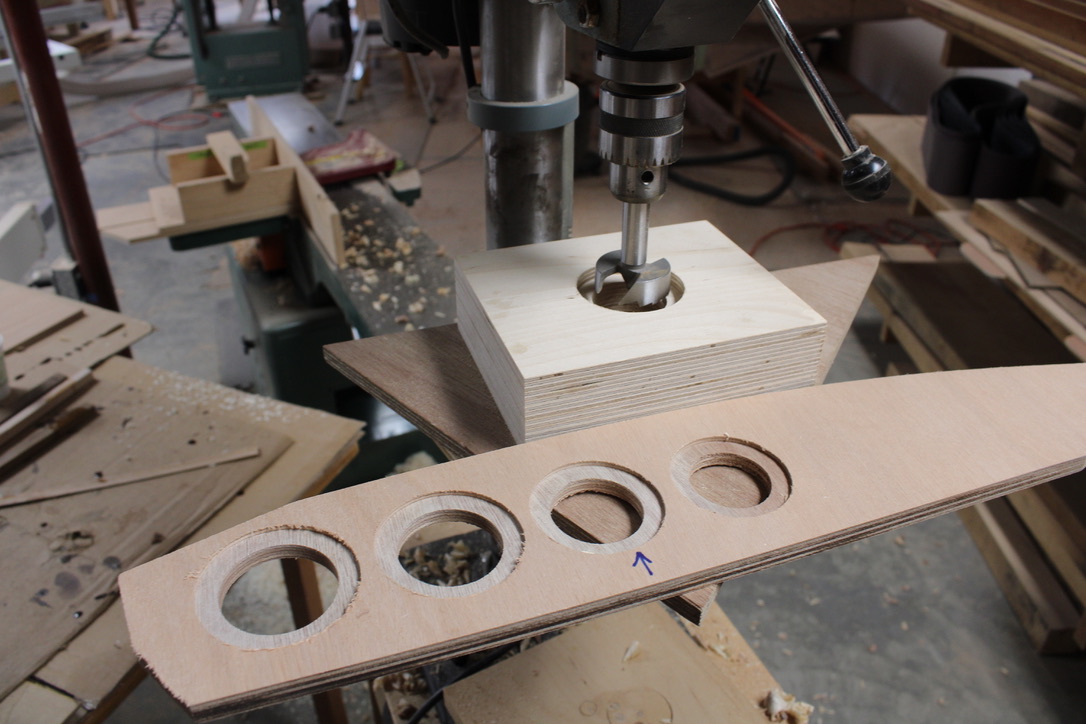
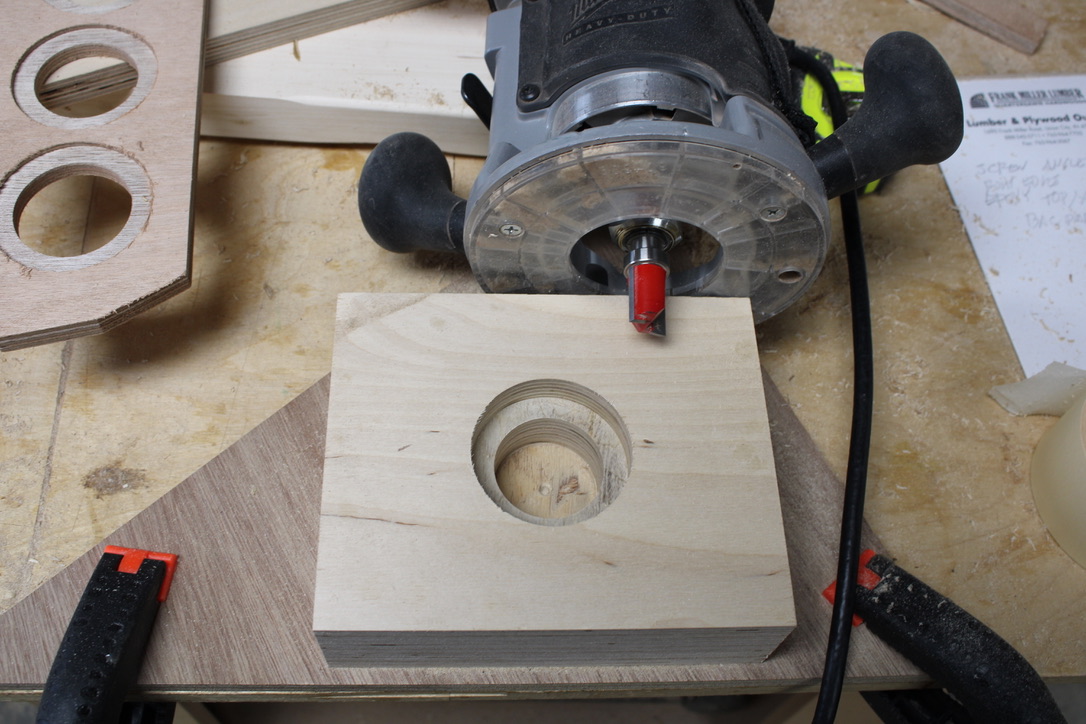
The ski post is 2-3/4″ wide, and don’t have a drill bit that exact size, so I had to cut it in stages. First, I used a Forstner bit and followed with a bearing guided router bit to enlarge it. Eventually, experimenting created the right sized hole.

After cutting the ledge a bit deeper, I used a flush-cut bearing bit to finish the hole through.

Last, I added a base support to hold the bottom of the pole. When the back seat top piece is epoxied into those front notches, it will add some side to side stiffness, and I am betting on the framework to pull two tubes strong with out complaint.

This is just a single example of many things in a boat building process that need to be researched, and thought fully worked through. When in doubt, overkill engineering tends to help me relax as I go on to the next chapter. But, I am pretty confident that when the first skier hangs on to the rope, it won’t let us down.

Cross Frame Modification

In a perfect world, each of the cross frames would have been modified in advance, especially considering that the pieces were CNC routed and little more effort would have been needed at that time.  But, since the original computer boat profile was lost, and some guesswork needed to place the frames, it seemed better just to wait.  Setting the floor height and imagining where the fuel tank would go, for example, was easier after the frames were in place.  

The first priority was stiffening the outside of the 1/2″ Hydrotek marine plywood. Fortunately, I had some Alaska Yellow Cedar, left over from the first boat. In the last 7 years, it would have been perfect for furniture drawer sides, solid lap-joint cabinet backs and drawer bottoms, etc. But I never wanted to use it along the way, with another boat in the dreaming stage.

The Alaska Yellow is full 4/4 thickness and 6″ wide planks, 16 feet long, with no knots. It is beautiful wood, but expensive, and I wanted to outline all the edges, with as little waste as possible.

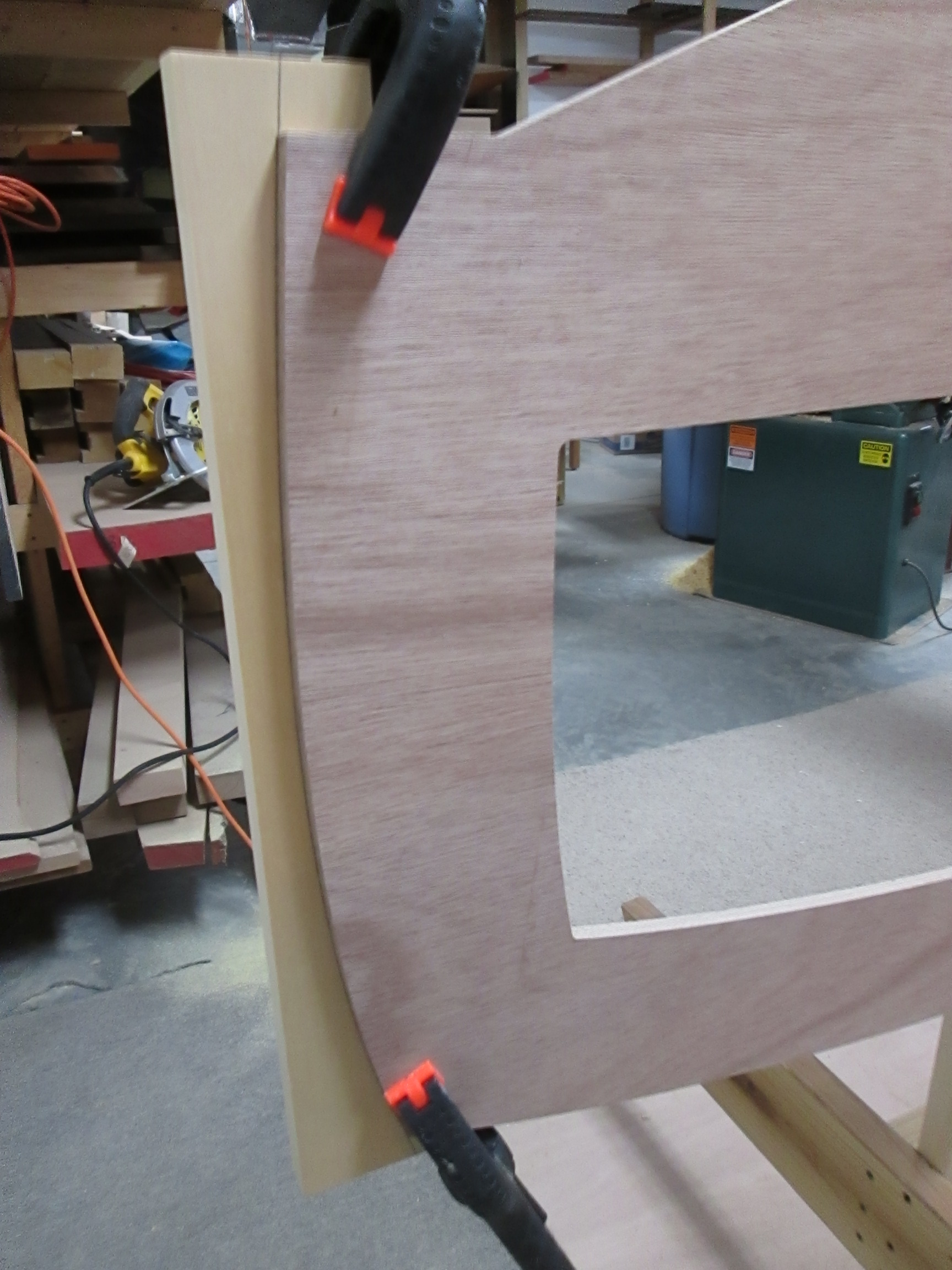
My technique was to cut the 6″ planks into two 3″ wide lengths, long enough for each part of the frame. Then, as the photo shows, I spring clamped the cedar against the Hydrotek, and drew the outline with a pen, roughly in the middle of the 3″ piece. 

Next, I cut the marked pieces on the band saw as close to the line as I could.

When the parts were reversed, with the straight sides together, the outside shape has a very close alignment with the original curve on the frame.

The Alaska Yellow Cedar parts were glued with Titebond 3 glue. It is water proof, and has a better working time than TB 1 or TB 2, and cleans up with water. Titebond 3 is my favorite of all marine bonding agents for edge gluing long grain wood with a good fit.

However, if gap filling or structural strength is required, that is where epoxy shines. Then, it is well worth the effort of extra mixing time and waste, oozing, dripping, sticky and drifting parts, and more difficult clean up. 

Next, I determined that the fuel tank would best fit under the floor from the 5th frame back, so I made a temporary routing jig to guide the router using an end-bearing bit.

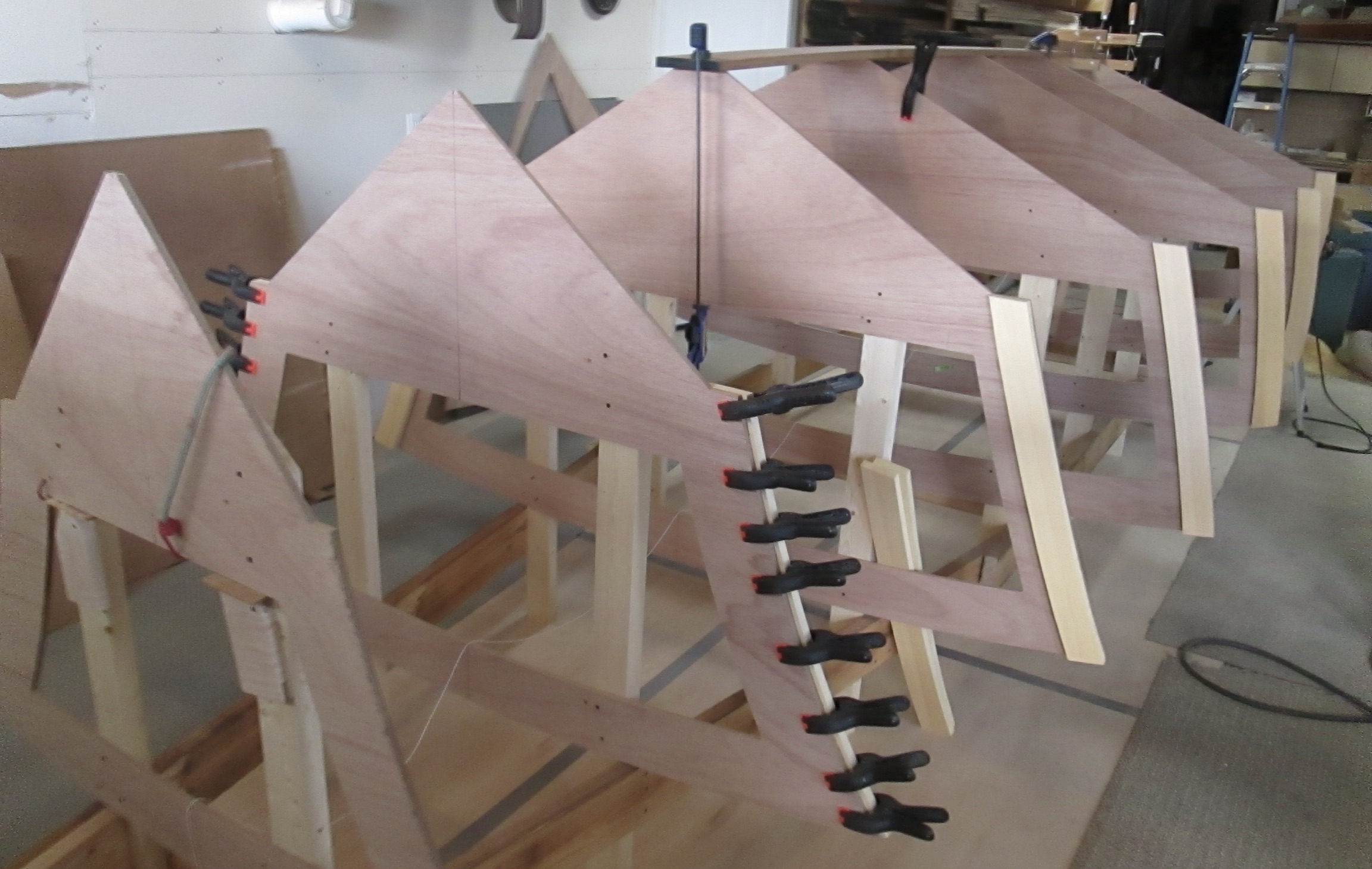
At the completion of adding the perimeter frame and center hole cut outs, the cross frames are getting ready for the longitudinal stringers, at the keel, chine and sheer lines.

All of this internal construction will soon be covered, and never seen by a rider in the boat. That is a little like human character, hidden for a while until under pressure, it will show what it is made of.