Boat Turning Party

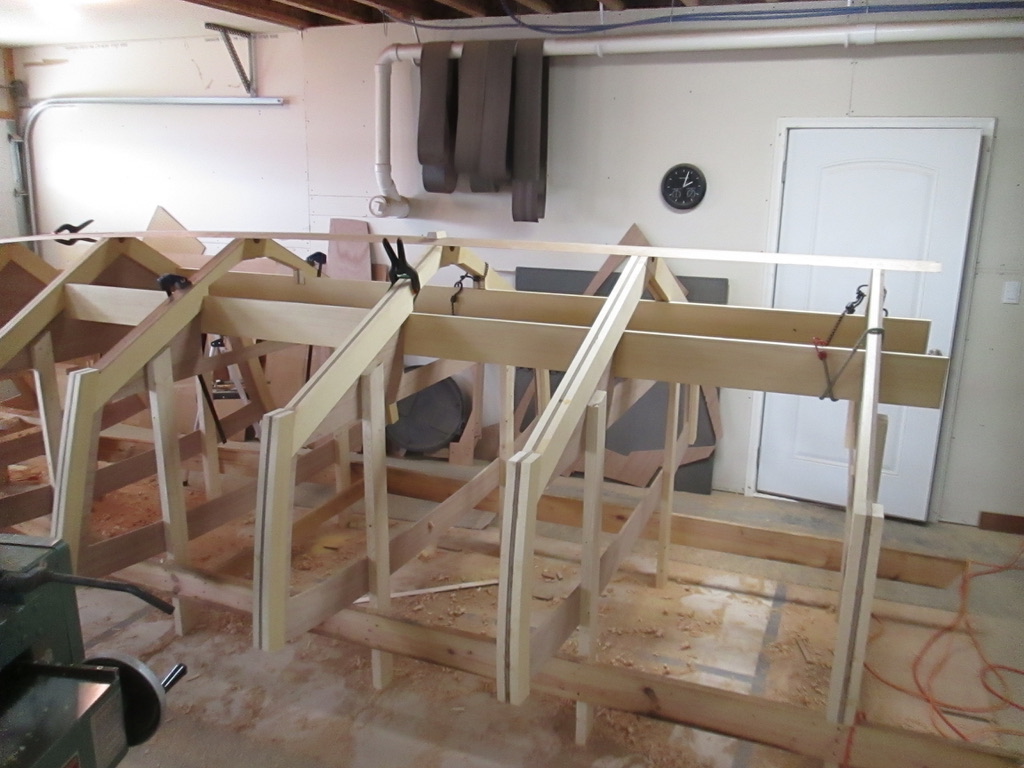
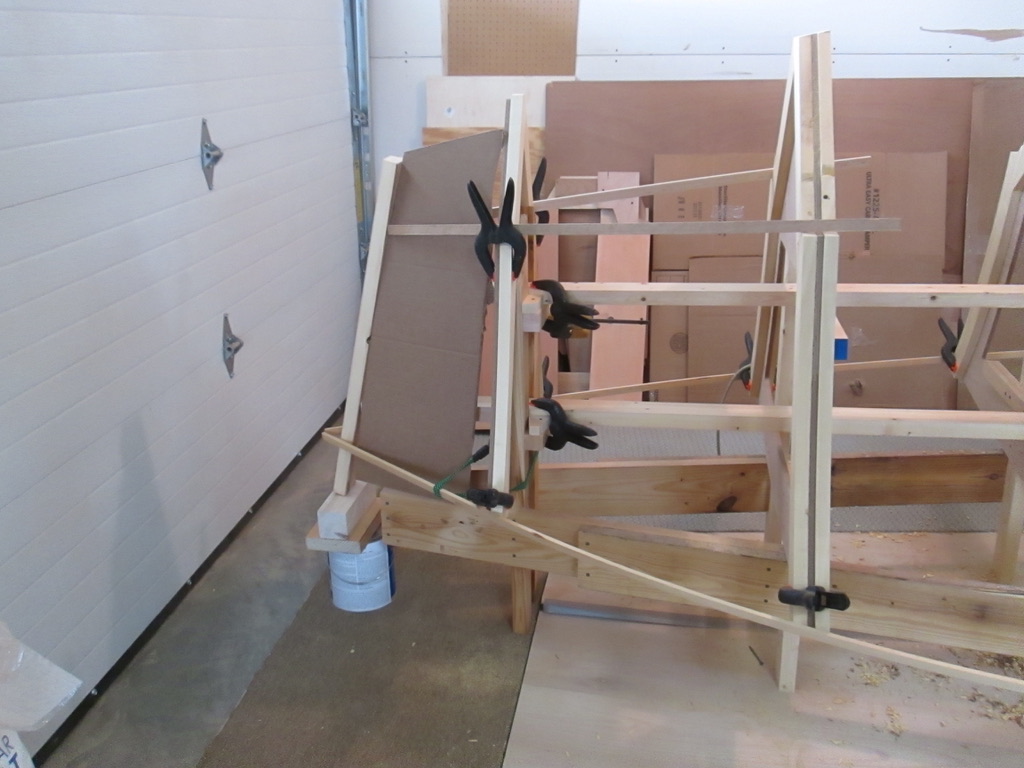
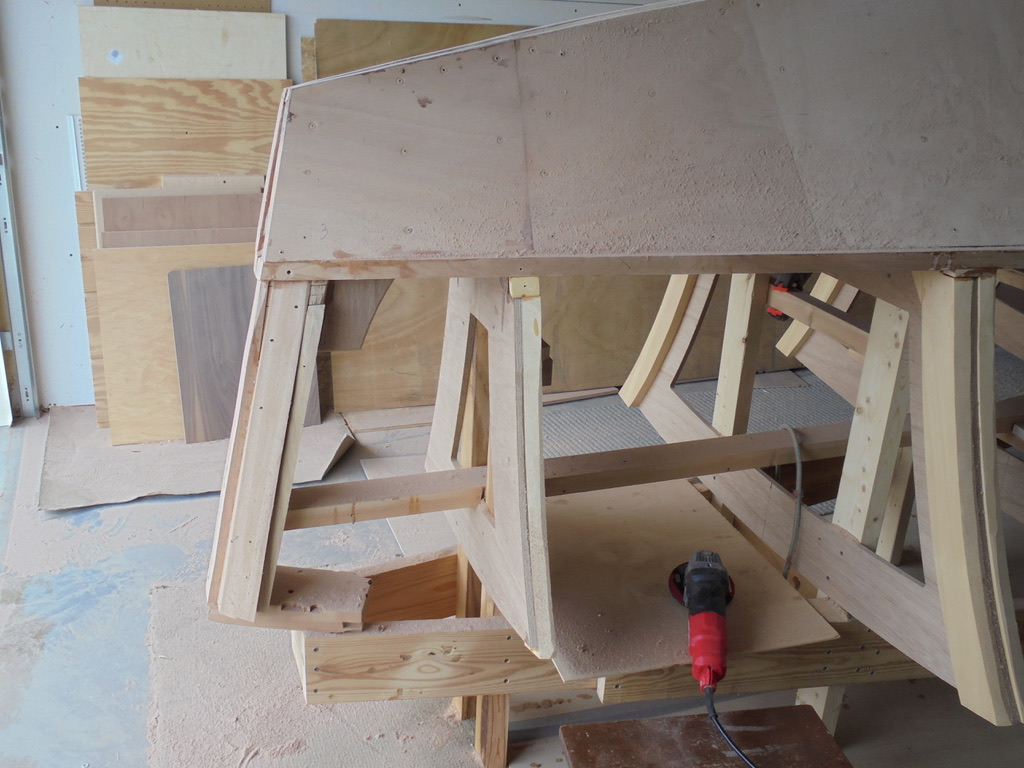
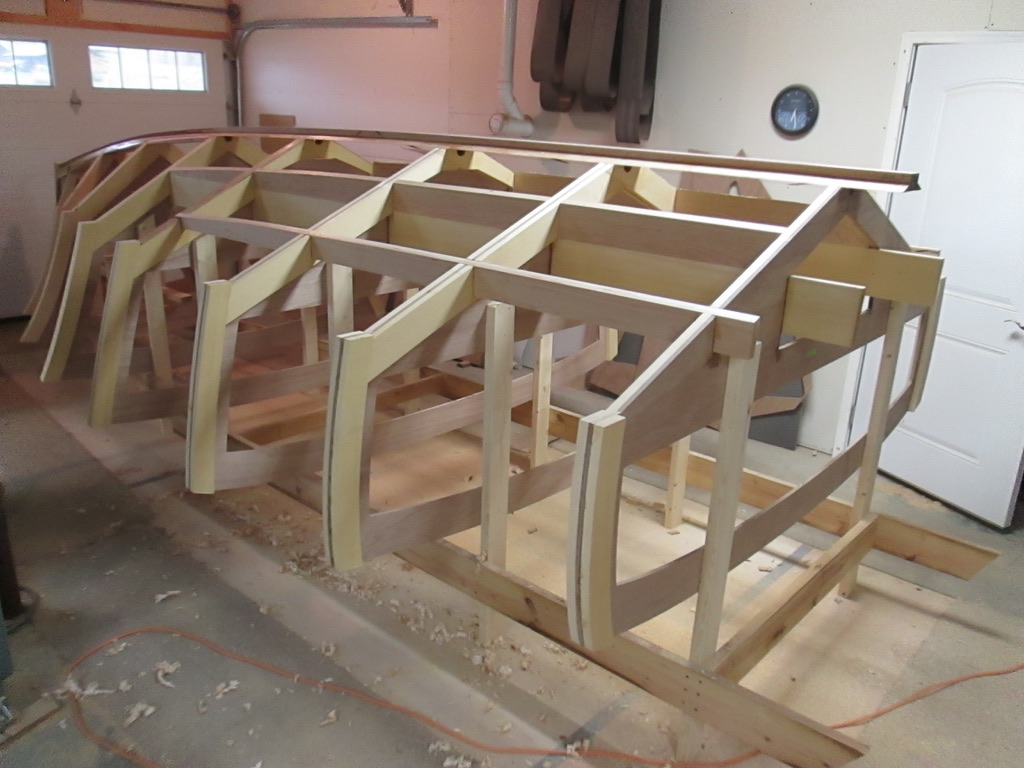
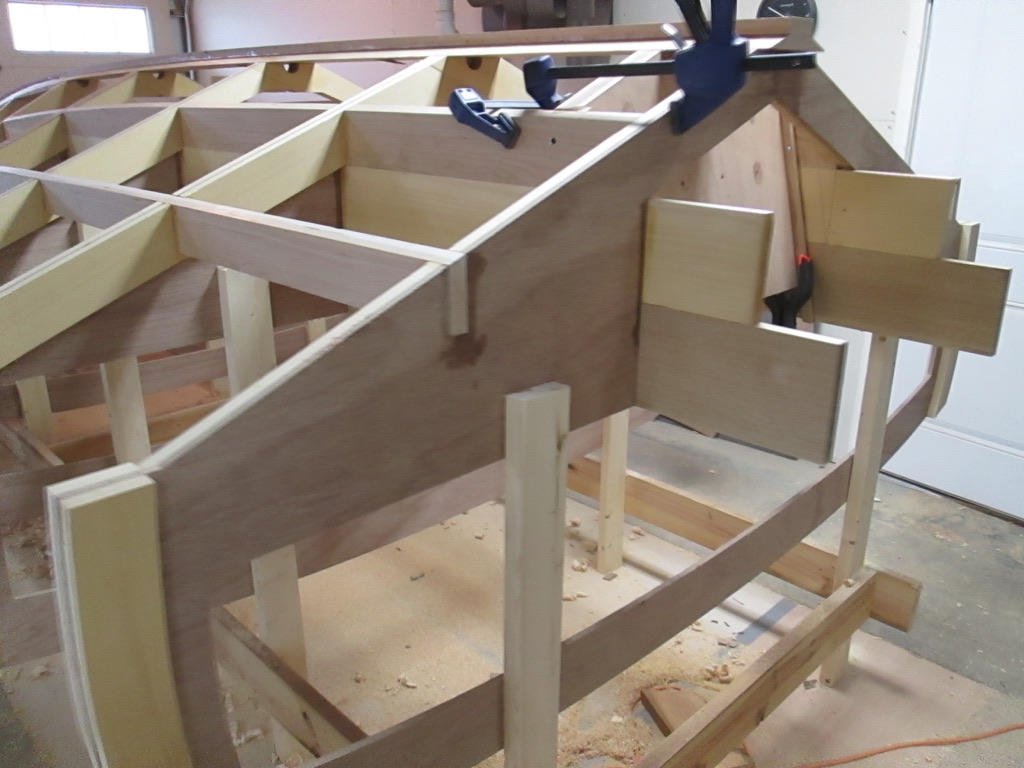
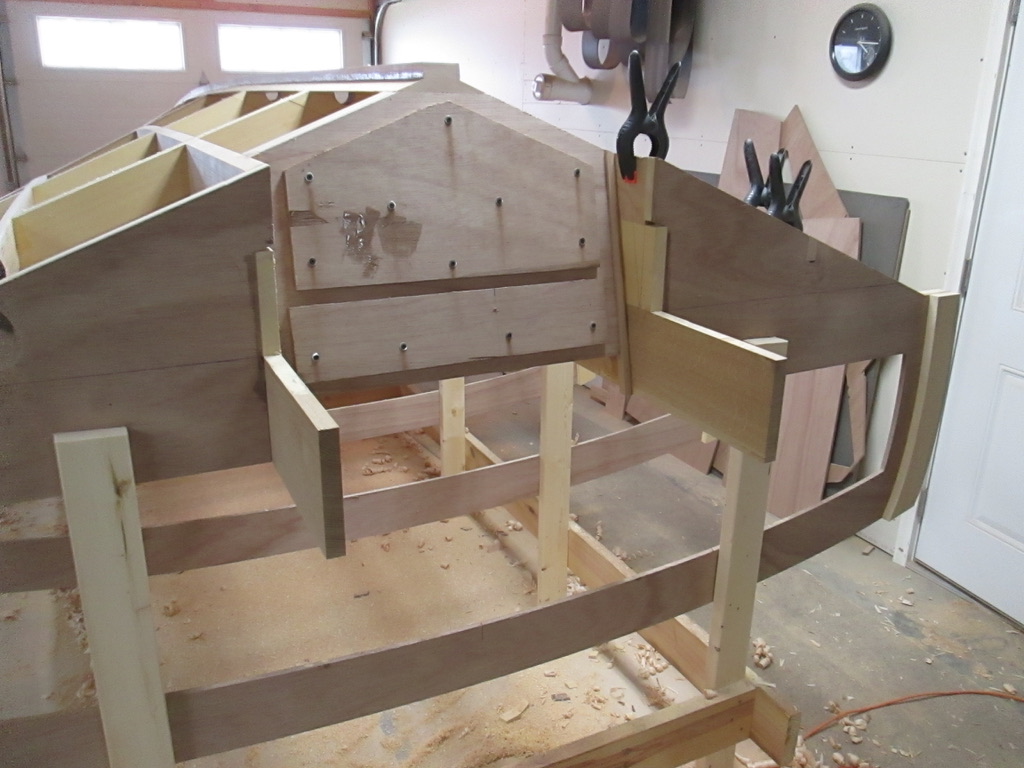
The boat strong back has finished its purpose, and was dismantled (last post), but as soon as the hull is turned over, it will need to be held up by another support, generally called a cradle. Since it is also temporary, it was built for braun and not beauty. It will have to hold up, reasonably steady, the increasing weight of the boat and occasionally my weight as I climb in and out.

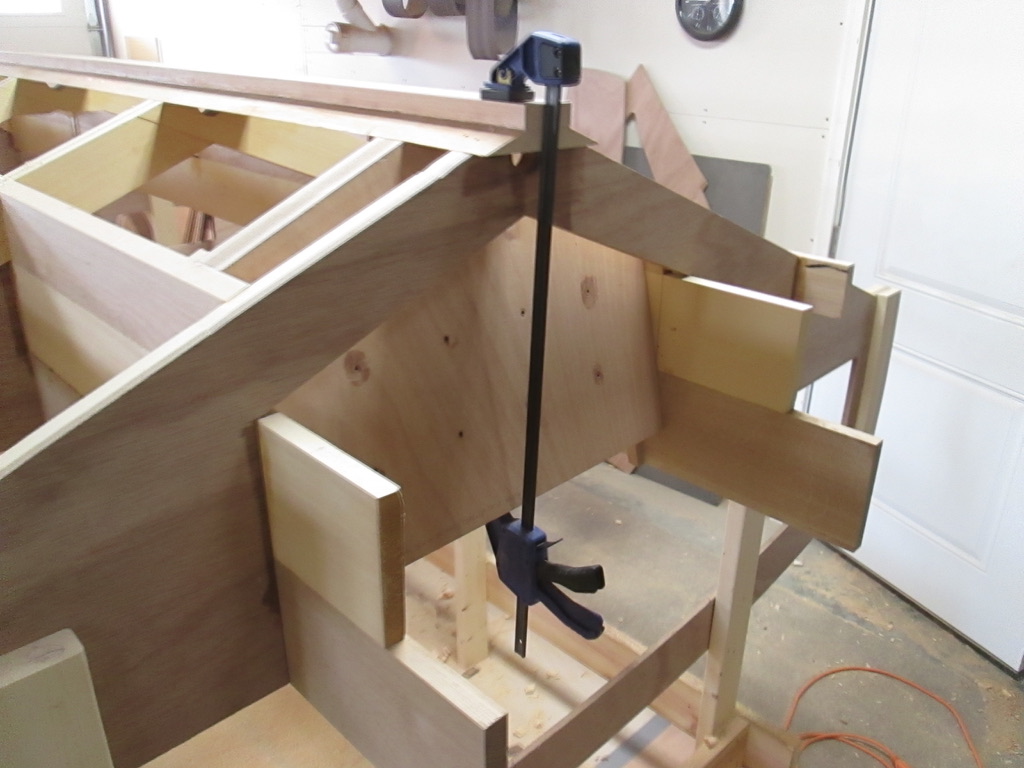
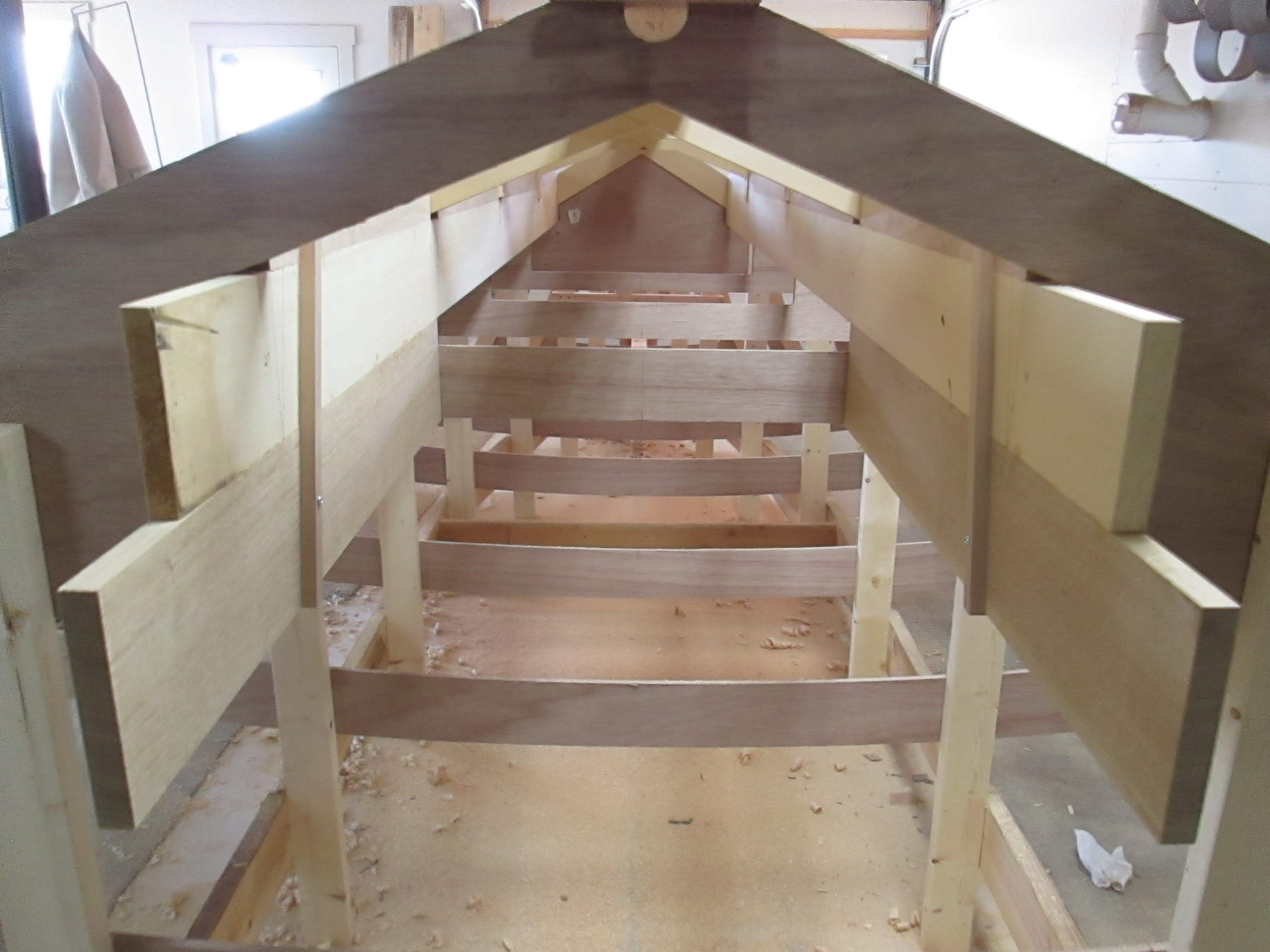
The legs are 2 x 4s recycled from the legs that were holding the cross frames. The other pieces are are random 2 x 2s or 2 x 4s that were laying around the shop. It is not easy to see, but the two boards that contact the hull have a cardboard cushion to avoid scratching during the next phase.

Last, the angular center piece is to give front to back rigidity, and prevent falling easily. If this isn’t enough, I may need to add some diagonal bracing later on.

As before, we needed the 2 x 4s attached to the ceiling joists, and Jeff Margush was agile enough to climb and get the job done. It is amazing what a few screws and a T-shaped 2 x 4 can hold, but from the look of the head scratching, I have some questions! I gained confidence considering that the thick yellow rope worked on the past boat.

Then the moment came to tie it up, lift and begin the turn. The rope prevented danger or over laod on one person.
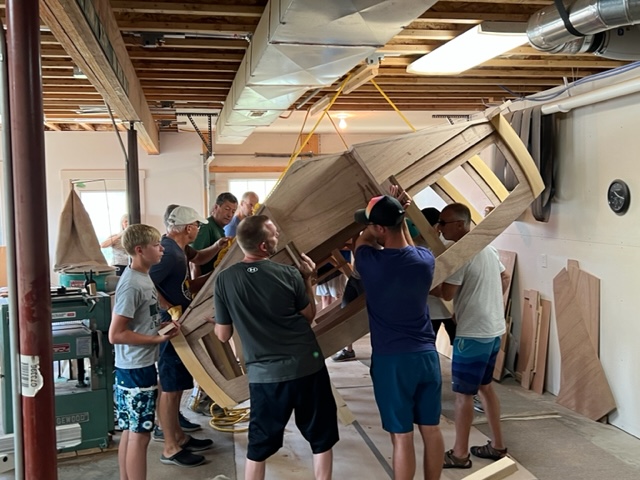
We should have removed the legs from the first phase, as they got in the way of the ceiling and almost broke the light. But damage was averted with patience and moving it forward.

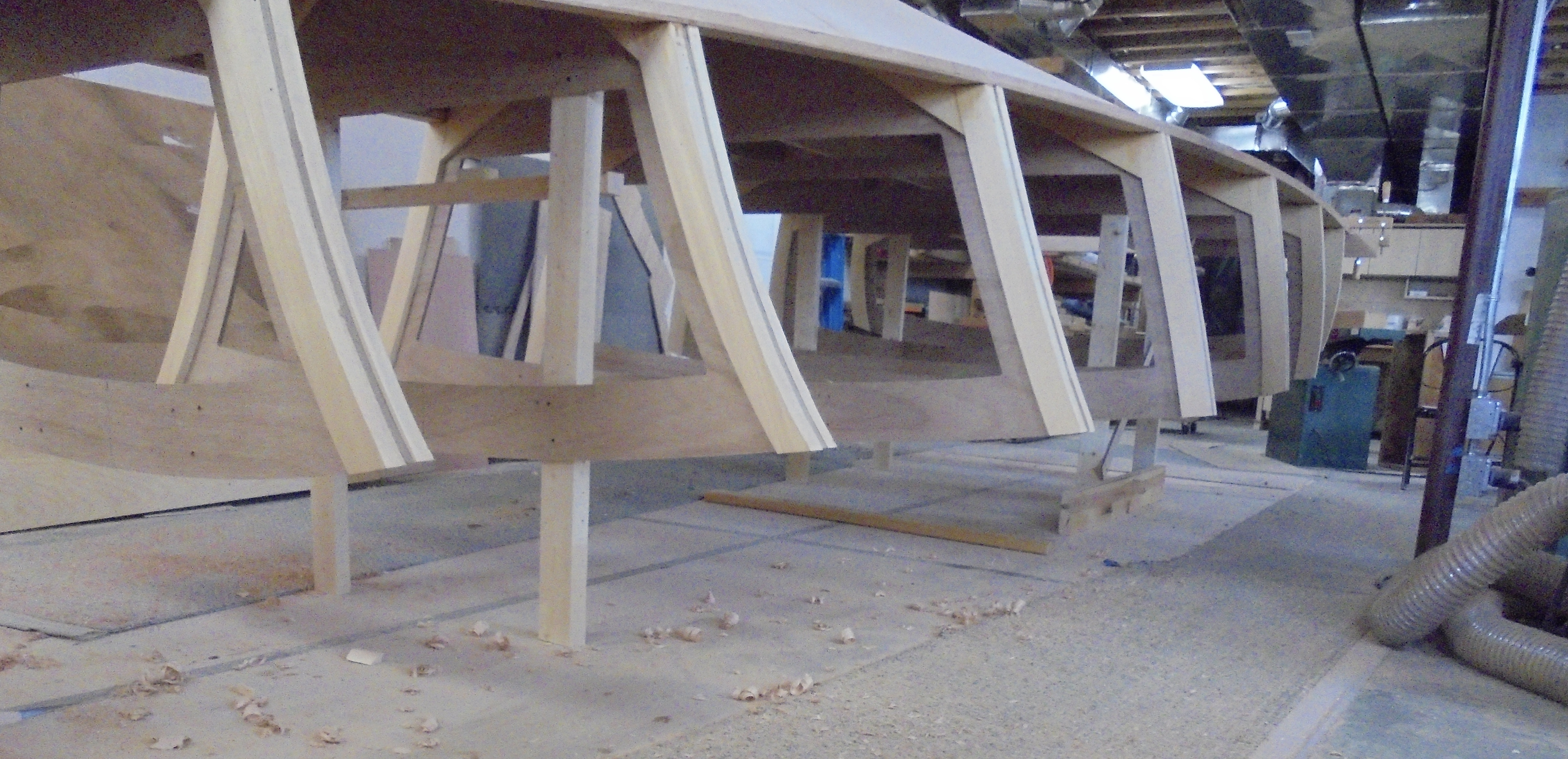
As the hull came down right side up, we settled it down on the custom cradles. It is remarkable how much construction on a boat is for strong backs, legs and bracing that eventually gets removed, leaving the boat alone.

Thanks to Jeff Margush, Johnny Crist (front) Marvin Metzler, Carsen, Aiden, and Jeremiah Greve, Leonard Nafziger, LT Newland, Stan Oyer, Jeff Bonta, son Jason Bonta and son-in-law Doug.

“It is not the end, only the end of the beginning,” said someone famous. And now the joy of seeing the boat up right. Much more work to do so we carry on . . .

Good Bye to the Strongback

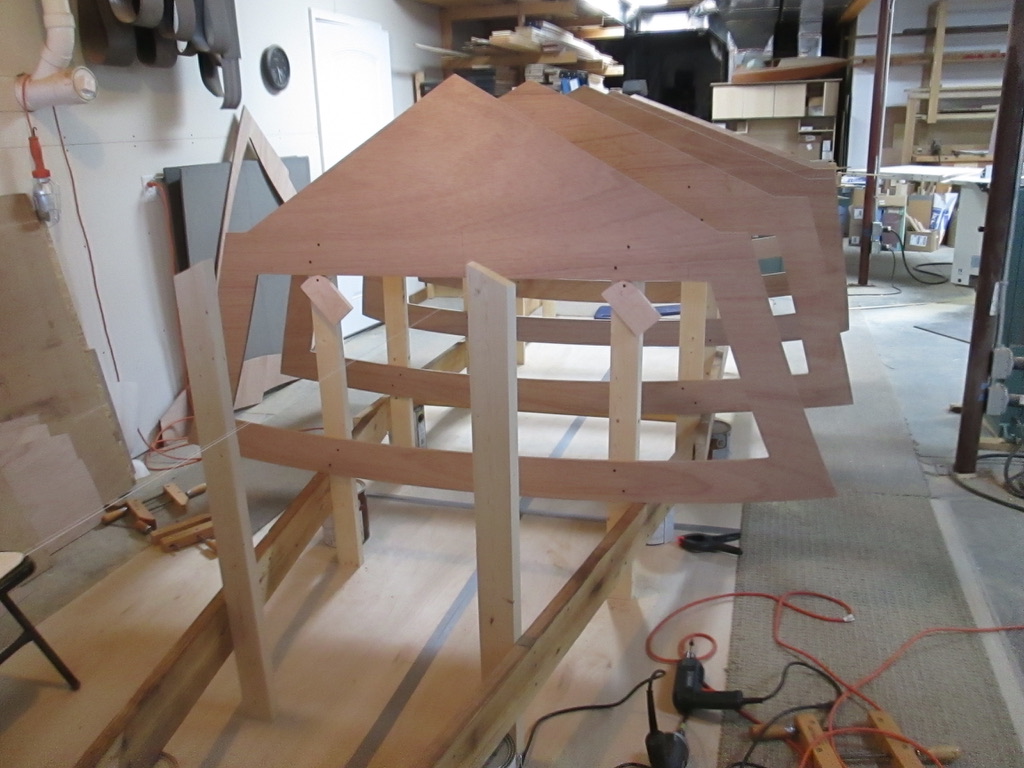
Sooner or later, the endless list of final things to do comes to an end, or at least to the beginning of a new stage. A lot water has gone over the dam since the beginning of this boat started about 7 months ago. The strong back is the under assembly of horizontal 2 x 6’s and vertical legs that was built to hold the cross frames in the right position.

Gradually, longitudinal beams were added to connect and strengthen the frames.

The keel was added and the transom was mounted inside the support beams.

The hull planks and the chine runner were installed.

The second hull layer was added and faired.

Keel rounded . . . check, chine flat filled with epoxy, front end given overlay bullnose, stern overhangs cut flush, the transom cutout stiffened . . . check, check, check.

Then the day came to dismantle the strong back. The long screws were taken out to release the 2 x 6’s, and most of the legs of the cross frames removed.

It is now ready get turned over and rest on the cradle, for stage two. . .

Creating the Bow Profile

After the cross frames take shape, the profile of the bow line is the next most important visual. These days a wide variety of design style abounds. The front of Redemption, my first boat, followed the upswept, pointed lines of the long sleek ocean racers.

A more contemporary front design shows a reverse, back-leaning bow line. For a slow moving boat like a cruiser or a sail boat, the result is a longer the water line compared to the width, for better performance. The downside is that especially on faster boats, waves will tend to come up the side easier, making for a wet ride. It is still a visual and functional mystery to me that anyone would use it on a speed boat.

Below is a straight upright bow line, which imitates the tradition of the old runabouts, and looks good sitting still. However, as soon as these boats get moving, they take a plane angle with the bow up, and the front angle tips back awkwardly.

The sketch below by Jeff Margush shows respect for the traditional, neat vertical front angle, but in my opinion will look good sitting or at any position from take off to high speed plane. Of a couple dozen photos and drawings of mine and Jeff’s, this one sits currently at the top of the pile for inspiration. The rake of the windshield may not be imitated . . . this time.
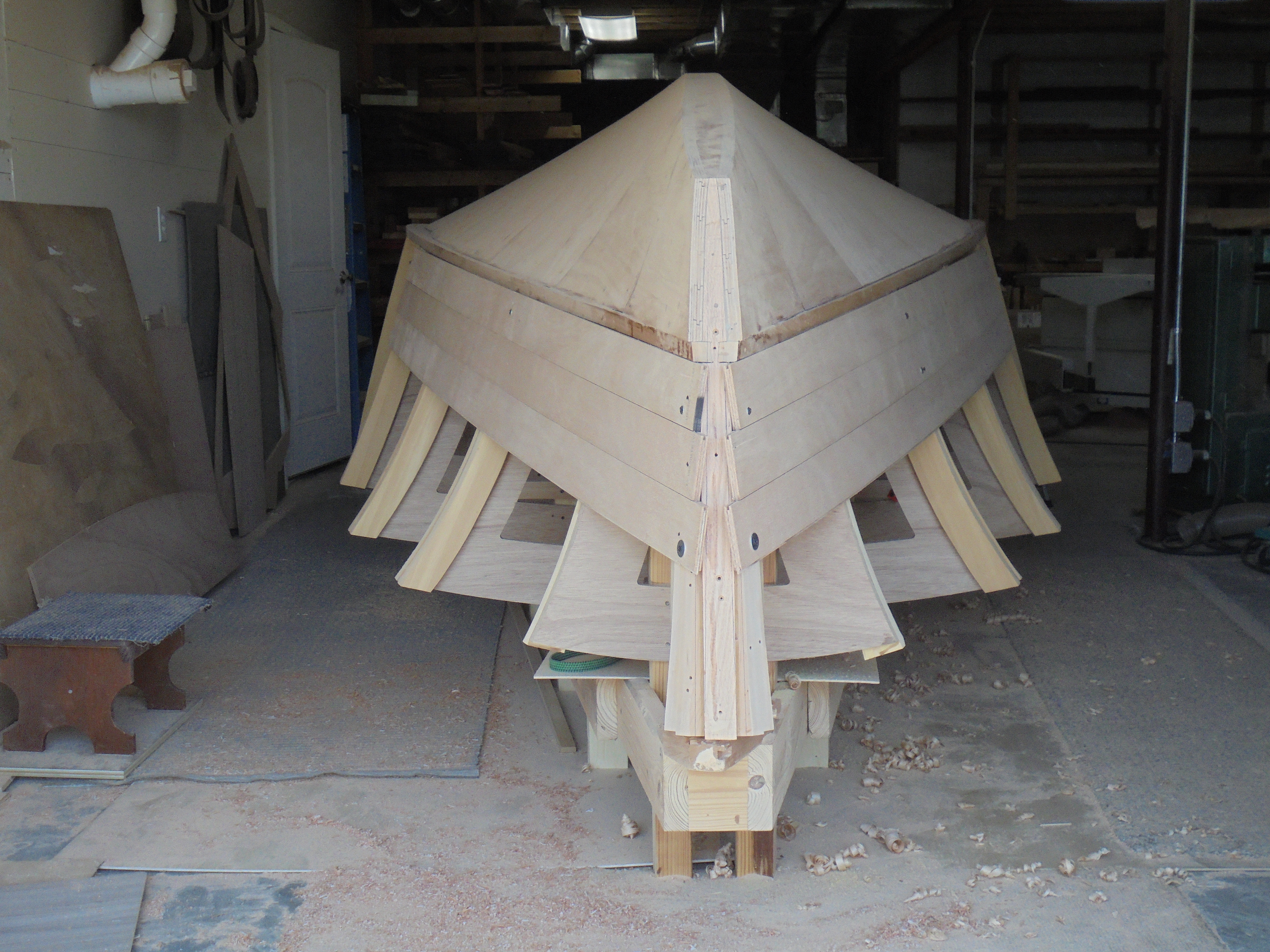
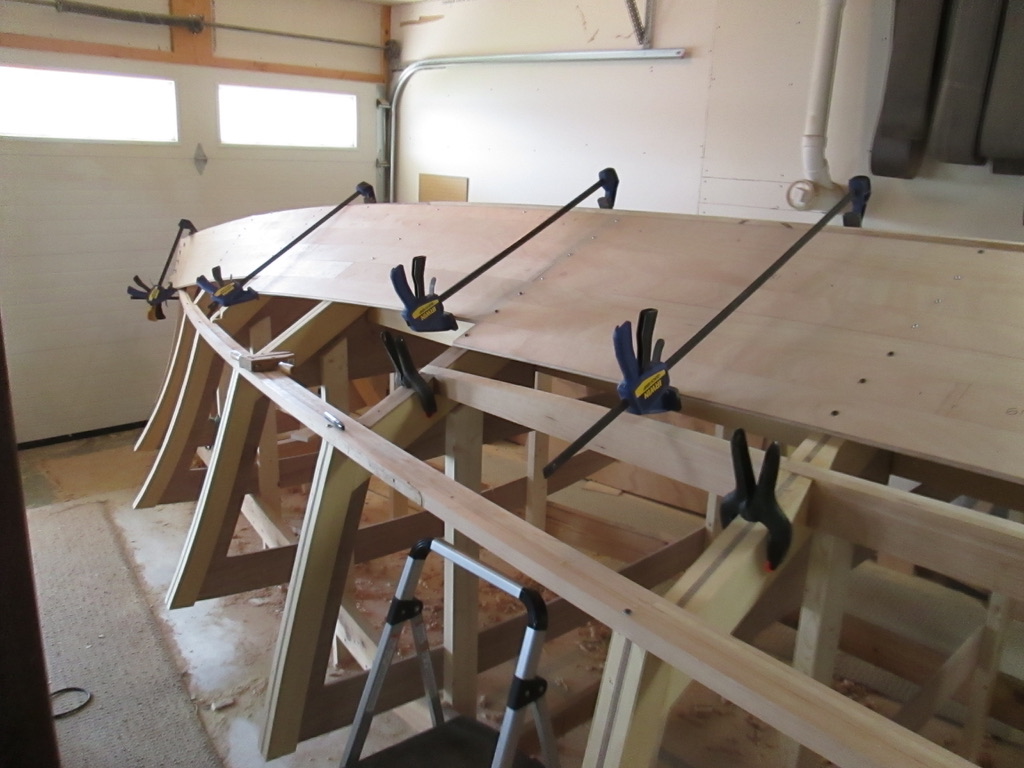
The first experiment extending the front was a cardboard pattern to test the visual sense, which is doubly hard being upside down.

Adding the angled piece below was judged to be too upright.

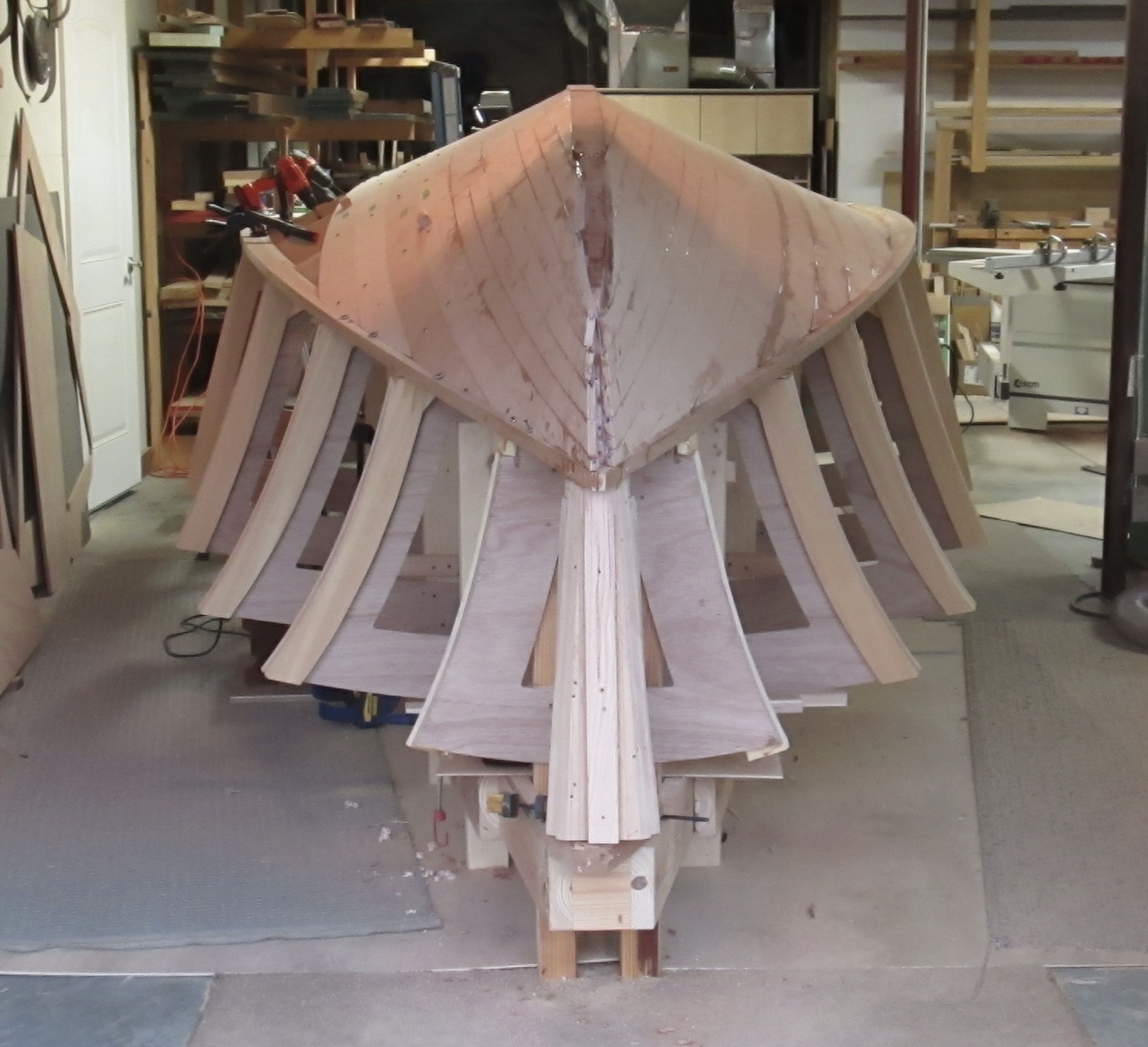
This is the angle settled upon, and is now rather firmly established, being set in the “concrete” of boat building, epoxy.

Although the side planks will not be permanently fixed until a later stage, I added three on each side just to see if we are headed in the right direction. With some sculptural attention to the chine line, it will eventually “fly.”

7-6. The Fine Art of Fairing

All of the cross frames, and longitudinal moldings and support parts just serve to build support for the shell of the boat, in this case the hull. The intention for the back 6-8 feet is that the surface should be flat for most efficient planing. At first glance the surface below looks flat, and it is pretty close, based on preparation faring work on the frames and stringers.

The tools of the trade for this task are the straight edge, a plane or two, these from Lie-Nielson, and the home made long sanding board.

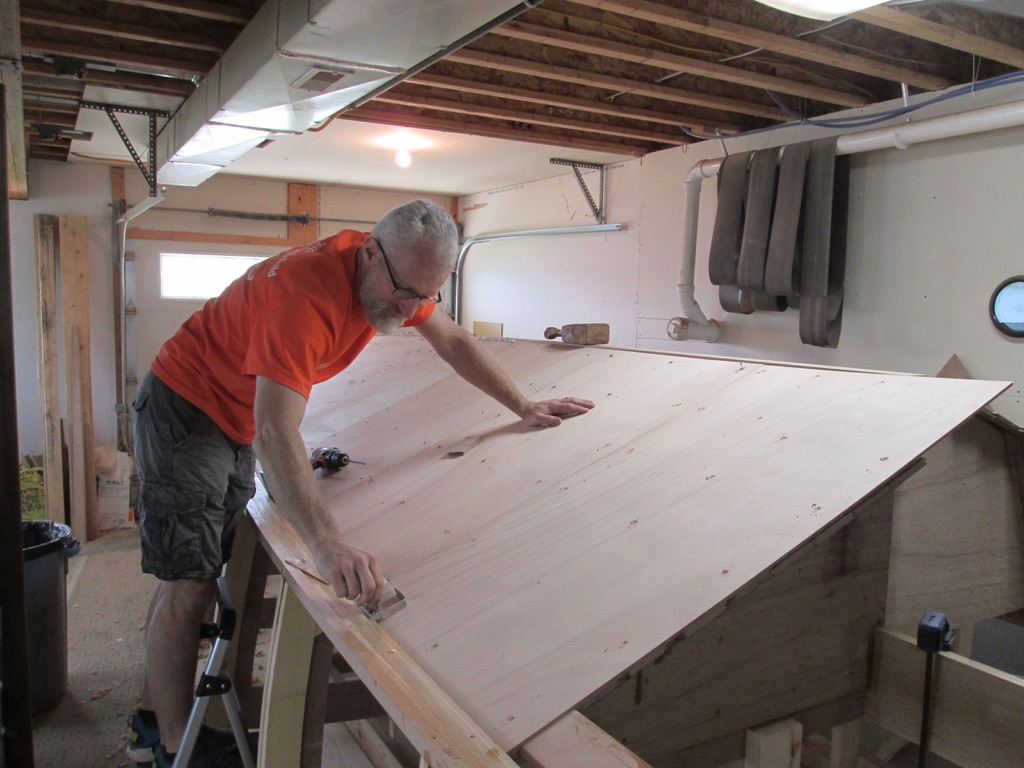
Pencil marks show where the hull was slightly high, and the block plane or the low angle jack plane start to flatten the area.

Then some sanding with the long board, to only hit the high spots, eventually tames the mildly lumpy surface to a happy, fair curve.

When you are hitting a ball, you have to keep your eye on it, and you might be able to play music by ear. But the if you are testing how well the hills and valleys of a surface are “faired,” the final judge is the hand. You could do it with you eyes closed.

The Art of Persuasion

Jan’s Grandma used to say “A man convinced against his will, is of the same opinion still.” I guess that could apply to a dog also, like Buck who would sit at the end of his chain beside the electric fence, as his head bobbed every current pulse. Sometimes, even a board has an “opinion,” with internal forces that show themselves when it is cut, springing apart or pinching together.

So when building furniture, parts are cut slightly over size, to discover any internal stress causing bend or twist. Then the edges can be straightened and the twist removed, before assembling it into the piece of furniture.

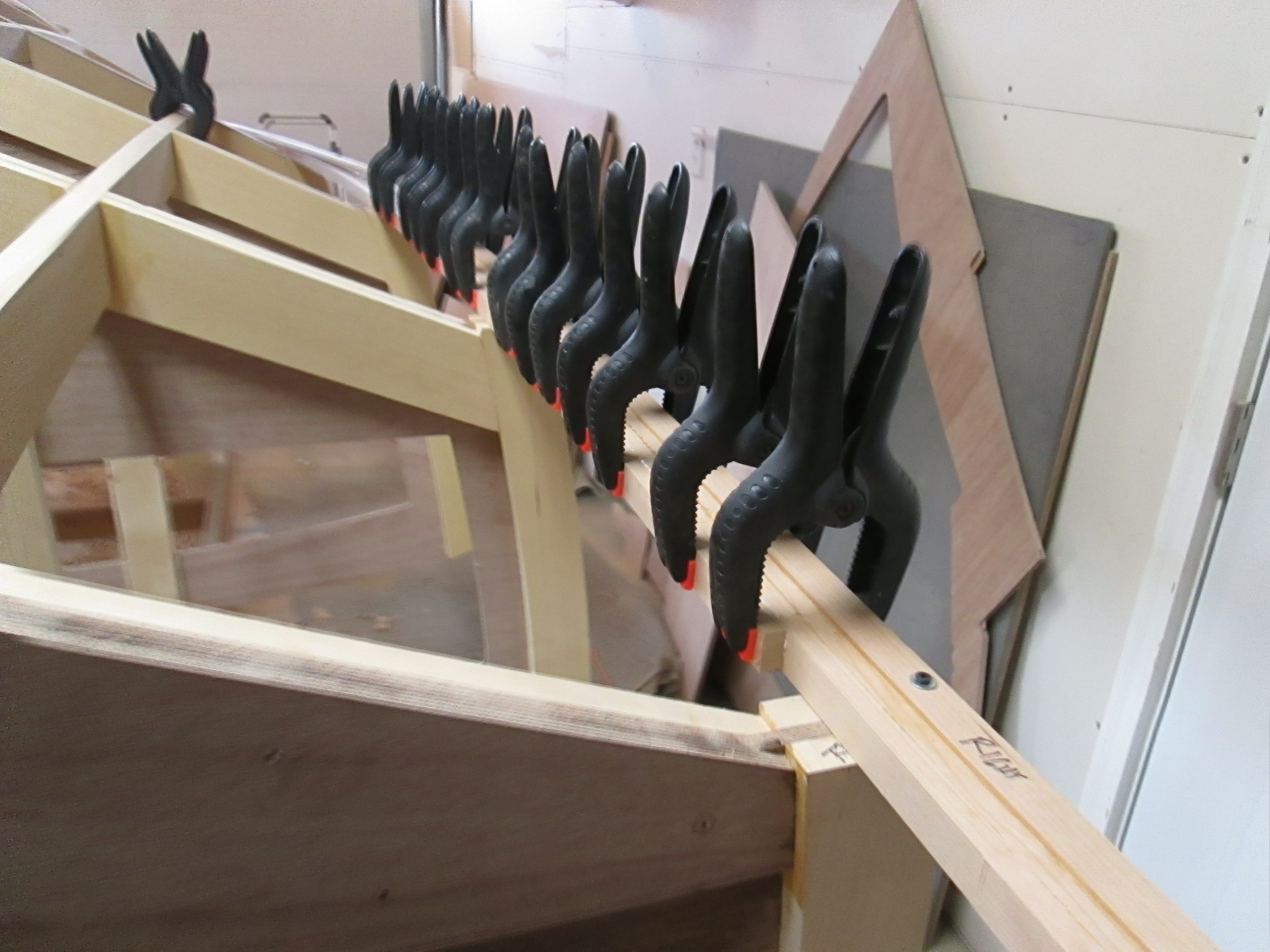
Boats, however, have so many curves that require different techniques to build and assemble. Laminating a straight piece to the curved chine stringer requires a bunch of clamps to persuade it to lay smoothly against the others.

Another example is in the machining of the tongue and groove planks. It is dangerous to have hands pushing small, thin parts near the cutter head. These angled feather boards are clamped with pressure downward, and inward against the feed stock, to allow hands farther away from the danger zone.

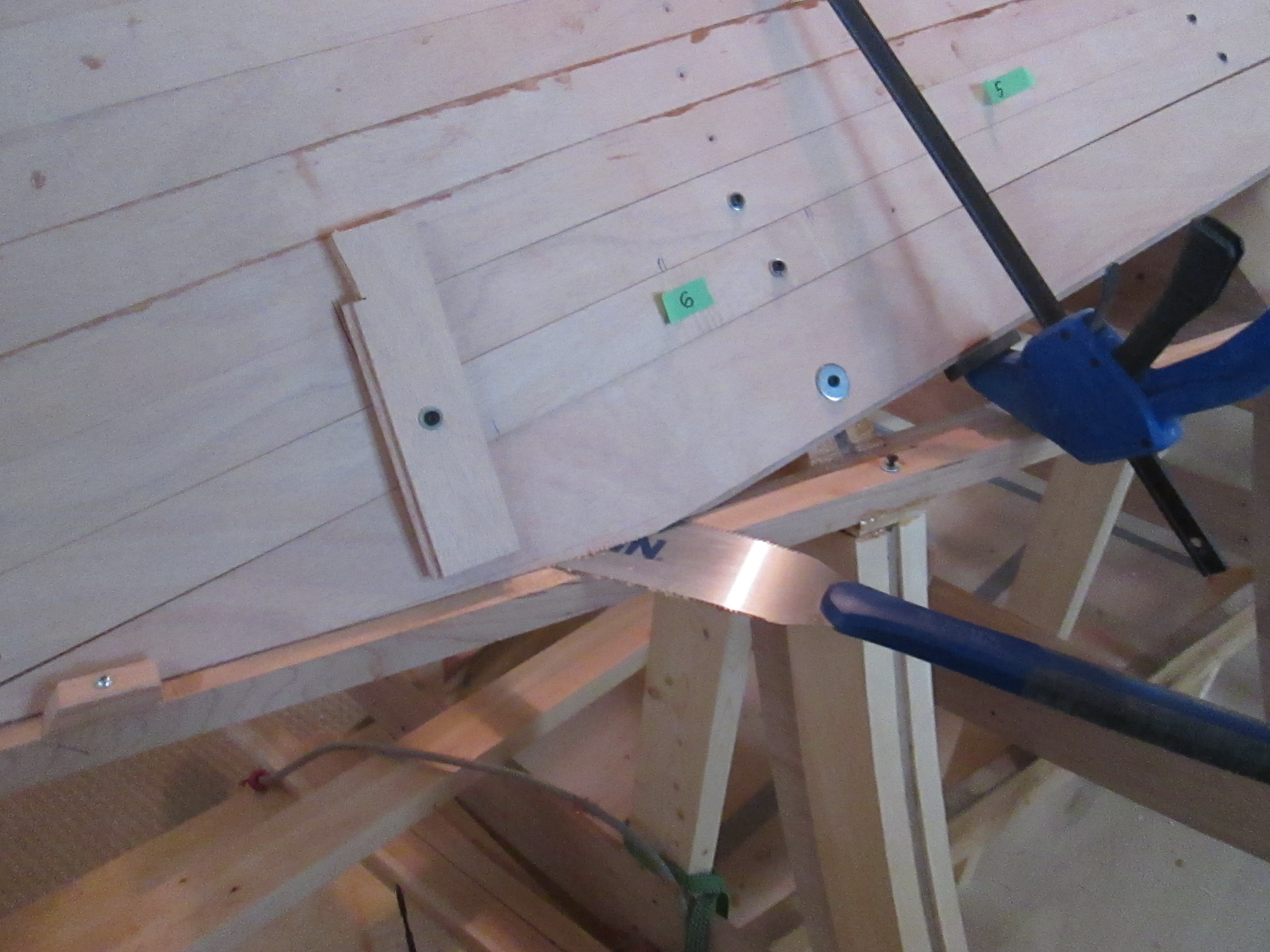
In the case below, the two ends of planks did not want to lay flat and made it difficult to fit the next piece. As the screw block is tightened up, it forces the edges together and the next grooved board will fit and hold them flat.

As the hull planks are assembled, some clamp pressure is needed to conform to the curves of the frame work.

Below, the angle block is shown which was temporarily screwed to the frame to hold the clamp securely. When the final assembly with epoxy was done, the clamp was replaced by screws to hold the planks in place.

Assembling the second side needed another temporary block to hold the clamp, and screws hold it together as the epoxy cures.

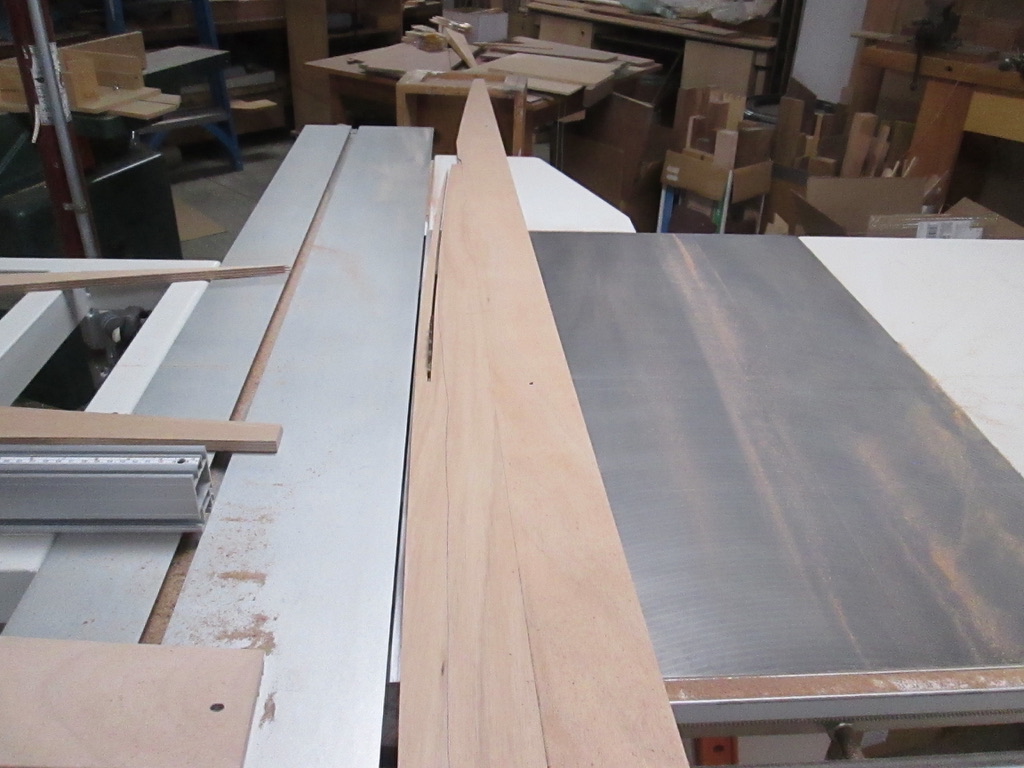
Where the planks come down meet the chine rail, the fit is more difficult. For a long curve, the cut can be done on the table saw to make an over sized plank.. It is a bit dangerous, but slow, steady cutting with gentle side pressure produces a good starter piece.

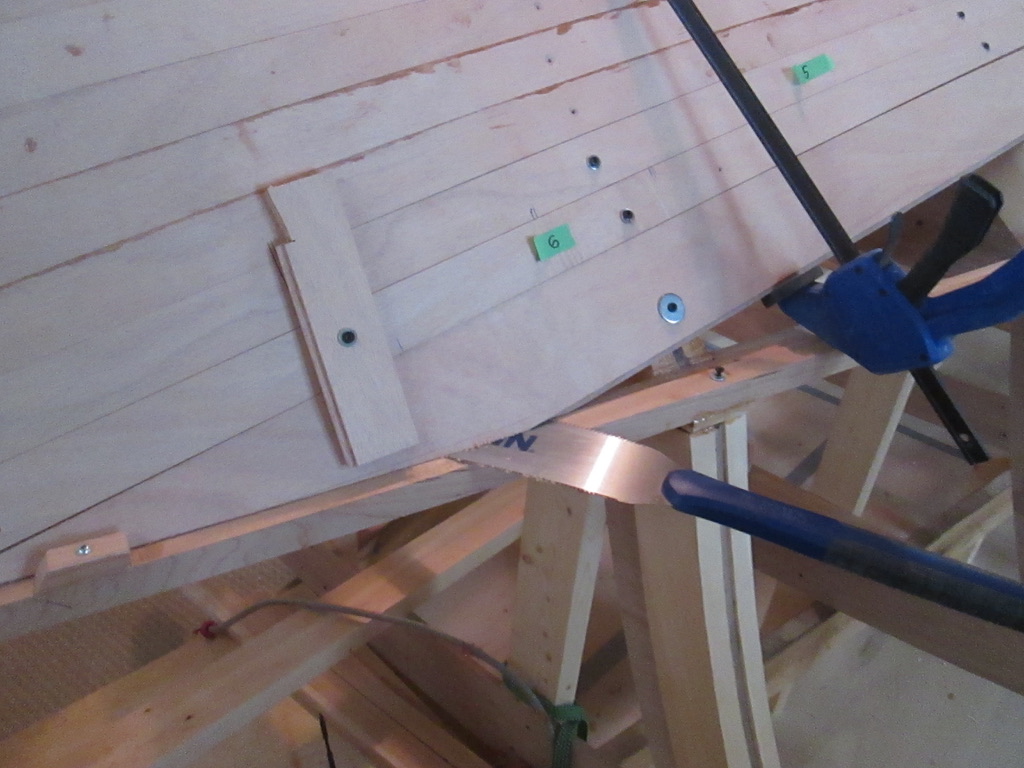
Below, the bottom plank was angled out too much, so the saw was used to cut through the contact point, so the wood block could push the bottom part inward. The clamp and screw with a large washer are used to hold it solid when the epoxy is added.

Temporary hammer blocks help to press another bottom piece in place, testing the fit. As it meets resistance, I mark the contact spot and continue sanding or cutting the high spots away.

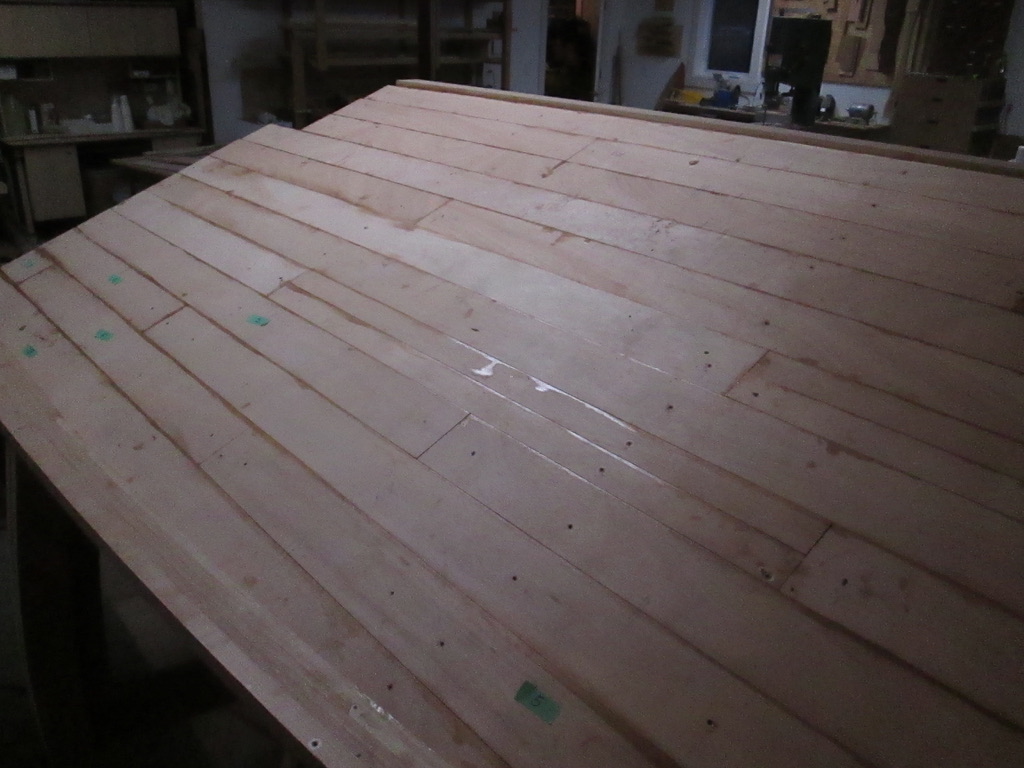
At the end of many trial attempts, eventually the plank can be hammered by the “Persuader” fully into place with the plank fitting well to the rail. The pieces marked with green tape show which ones still need to be removed and epoxied.

Finally, only a few planks remain to be fitted on the second side. It breathes a sigh of relief, nearing the end of a great step of progress.

Next up, some fairing, a second layer of thinner plywood, and paint before turning the boat over for phase two!

Installing Hull Planks

Next up to light some fire under my feet is none other than the third member of the previously mentioned Car, Boat and General Design Club. At church, between services, near the offering box, where we regularly have our scheduled meetings, Bob Herrold asked me what my time schedule was for the boat to hit water. I said that I was optimistic for a spring of 2025, which gives me two years from today.

That seemed unacceptable to Bob as he had a disappointed expression on his face. He said that it must be a pretty complicated boat! True, but with other life complications. I need to work as hard as Bob does in his volunteer work at the hospital.

Consider it a challenge taken, and I am determined to shift into a higher gear. The cross frames are mounted, and the keel and structural beams are connected to the transom. The chine is now complete, and all surface parts have been faired.

The time has arrived to put the hull planks on the bottom of the boat.

Below is shown how the tongue and groove planks machined on my router tables from 1/2″ Marine Grade Plywood fit together.

The large washers for the screws are needed to hold the front planks to the keel frame. The extra length will be cut away later in the fun stage of final shaping.

The most difficult parts are the border planks which must be shaped to fit to the keel or the chine. When they don’t line up side by side, I sometimes use a guide block as shown below to pull out a depressed area. Getting a great fit to the chine is a challenge also, and when it is close, sawing through the joint is a good way of reducing the high spots.

When dry assembly is done, the hull planks are numbered, removed, glued with epoxy, clamped, and screwed to the frame members.

The epoxy takes a few hours to set up, but I generally wait over night to make sure it is hard. Then all of the screws are taken out, because any metal left in a potentially wet environment will corrode and the wood around it will eventually rot.

The surface created is already pretty well shaped, due to the benefit of the tongue and groove method of joining pieces. Sometimes, as shown above, an alignment block helps to flatten a poorly cooperating board.

After this layer is glued on, a thorough sanding will be done to “fair” it smooth without high or low areas, only regular curves. Then, the half inch bottom plywood will be covered by a second layer of 1/4″ plywood, making a strong and stiff 3/4″ bottom surface.

Boat building is a long, demanding process, so dividing it into smaller steps helps to see progress. This step of seeing the structure begin to take shape is a strong, motivating milestone.

Another encouragement comes from other boat builders. We are few and far between, so we don’t tend to have much routine contact. However, in the history of building both my boats so far, curious people from 140 countries of the world have checked in. Thanks to recent readers from Belgium and Ecuador. I hope your boats are coming along spendidly.

Stiffening the Chine

The pretty curve of the chine previously shown was made from a two piece assembly of 1″ x 1″ cherry, which was the maximum thickness to make the bend comfortably. After the outside shape was established, I added 1/2″ laminations to the inside of the curve.

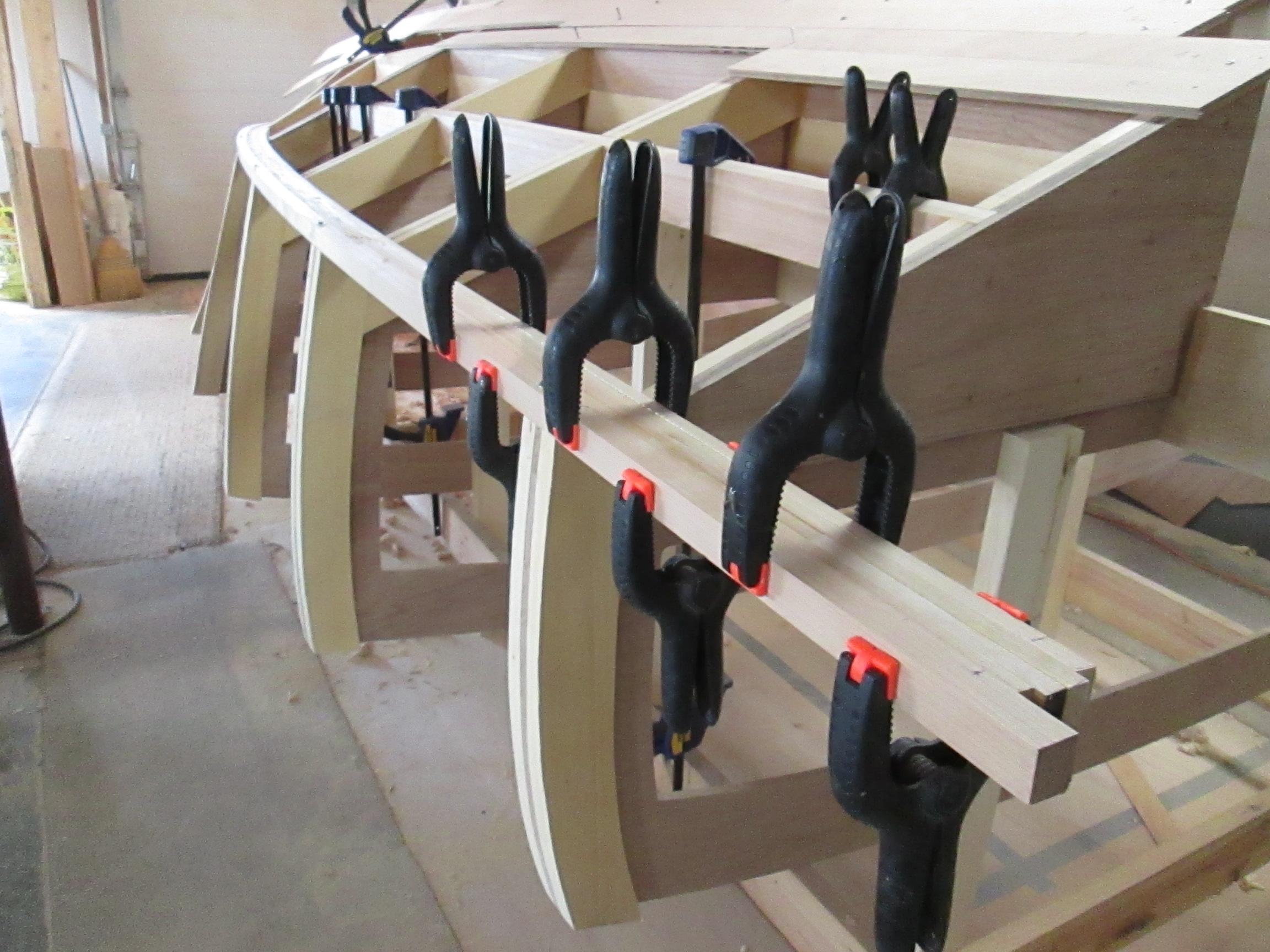
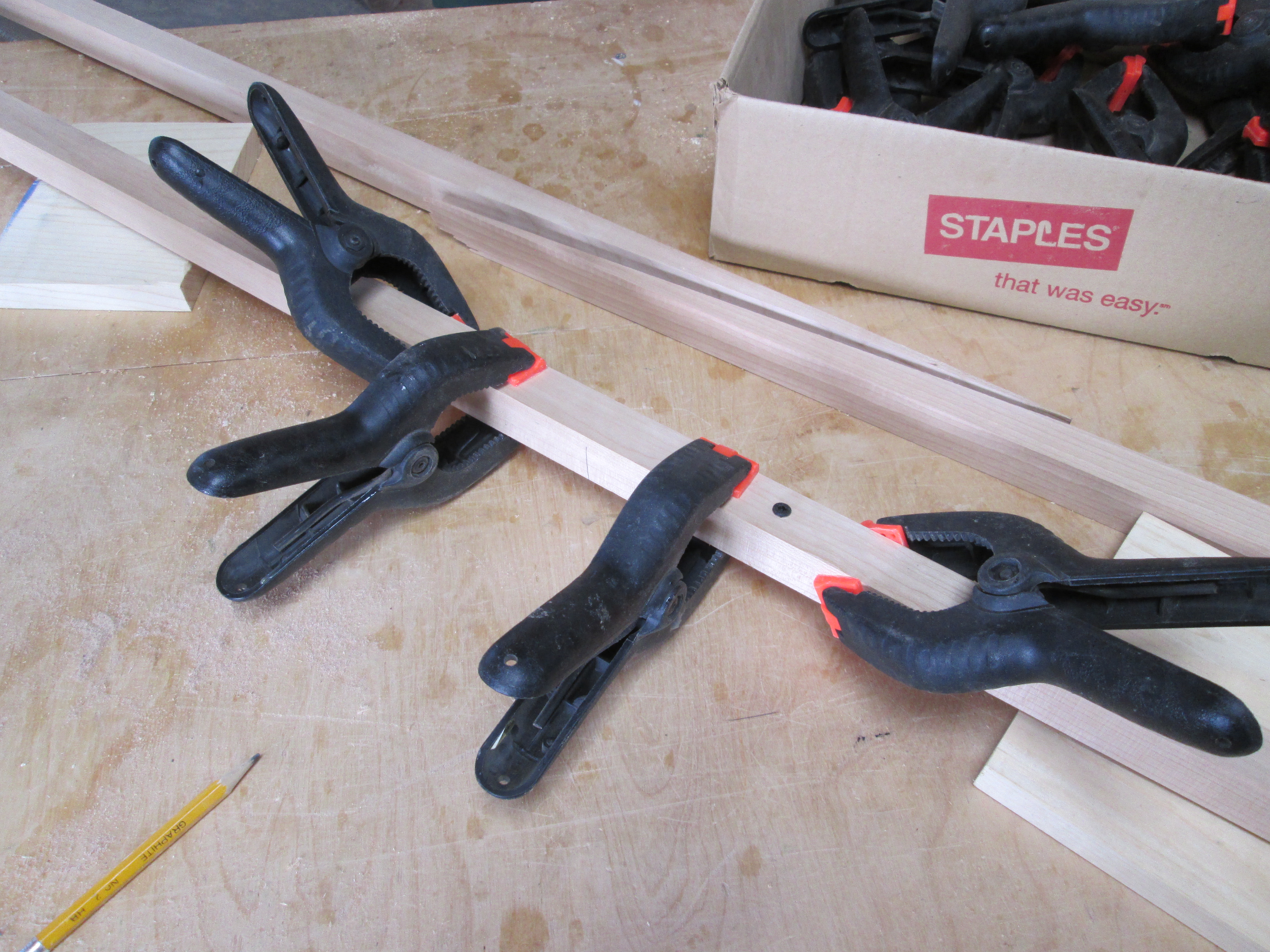
I have about 20 small spring clamps, and 20 more larger ones for a task just like this. I love my wood screw clamps, my pipe clamps and some miscellaneous hand squeeze clamps, but more often than not, I reach for these useful spring clamps.

Once the curve was established, the 1/2″ layers easily fit to the curve and began adding great strength. As shown below, two laminations started from the front and at each cross frame, another layer was added until five were in place. Since this assembly was edge to edge long grain, I used Titebond III, but from here on, most of the connections will need to be structural strong. That will take Epoxy.

This becomes the chine line, and the future spray flat.

Encouragement continues to drift in: We recently went to a graduation open house for Keegan New, whose family lives on a small farm of mixed metaphors. On one hand is the car barn which reflects their family’s love for old cars, and fixing them up. Grandpa New got it started with his restored Dodge Charger and interest in the classics. Among the grandchildren, there is a restored old VW van, a Dodge Dart, and a couple other Mopar cars in progress.

The other barn is more along the lines of a typical 4H family, and Keegan took Jan and I there, with particular pride in some sheep he was raising to show at the fair.

This sheep is named “Jan,” and Keegan mentioned she should compete successfully, with the well developed hind quarters.

The next two sheep appear some what embarrassed when the person they are named after: “Doc” and “Lehman” actually shows up to say hello.

I think Andy Warhol said that everyone gets fifteen minutes of fame. This coming September at the Cass County Fair, I look forward to getting a generous lifetime dose.

Final Fairing

When the cross frames have been mounted on the strong back, the longitudinal center support beams are installed, and the transom is firmly connected to them to resist 3D forces, we are ready to move on. The next step is preparing the wood edges that contact the shell so when I add the hull planks over them, they will lay in the most fair curves.

Below I am getting some help from Owen, Jane and Will, my grandchildren.

Fairing means making a curve regular so that no noticeable dips or bulges are present. I start with the tape measure to try to get both sides of the boat symmetrical. But sooner or later, it becomes an exercise in hand and eye work. Long straight edges are helpful near the back of the hull, as there is a 6-8 feet flat zone on both sides of the keel.

However, as the runners go forward, they need to follow the curve of the hull, and a straight grained bendable stick helps find the high spots to work down. Ultimately, the eye gives the final inspection and Jane and Owen appear to be satisfied.

The further we go toward the front, the more critical and difficult the fairing becomes, to see how the planks will lay on the compound curves. Below, Jeff Margush, my main partner in design crime, is working multiple test sticks close together, to sleuth out how this difficult front end can get fair and fine.

Someone should have told me how difficult it is to design and build a vertical bow shape. Much chair time for thinking and some couch time for dreaming is required . . .

The Chine Line / Scarf Joint

The line where the bottom of the boat meets the side is called the chine. For slow moving, displacement boats, that area is rounded for the most efficient travel. But, for speed boats like the one I am building, the motor is strong enough to push the boat up onto a plane.

Edges created by a sharp chine on the sides and cutoff at the transom, lets the water separate cleanly from the boat, reducing the wetted surface. This loss of frictional resistance allows planing boats to reach amazing speeds.

When the chine line is defined, it is partly visible when the boat is at rest, and more fully shown at planing speed. It becomes an important part of the visual profile.

That edge must be strong also, because the corners are where the boat may contact a dock or an object in the water. For my boat, I am using one inch thick Cherry wood to make the chine log, as it is sometimes called.

The trouble is that the boat is 20′ long and my longest cherry is 12′ long. This requires joining two pieces using a scarf joint. Below are shown cutoffs from free hand cutting the roughly one foot angled ends.

The ends are not a perfectly consistent angle, so they are sanded, using a backer support to keep them from bending.

Then, the sides were matched together and assembled with two screws to prevent sliding under glue and clamp pressure.

Below is one 22 foot chine log clamped together.

Now they are ready for glue clean up and assembly onto the boat.

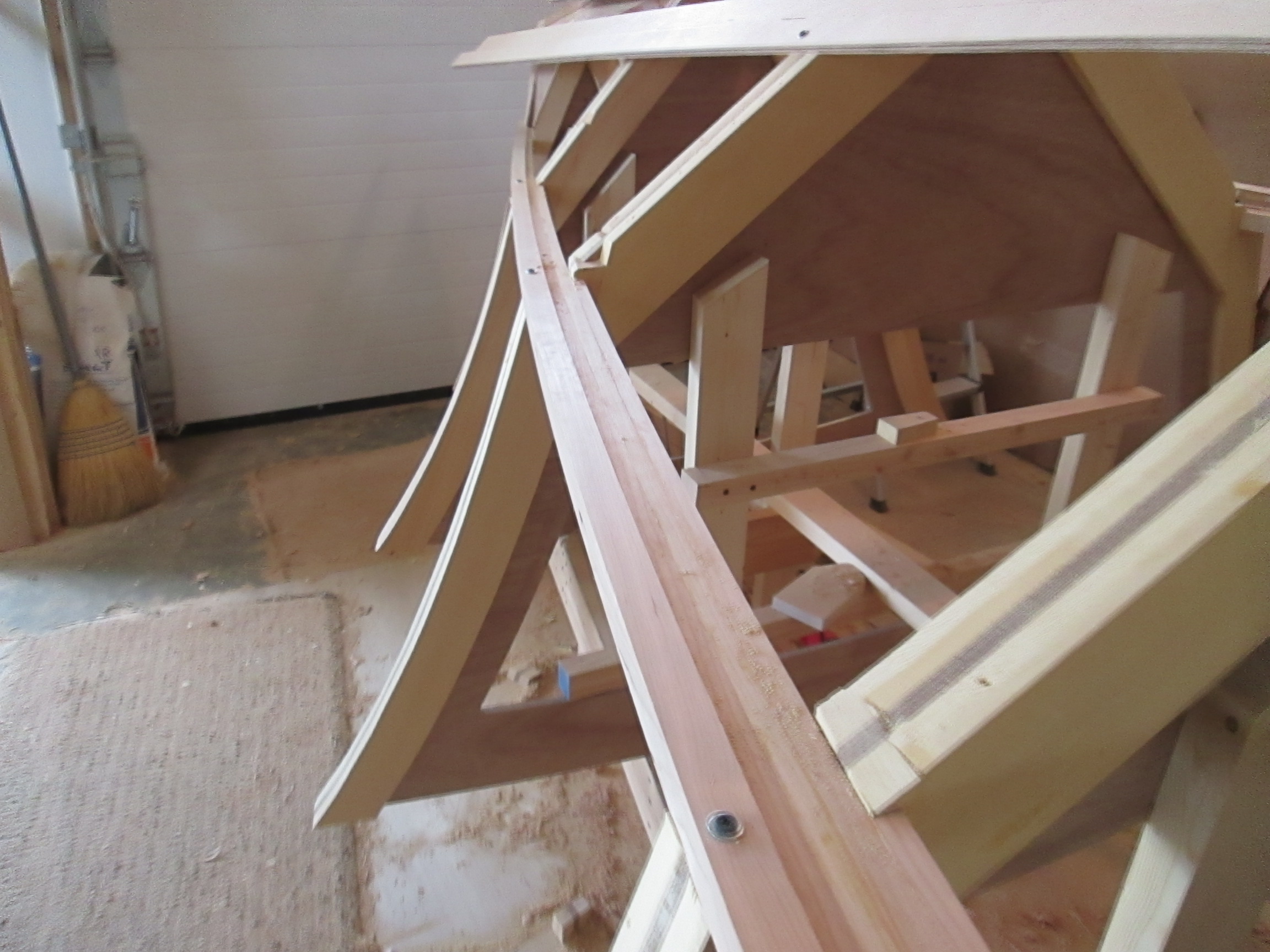
The chine log dimensions were picked specifically so it could be bent on a comfortable, easy curve from front to back. This is intentionally done without steam bending which is cumbersome and can give irregular results.

When the scarf joint is well done, and the grain of the both pieces are selected for longitudinal grain, without knots, the log will bend very consistently. As it is temporarily clamped in place, it helps to show where to adjust the cross frames on the way to creating a fair and beautiful curve.

Wooden Boat Transom

The transom leads the pack of all of the engineering challenges presented in boat building. In my case, it will need to be strong enough to hold the weight of a 500 plus pound outboard motor, with all of the rotational forces of acceleration and turning. Last, but not least, the transom will need to stay intact in the bounce of choppy water, and the serious bumps from road pot holes and railroad crossings.

The keel stem and long boards are looking strong enough to bear up to normal water pressure forces and the forward pressure from the motor. Next, in order to model where the transom would go, I cut a pattern out of cardboard to visually evaluate the best place. The tip approximates the mounting angle for an outboard motor.

I picked a location inside the first cross frame and screwed a slat at the recommended 13 degree angle to act as a guide for the router. Then, I routed a 3/16″ deep groove, 3/4″ wide for the end blocks on both sides. Much greater strength is gained with a cross grain stop.

Here are the stop blocks in place, and a temporary view through the sub floor transom and fuel tank space.

The transom was laminated from four pieces of 1/2″ marine plywood with epoxy. One more 1/2″ ply will be added to make a strong motor mount plate.

Once the transom blank was adjusted to fit the keel, and inside the runners, it was epoxied in place, against the cross stops.

Below, the keel has been cut shorter, and the first frame partly cut out to reveal the motor mount area. The scrap pieces are temporarily used on the transom help to spread pressure evenly as the fifth and last lamination is epoxied in place.

The rest of the stern will be built out when the boat is turned over, adding more transom support structure, but that’s for another day.