Curves and Corners

From the beginning of building a boat, a grand attempt is made to follow plans, if you have some which I do not, and keep both sides symmetrical. That applies especially to the level, straight and and flat parts.

But the most visible and beautiful lines on a boat are at the edges, on the side, and the transom end. Those are mostly curves that are not so easy to measure, so the eye makes the final judgement on whether a line looks fair and pleasing.

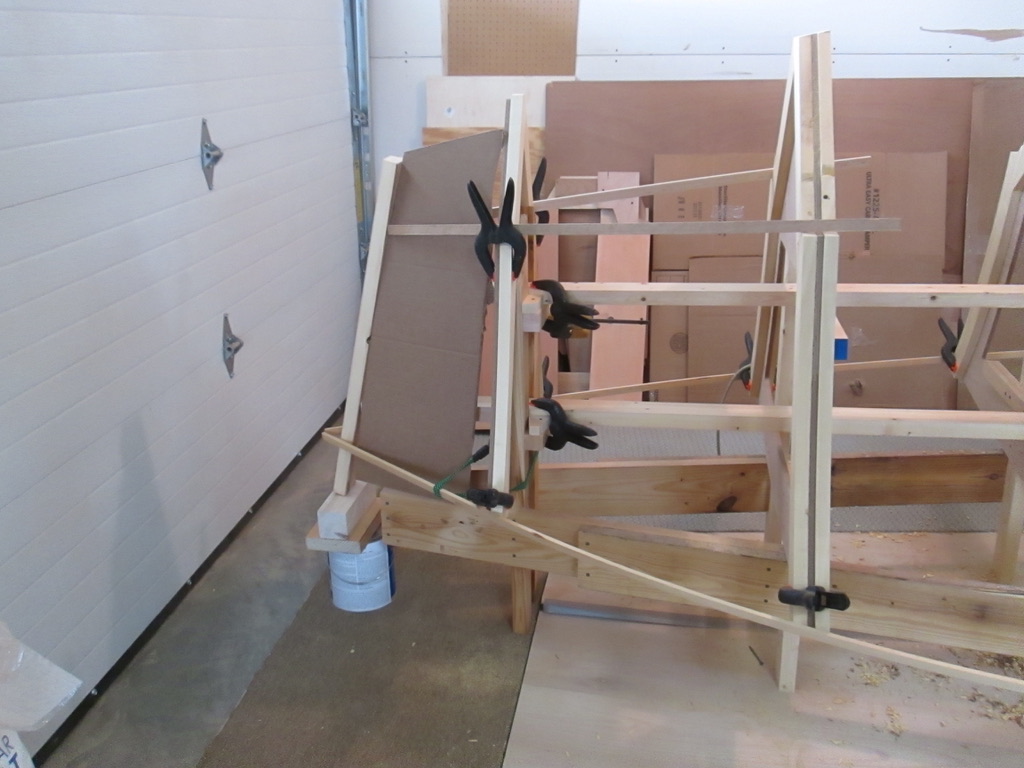
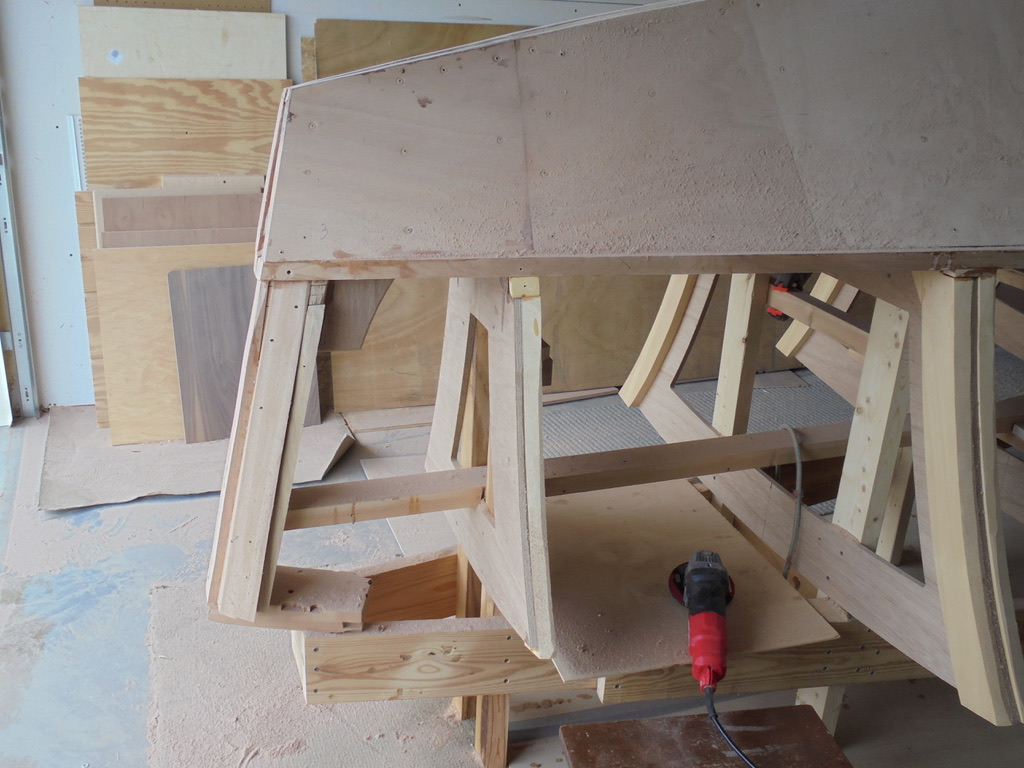
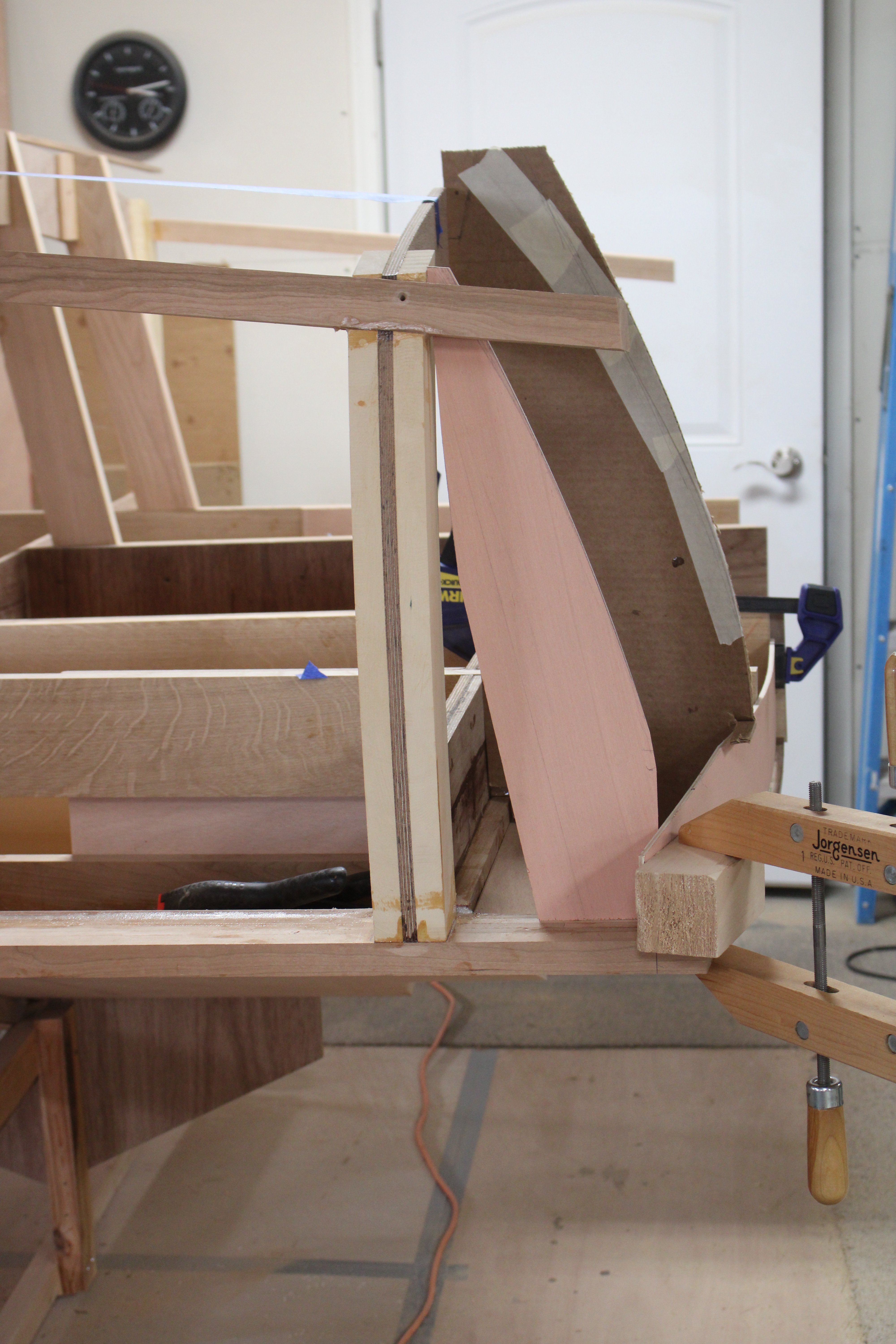
This time it was figuring out the outer, lower curve of the transom. As usual, it starts with a pencil on paper. Then, I often use a thin bendable stick, shown at the bottom, to visualize the full size 3D shape.. Below, the bottom pieces complete the line, and compliment the top deck edge molding (sheer line), in smooth symmetrical curves.

Here is the side view of the full size cardboard and 1/4″ plywood patterns in preparation for the curved back corner lines.
Admittedly, the wooden boat building world is small, but when I hear of another builder, I like to meet and discuss construction ideas with them. So, it was my pleasure recently to be introduced to Charles Onyon, who has an interesting resume’ including working four years at Van Dam Custom Boats. A few years ago, I visited and took a tour of their inspiring shop, likely the premier boat building company in the country.

Charles came over to visit, and gave a far more educated scrutiny of the boat than the average house guest. He knows boat building including wood types, joinery, paint selection, and engineering for strength and esthetics. He is smiling because most people don’t know he is a celebrity . . .

Creating the Bow Profile

After the cross frames take shape, the profile of the bow line is the next most important visual. These days a wide variety of design style abounds. The front of Redemption, my first boat, followed the upswept, pointed lines of the long sleek ocean racers.

A more contemporary front design shows a reverse, back-leaning bow line. For a slow moving boat like a cruiser or a sail boat, the result is a longer the water line compared to the width, for better performance. The downside is that especially on faster boats, waves will tend to come up the side easier, making for a wet ride. It is still a visual and functional mystery to me that anyone would use it on a speed boat.

Below is a straight upright bow line, which imitates the tradition of the old runabouts, and looks good sitting still. However, as soon as these boats get moving, they take a plane angle with the bow up, and the front angle tips back awkwardly.

The sketch below by Jeff Margush shows respect for the traditional, neat vertical front angle, but in my opinion will look good sitting or at any position from take off to high speed plane. Of a couple dozen photos and drawings of mine and Jeff’s, this one sits currently at the top of the pile for inspiration. The rake of the windshield may not be imitated . . . this time.

The first experiment extending the front was a cardboard pattern to test the visual sense, which is doubly hard being upside down.

Adding the angled piece below was judged to be too upright.

This is the angle settled upon, and is now rather firmly established, being set in the “concrete” of boat building, epoxy.

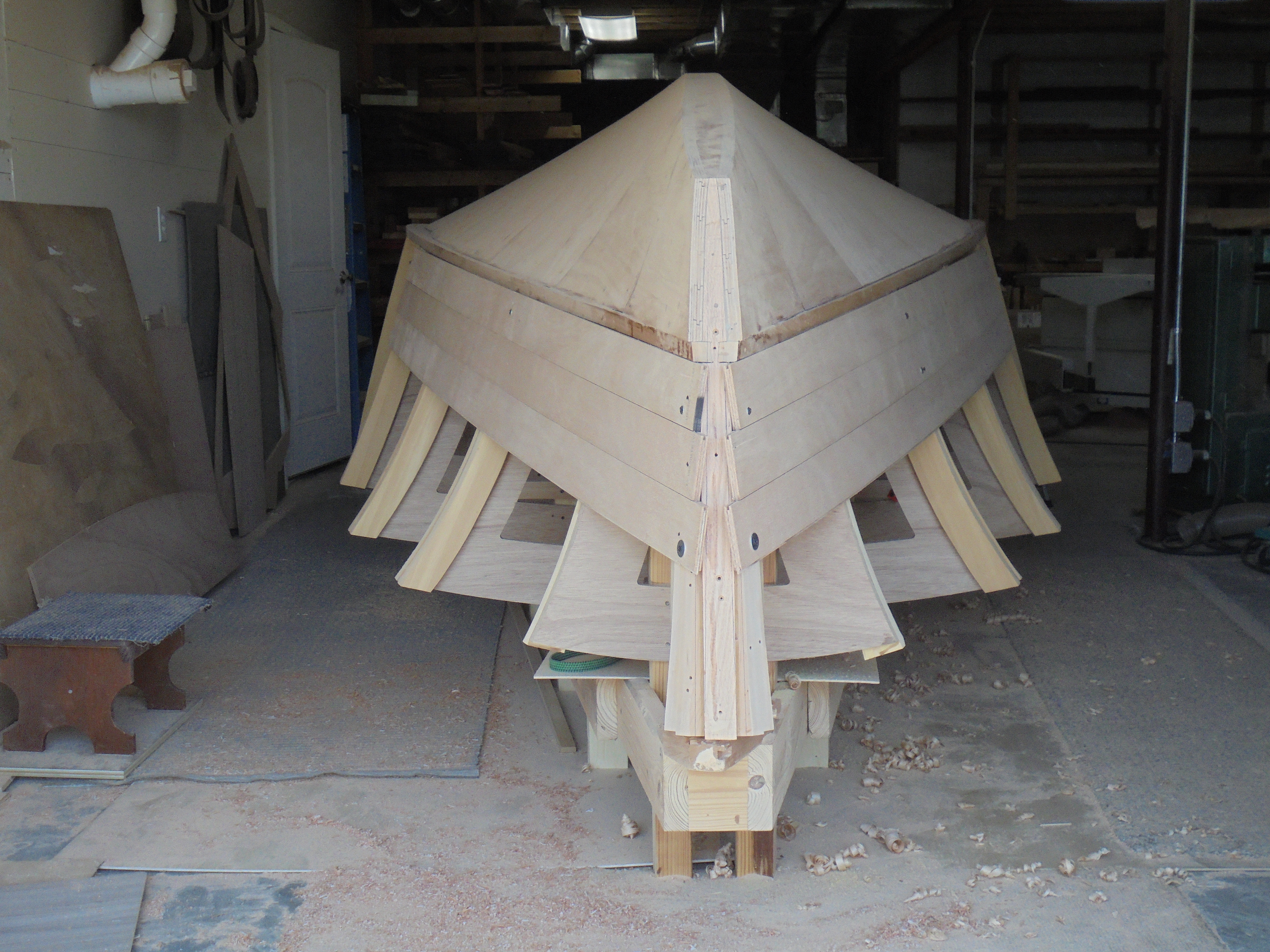
Although the side planks will not be permanently fixed until a later stage, I added three on each side just to see if we are headed in the right direction. With some sculptural attention to the chine line, it will eventually “fly.”

Speed Boat Design 1

A new boat! The original 2016 LC20 “Redemption” was a grand learning curve, and a great success in many ways. The first boat was more like a sports car, where “look good” and “go fast” were pretty much the key intentions. But Jan had some bigger functional parameters of her own, along these lines:

“Well, maybe enough comfy space for a few of my friend groups, like 10-12, or 15 if mostly grandkids?”

“Maybe some drink holders and a cooler, a little party table?”

“How about an easy way to get back on the boat, if we do “diaper dipping,” a form of swimming with an upside down life jacket?” Should I even encourage that?

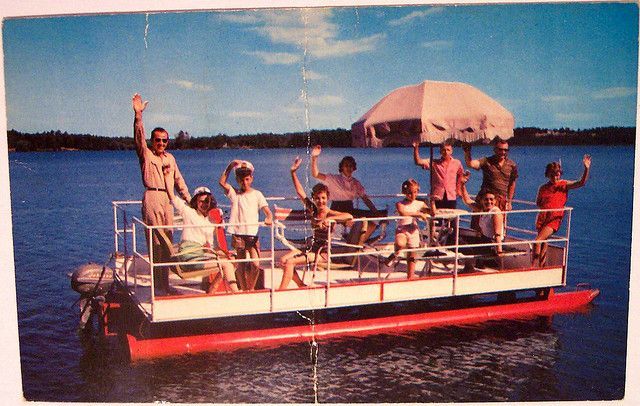
“Honey, it sounds like you are wanting a “Pond Tune” boat!” I said. “I am sure I don’t have room in the basement for that size of a boat, and I have never seen one done as a “Woodie.” The Kansas relatives above, Marge back left and Ed, second from right seem to be having a great time on Pete’s Puddle, if my reimagination serves me right.

Well then, Jan asks, “How about at least putting a few grab bars near the shotgun seat in case of mild turbulence?” Okay . . . there was the one time, we went for a slow cruise on the wooden boat, and a monster wave surf boat came cruising by, pushing up a four foot wake.

Instinct from driving a 16′ Marlin Scorpion speed boat in the 70’s took over, and I might of goosed it a bit just as we neared the edge of the wake, on an angled approach. The neighbors said we went airborne, including the motor, and Jan went from sitting high at the peak, to disappearing under the dash into the front cuddy on reentry to planet earth.

Being the doting and sensitive husband, I noted the important take away: add some grab bars!!!

A second accommodation for the new boat was drawing a wider beam, going from 6’6″ wide to around 7’8.” This design change adds extra carrying capacity, for that 8-10 plus chatty friend or family group, and will create better side to side stability.

The first wood boat, shown above, was modeled after the ocean racers, with a more pointed bow line. On the sketches for the new boat, e.g. below, I tended to draw a more vertical bow line.

This leans more along traditional lines, but some contemporary boats have used a near vertical front as well, and I find this example quite inspiring.

This time a windshield will be in the plan . . . stay tuned.