Hull Planks and Contours

With the boat turned upside down the last time, the side planks need to be installed. They are made of 1/2″ marine plywood, cut into 4″ planks and routed with a tongue and groove to fit the best side by side. I alway start dry fitting a group, to see if the underlying cross frames are supporting fair curves.

In this case, I will not be doing the last few rows until the boat is flipped over and I can make sure the shape at the top line is good. But most of the side needed to be done in preparation for final painting of the bottom. Jeff Margush lends a hand, actually you could probably make the case that he might be doing the work mostly by himself.

After the epoxy dried, I needed to shape the plywood plank down to meet the longitudinal corner molding, called the chine. This Okume Marine plywood is the best plywood I have ever worked with, being almost as easily planed as solid wood. It is a woodworkers delight to have these wood curls roll up from a sharp blade in a good plane, especially the ribbons below.

After doing whatever wood removal is needed, then it was time to add some epoxy fairing compound to smooth gaps and add nice fillets to the corners. Between a rasp, a scraper, coarse sandpaper with flat or rounded blocks, and a dust brush, slow progress can be made. The proof will be in the pudding of a shiny paint job, to see if the contours are good.

A bit more fairing on the sides, finishing the bow and stern contours, and it will be ready for the next nerve racking step: putting a huge sheet of the glass fabric on and trying not to repeat the snafu that happened last time. Too much epoxy over a complicated surface ran and pooled in an ugly mess, that required many hours of scraping and sanding. This time I know what I am doing?

Building a boat seems like a continual learning project, and hoping not to have to repeat too many steps. Sounds like life . . .

Under the Surface

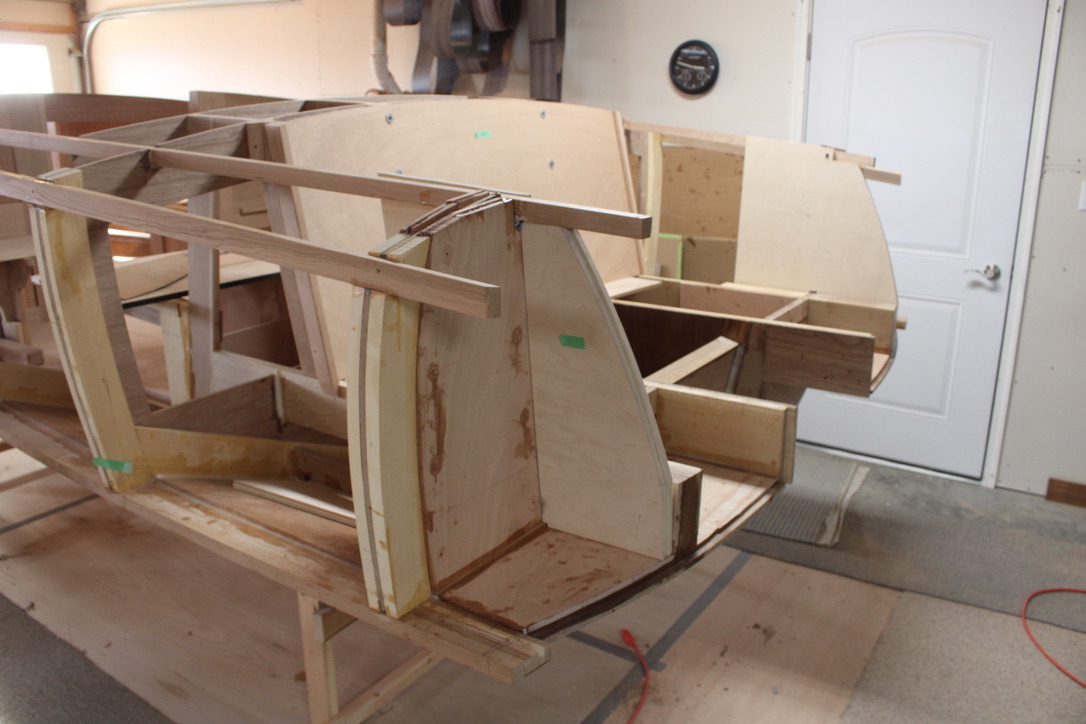
Before the hull planks go down and create the beautiful curve shapes, the interior frame work has to be ready for the hard work. The boat must be built strong enough to be lifted by three points, one in front and two from each side of the stern. It would be a grand shame to see the boat chained and raised off the temporary trailer, and watch it drop from a failing U-bolt. 

The same area in the back will also needs strength to hold a ski/tube rope, and tie downs to the trailer when traveling.

The top of the back cross frame has been cut off to make room for the motor well, but the remaining C-shape sides are the most obvious place to begin building strength.  

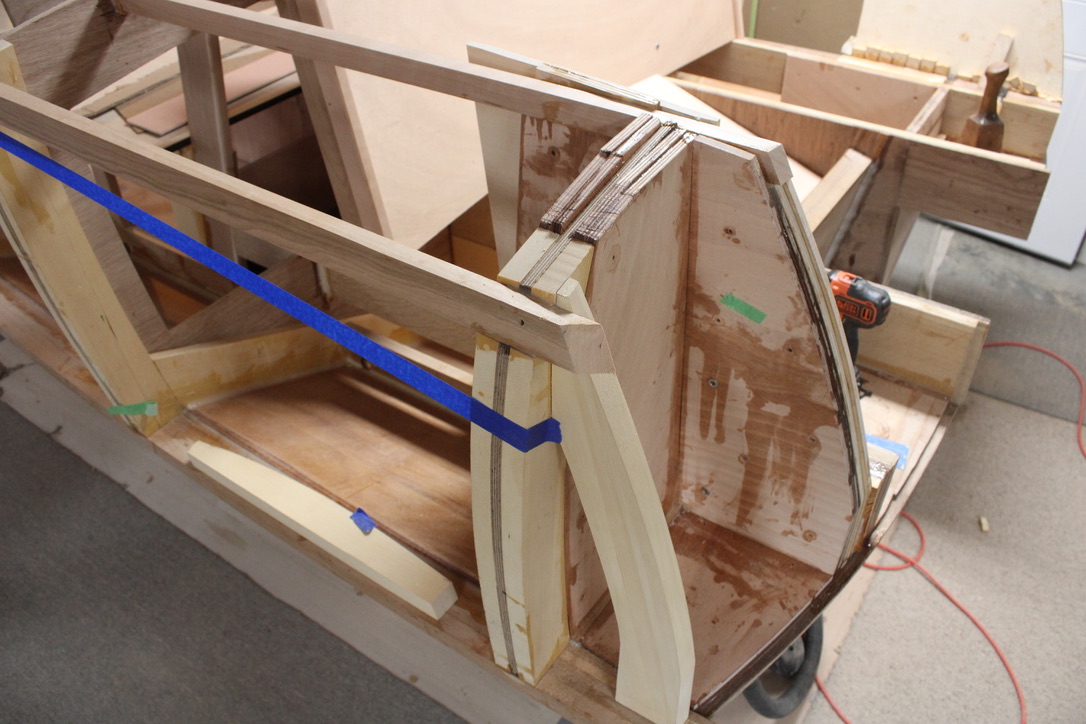
More plywood layers were added on the inside and out, connecting the top and bottom to make a strong outer panel. They are bonded with epoxy which is very tough and does a better job of filling gaps than most other glues. 

If I had planned perfectly, the outer longitudinal beam would have been right up against the glued layers. But instead, the deck needed more space for the folding ladder, so I had to add some filler layers.

To fill the gap, I epoxied the marine plywood blocks to the long beam. The speckled markings are shallow holes drilled to allow the epoxy to grip a deeper layer, and resist a shear sliding force.

Next, another plywood panel was constructed beside the longitudinal beams. It is beginning to show the 3D shape of the stern extensions.

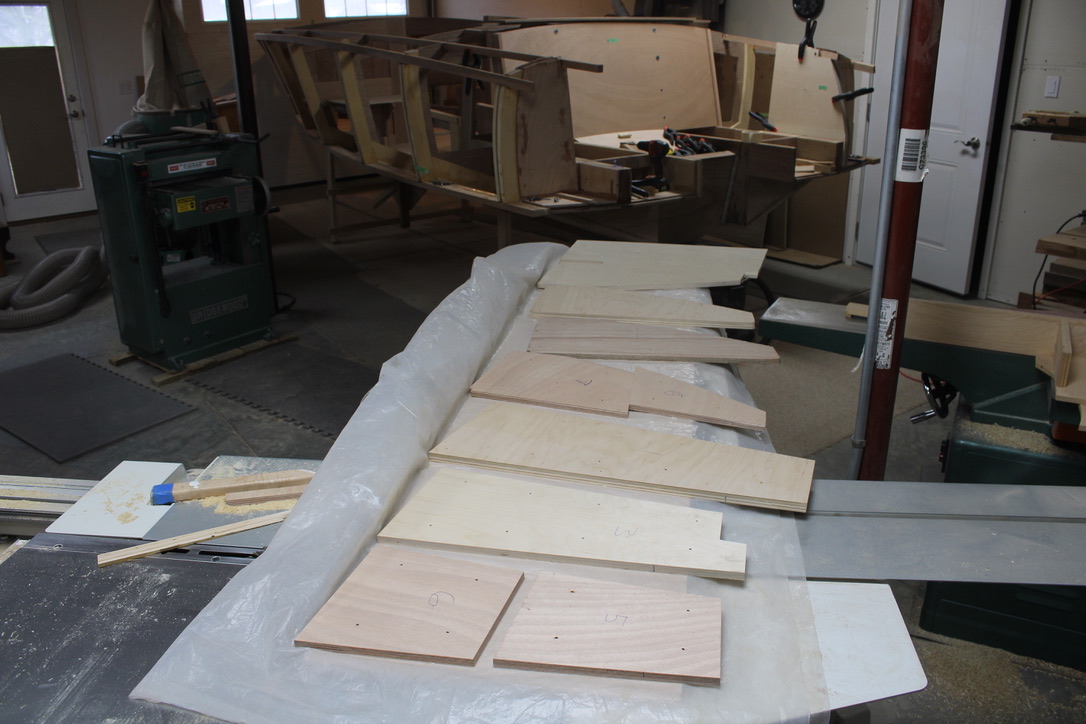
This is the group of eight plywood pieces that went into making the left (port) side wall. The right side was about the same. It did get a little complicated. The morning that I planned to glue both sides turned into a whole afternoon and made me late for supper.

Since the middle wall was slanted out, in the way that looked best to me, I had to make some perfectly angled wedges to glue in the gap.

They were made from a Douglas Fir 2 x 6. By angling the cross cut fence and flipping the board over each time, eventually I found an angle that worked great. 

Since the wedges were cross grain, when I applied the epoxy, it soaked in to the large pores and (I believe) became a very strong wood and epoxy link. 

If this was a production boat, I suppose some testing would be in order to see if my seat-of-the-pants engineering worked out. Especially since the last time I took the 2016 wood boat to the dealer for motor service, they told me that the transom was cracking.

Now this was a surprise, because it has always been a concern. I do inspect on occasion to see if that last big wave or the bumpy railroad tracks, may have crossed the limit of the transom’s strength. So, I asked the mechanic to show me the problem area, and he pointed out some cracks on the back stern panels , not really a part of the motor mount area. 

It is annoying but fortunately not serious, as the issue is sun damage. The mahogany veneer is developing small cracks because it was less protected under the boat lift canopy. So, with no major engineering failure on the previous boat, I take it as my cue to carry on. Inspectors Jeff Margush, Don Florea, and Andrew Alger will be relied upon to set me straight.

The stub cross frame now has five half inch marine plywood layers, and the longitudinal panel has three layers.

Slowly, slowly, the work on the inside frame is getting done. It gets tedious, and without glamour, to put some pieces in place that soon will never be seen again. But when the big waves and bumpy road comes to stress the pretty boat shell, what’s inside gets much more important and obvious. It is like a life well built.