Intuitive Wooden Boat Engineering

Boat strength is an imperative topic in the creation of a boat, designed to safely carry people. If you want the full story in mathematical detail, Dave Gerr wrote a book called The Elements of Boat Strength for Builders, Designers, and Owners. You could call him “Noah Thing or Two.”

He lays out multiple graphs of plank and frame dimensions for all sizes of boats. This gave me comfort on the first boat when I planned the shell thickness of 1/2″ on the side and 3/4″ on the bottom. When I covered it inside and out with fiberglass fabric embedded in epoxy, I figured it was all good. So far it has survived lots of railroad crossings which will show up the weakest link.

Since I started with the 1/2″ Marine plywood, CNC cut cross frames, I needed to first strengthen them.

The Alaska Yellow Cedar left over from the first boat served admirably to stiffen the edges and provide general frame strength. The deck will be reinforced after turning it over.
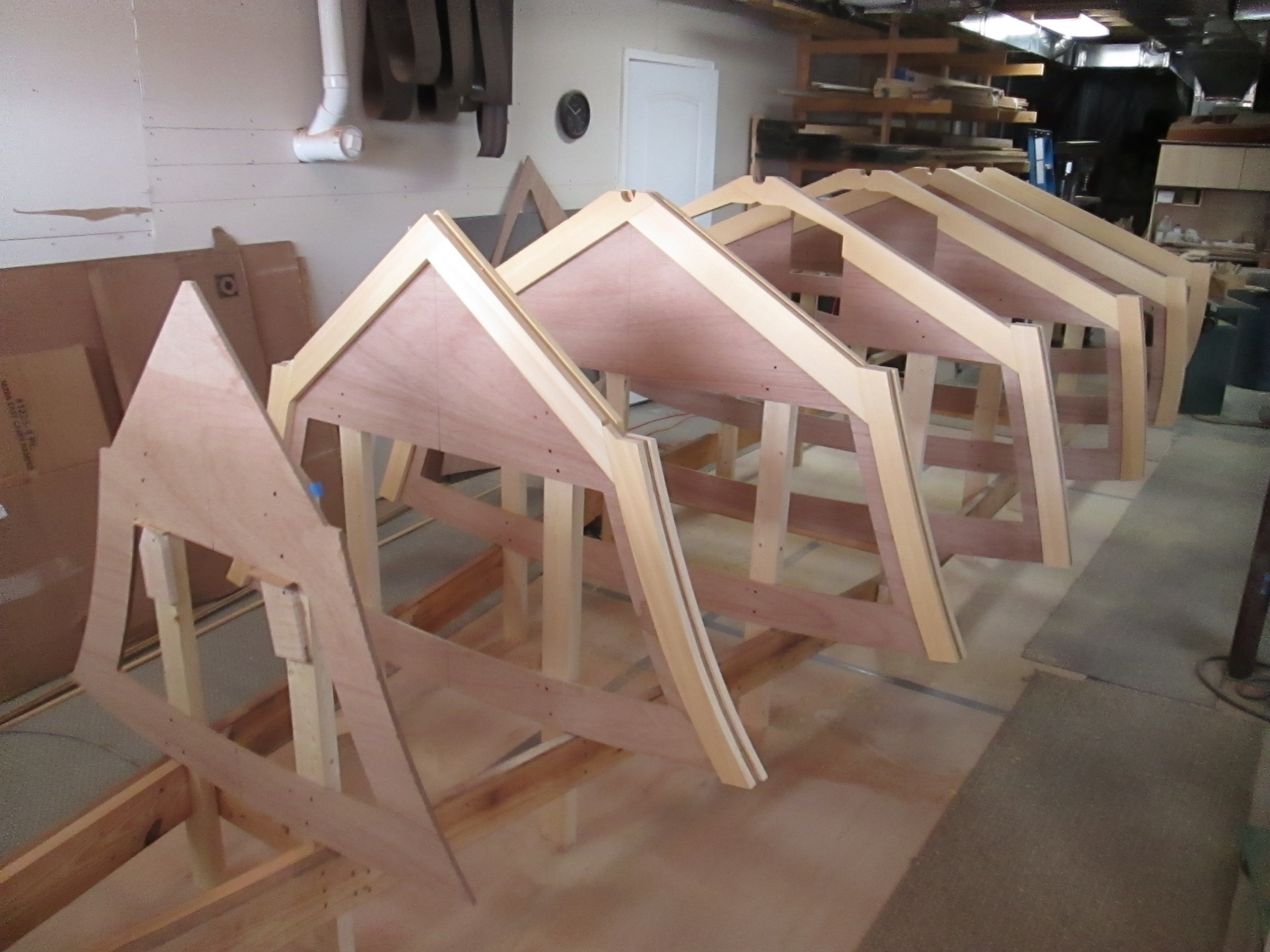
Next, the frames needed to be connected, and the keel was the first place to start. The fair curve of the line was more critical than strength at first, so I used a single piece of Cherry that was planed down just thin enough to make the bend without needing to do any steaming. Ah the beauty of the line, however weakly drawn!
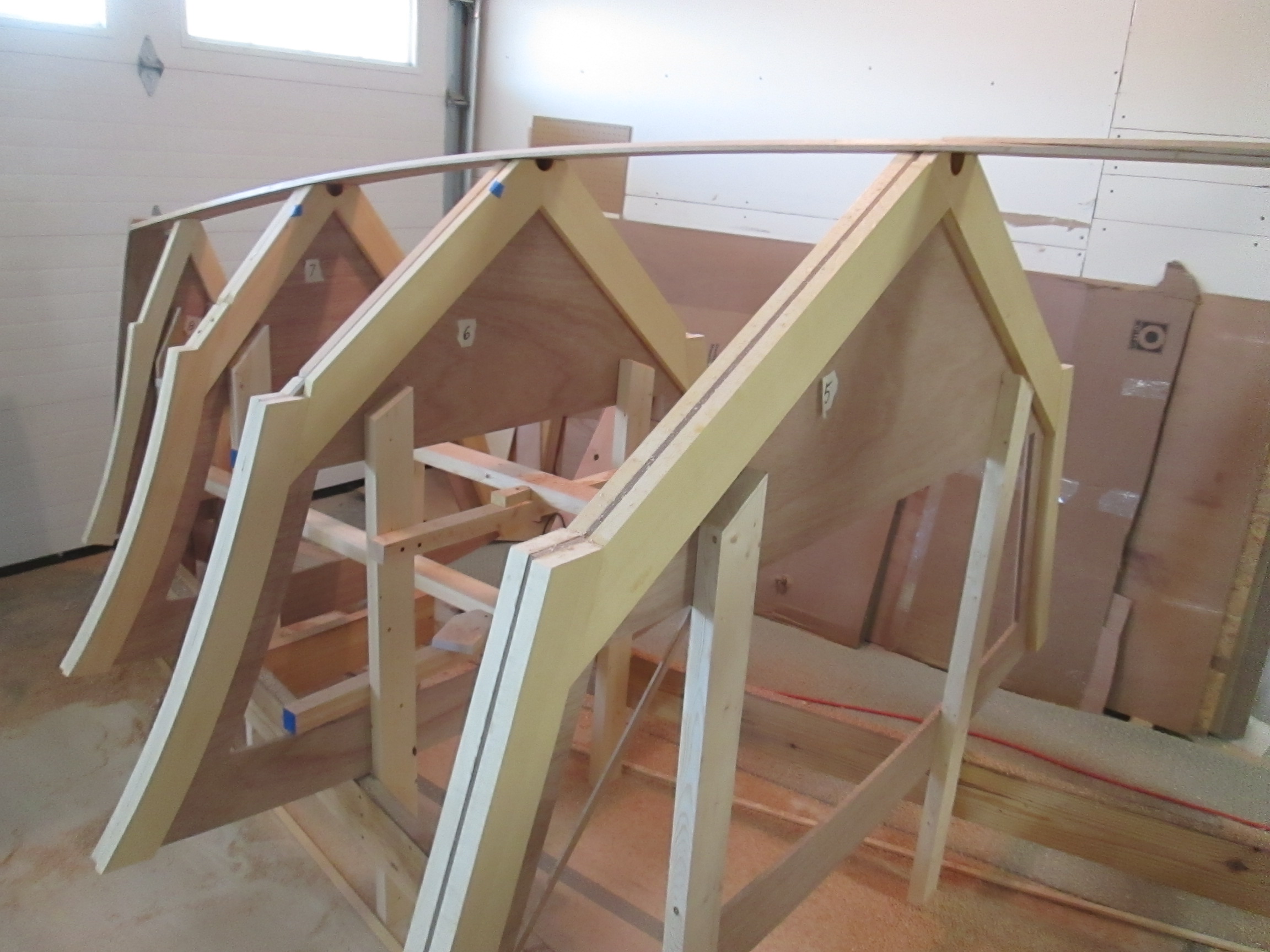
Then I added thicker wood under the long keel in proportion to what strength might be needed at each area. The boat is upside down right now, so the upper left corner of the boat is going to be the lower front of the hull when it is done.

The triangle corner brace is a three piece lamination of marine plywood. Of all corners of the boat to take a hit, on a rock, the sand, a log or a dock, this is the likely place where the most damage would be done.

Across the top of the single board that created the keel line, I laminated a second board to give it more stiffness. The back 8 feet are straight, for consistent planing.

Internally, the long boards were added to tie it all together, define the space for the fuel tank, and to pass the force of the future motor to the boat as a whole.

This is a wider boat than the first one I built, and it seemed like it could use a second long runner, to help stiffen the shell. I sawed and chiseled out some notches on the frames and runners to retain the best strength on both parts.

Someday it will sit for long periods of time on a trailer. The outer runner is about where the trailer bed rail will hold it, which can deform the hull if it is not strong enough.
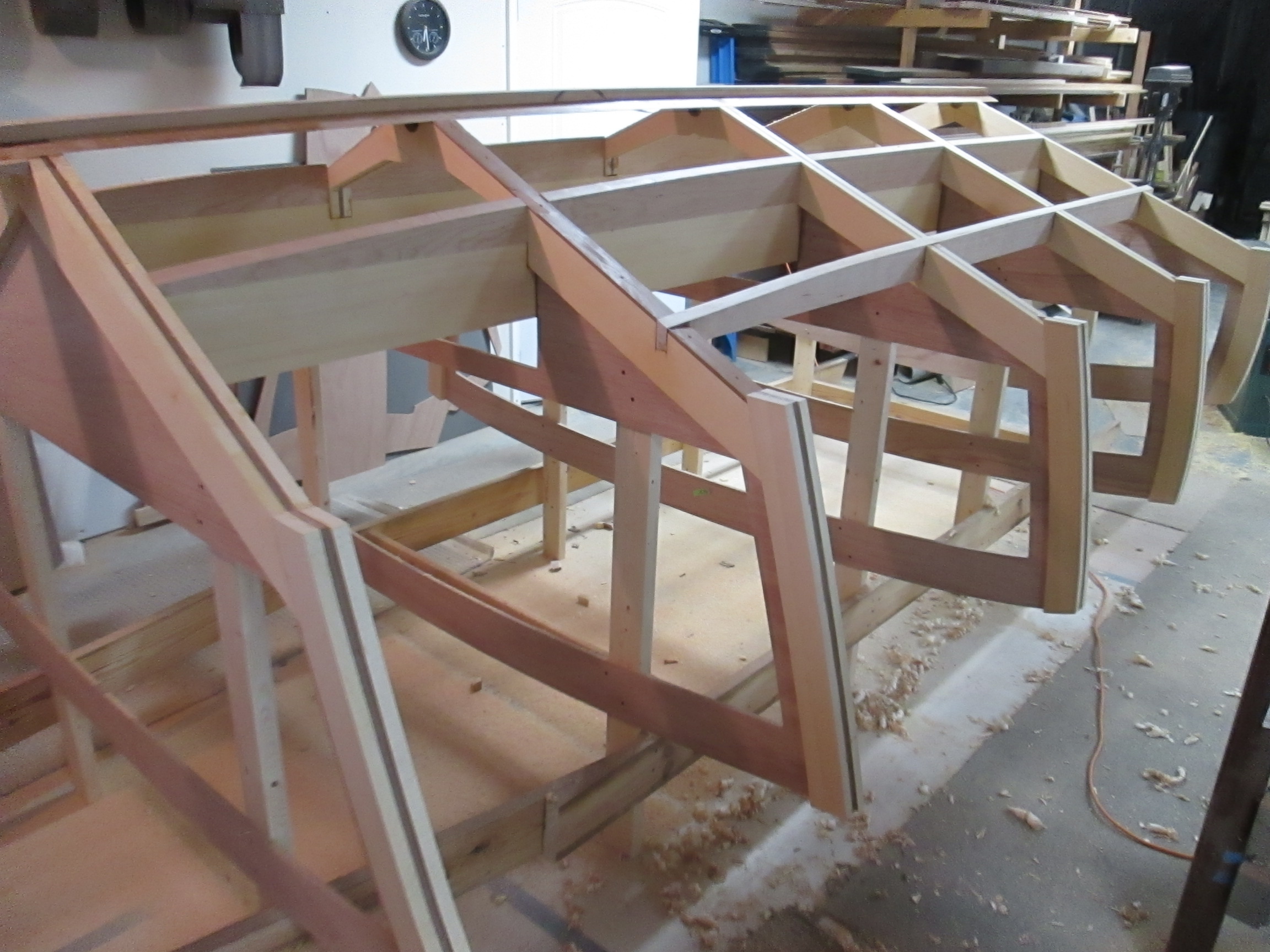
A finely curved laminated stringer at the chine line (where the bottom meets the side) will be the remaining connector before the hull planks go on . . .
The Best Laid (Boat) Plans . . .

The new speed boat is coming together sweetly:

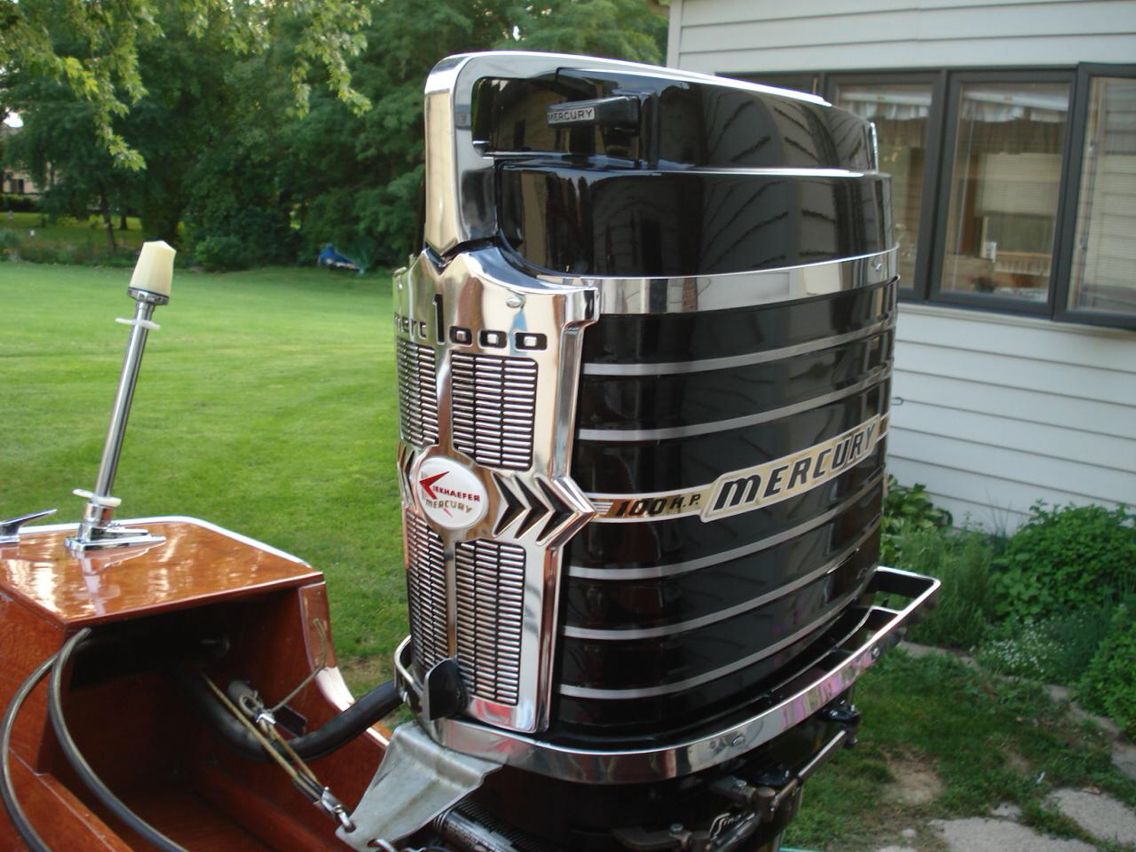
It will be 20′ long by 7’6″ weighing about 2100 pounds, and capable of carrying 8-10 people. This will be powered by an outboard motor of 150-200 Horse Power to push the boat to perhaps 45 MPH. At 450 pounds, the outboard delivers a much better power to weight ratio, and sitting right there on the transom, makes for easier maintenance. An old Mercury 200 Tower of Power like the one below would be the perfect attitude, but then, there goes the ease of maintenance.

The new wooden speedboat will follow a similar construction plan as the first, built of wooden cross-frames and stringers. This time, however, I plan to use a more local variety of wood, starting with the lumber left on my racks from a decade plus of projects. This will include some White Oak, Alaska Yellow Cedar, some Mahogany. These are from long and straight boards, with no knots, and rot resistant.

But my 10-12′ American Cherry lumber is also great to work with, and can be sized appropriately for the strength and function needed. Building a hull stiffened by fiberglass cloth, embedded in epoxy to keep the water out, is a far more important factor than the wood type.

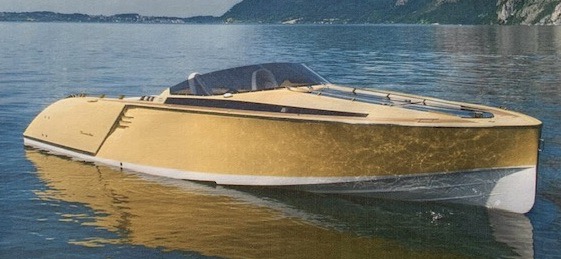
The design concept has firmed up as well, taking inspiration from boats like the Frauscher below.

Some examples of work from my design program are shown below. This is not exactly the boat I am building, but it shows what fun a fairly simple program can create.

The boat shown below is also not the exact model I used for the frames. It does however, show a more vertical bow line, and forward leaning transom above the waterline.

The first serious step towards production was making a series of PDFs of the bulkheads from my boat design. Below is cross frame number 6, third from the front. My old computer with the free boat design program is 25 years old, and with my lack of tech savvy, I hoped that it could still be used.

One day I came to the moment of truth. Was this to be only a design hobby or am I actually going to build a boat? I called Tyler at Cutting Edge CNC in Millersburg, Indiana to ask if he could use the PDF’s. He said that it was quite possible and he would give it a try. In few days later, he said bring the wood!

For the last boat, (frames shown on right), I used large patterns and assembled all of the frames from Alaska Cedar and Marine Plywood parts.

This time I am trying a different approach, having the frames cut from 4 x 8 sheets of Hydrotek plywood. Then I will reinforce them later.

At Johnson’s Workbench in Charlotte, Michigan, I bought the 6 sheets of plywood, and dropped them off to Cutting Edge. Another couple of weeks, and voila’ the possibility of a boat became real!

After I received the cross frames, I went back to my computer design program to review the actual model’s side view lines. This was for the final information about how to position the bulkheads vertically, especially the front 3 or 4.

With apparent careless habits from new computers, I did not press save one time, and experienced the unfortunate disaster of the old days of computing. The current design concept was not shown above. . . because it is gone.

None of my efforts, or advice from experts to recover the design worked, and there I lost many hours of irreplaceable work. There is a lot about building boats that is like life.

Till next time . . .

Boat Building Wood 1

The design of a new wooden boat requires thinking about the choices of wood. Trying to keep the water out of the floating space takes a combination of strength, stability, toughness and endurance. Western Red Cedar, Alaska Yellow Cedar, Sitka Spruce, cypress, teak, ash, white oak, and mahogany are some of the most highly prized woods for the beautiful traditional wooden boats of the last century. 

Some physical properties that matter most for the wood in a boat are: strength, density, hardness, stiffness, bending properties, moisture resistance, and dimensional stability. From a practical standpoint, some of those factors may be overridden by cost, being able to source them close by, and working ability. With all of that in mind, here is one of my personal favorites:

Alaska Yellow Cedar – It is not cheap, in 2023 around $10-15 / board foot rough. But everything else about yellow cedar is amazing. Mine came in generous 4/4 thickness 1″ x 6″ x 16 feet long with no knots. The prime vertical grain boards are straight, lay flat, are very stable and weather resistant. It is very light weight, and has an exceptional strength to weight ratio which is great for boats or airplanes. The distinctive aroma advertises its unique personality, which is like your Grandma’s cedar chest, spiced up a bit. 

But it really shines when you actually pull it off the rack and put it to work.

Alaska Yellow Cedar cross frames and stringers.

The tight consistent grain cuts so consistently and smoothly, that it makes hand tools seem like a good idea. A bonus is that it over a few years working with Alaska Yellow, it has never once given me a splinter. I love this wood.

Perhaps you can imagine how sorry I am, that the original stash I bought in 2013 to start the first boat is coming to the end.   But, there are other wonderful wood choices . . stay tuned.