The Third Boat Turn


Painting the hull bottom is a bit like going from Elkhart, IN to Grandma Liechty’s house in Archbold, OH when we were kids. Dad loaded up the six kids in the blue Dodge station wagon, generally with a brief fight about who had to sit in the back rear-facing seat. Then after what was probably only minutes into the two hour trip, someone would ask, “Are we almost there?” At an early age, everything was unfamiliar, and gave no reference point as to when it might end.
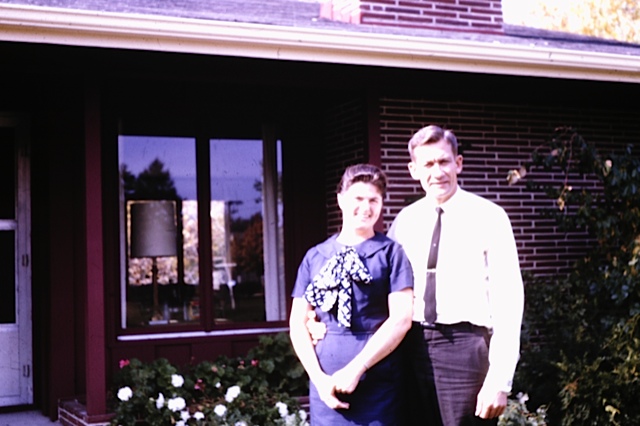
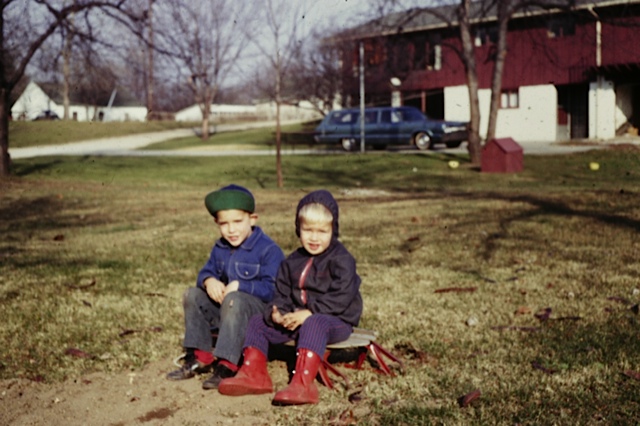
Below are photos of mom and dad in front of our house, and Joe with a neighbor friend at the back. Behind them is the blue Dodge station wagon.
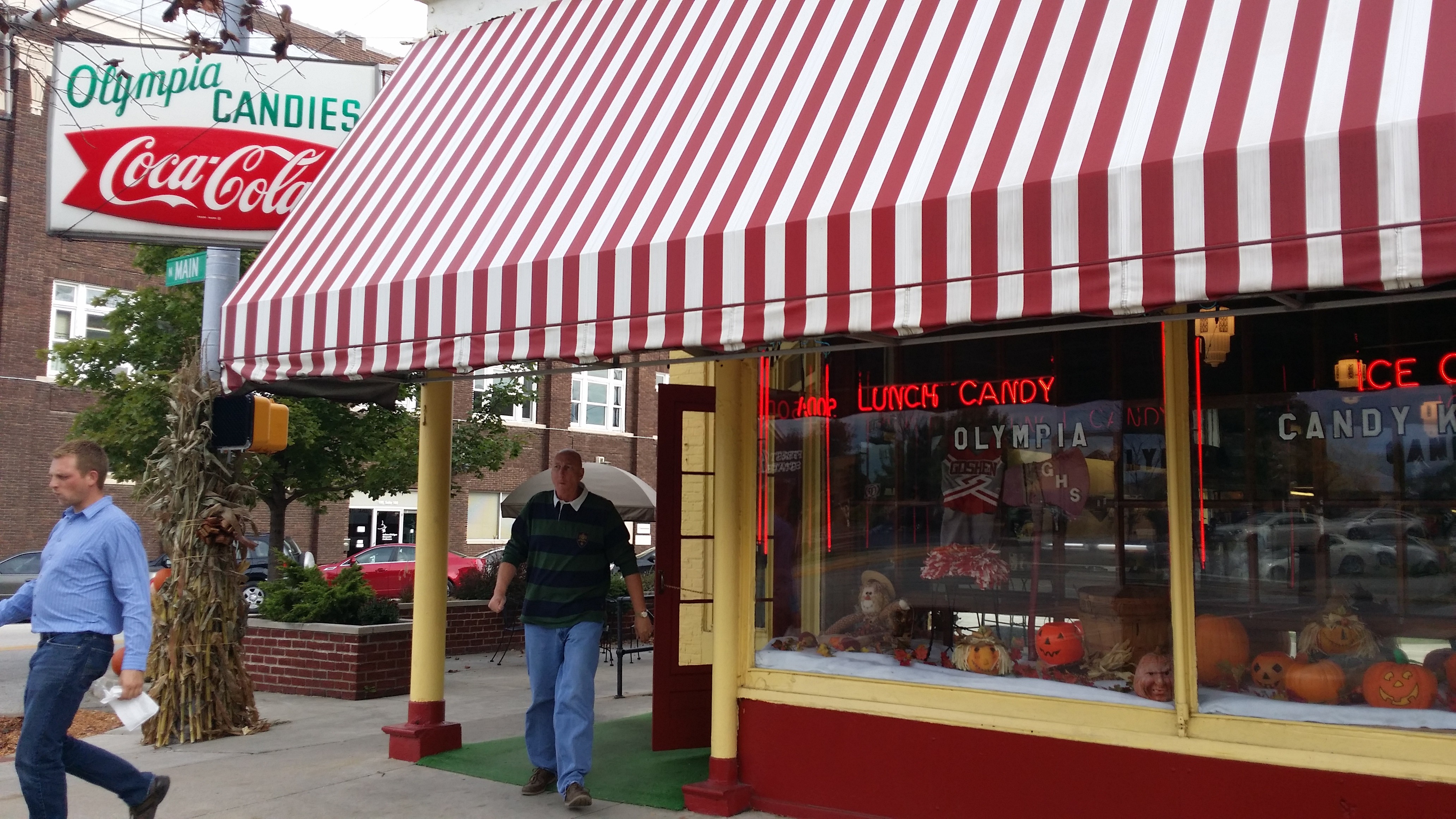
As we got older, we began to know Route 33, past the Midway outdoor theatre in Dunlap, the A&W Root Beer Stand, Olympia Candy Kitchen across from the Goshen Courthouse, and the big white house in the country near New Paris. The we came to the T-intersection where we turned left on Highway 6, heading over to Ligonier. After the stop light, it was down the hill around the pond, and through the country where we would sometimes race a train on the tracks heading east.
At the stop light in Edgerton, the official route for Highway 6 went left through the business district, but we always turned right across the tracks to beat the inevitable truck ahead of us. Then there was another straight stretch of road where we would try to keep concentrated on the horizon. Finally, someone would yell, “I see the church steeple.” A few miles more and we would reach the old white church at the corner of 6 and Route 66. Then it was less than 5 minutes north into Archbold, past my Uncle Herman’s shop, Uncle Wes’s Chrysler Dealership, the A & W Root Beer stand, and the huge limestone church, to Brussels Street where Grandma lived.
Here are Grandpa Joseph and Grandma Emma Liechty, with Uncle Wayne, Shirlyn and Ellen and Dad and Mom, Anne, Margaret and I
We hadn’t really arrived though, until we checked out the deer head in the den, heard the chime of the Grandfather Clock and sampled a lemon drop from the cut-glass bowl in the living room.
So when the boat hull planks were installed and the surface faired, I started thinking about when we could have the turning party to get going on the topside again, wondering if “we were there yet.”
Looking back, I remember discussing my painting time schedule with an experienced sailer/builder who just smiled knowingly. I imagine he was thinking, “You aren’t at Grandma’s house yet.”
My previous experience with paint was of the house variety, redecorating walls at some houses where we lived. There, we just opened the can, which was already mixed at the store, and started brushing paint around the trim and the corners. Then we got out the roller for the big surfaces. It seemed like quite a job, but we might complete a room in an evening.
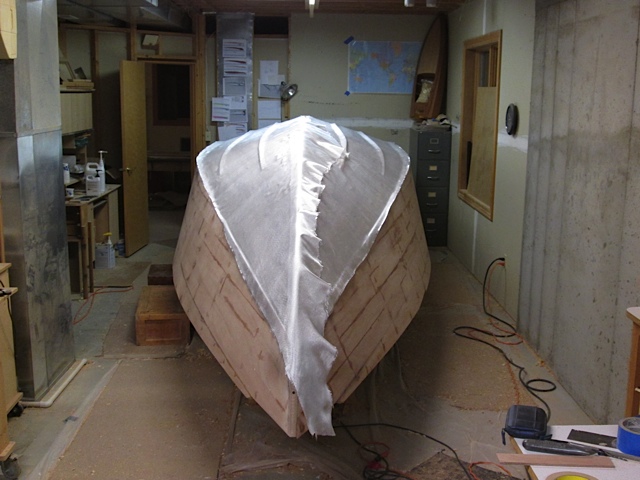
Then I got introduced to the complexity of finishing the bottom of a boat. The first activity after fairing the wood was to place the glass fiber cloth and imbed it in epoxy. This would have been a great time to call my friend Brad Collins for expert advice, but I didn’t think of that. It seemed similar to what I had done on the inside so Jeff Margush came over and we plunged ahead.
The first problem was that a 20 foot boat (even a skinny one) is a big surface. Second, since I couldn’t imagine positioning the 6 oz. fabric after a sticky sealcoat, we started dry on the hull. Third, I laid the fabric out on both sides, overlapped at the midline, which gave no great stopping point.
Fourth, the strakes provided a difficult contour, making it difficult to stretch the fabric evenly.
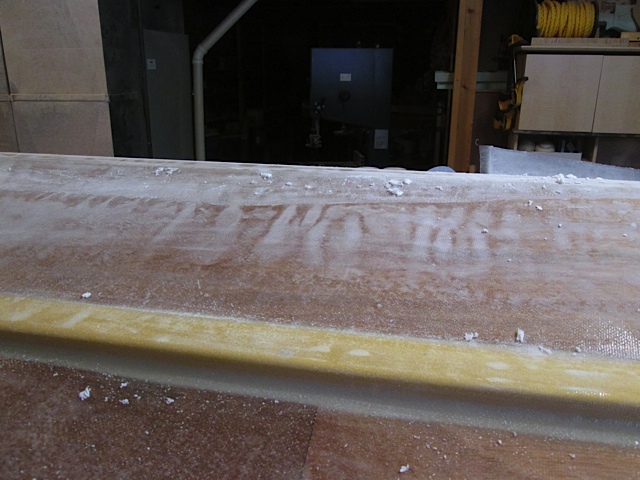
This led to using much more epoxy than was needed, so during the time before it kicked off, the epoxy flowed down under the fabric and created some mini-waves. Fixing it required much extra effort and some new tools which I had to acquire immediately. I bought a carbide paint scraper, some 60 and 80 grit sandpaper, and went to work.
I have heard that the only two ways to learn are by instruction and by experience. Experience helps you to avoid making mistakes, but you can usually only get experience by making mistakes. I would rather wear the big “S” (Superman) on my shirt, but it keeps popping up on my forehead (Stupid).
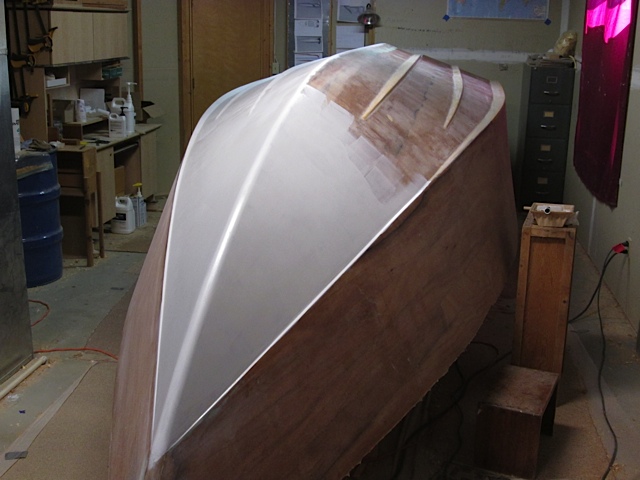
The net result was that when I put the glass fabric on the sides (this time 4 oz.), I made sure to be more careful. I still laid it on dry, because it is so hard to position a large piece alone. This time I used a minimal amount of epoxy, which I applied by brush, and a large plastic spreader, with fine success.
Then, it was time to start an entirely new adventure. With wood furniture, the way to change the shape of wood is by carving or sanding it, to retain the natural grain to finish. I have never added any fairing material. However, in the case of this boat, I had to add some green fairing compound to blend where the fiberglass cloth overlapped.
When I began to research boat paint, and bottom paint specifically, I found a complicated array of choices. Since the boat is intended to be used mainly in fresh water, and kept on a lift or trailer, the anti-fouling paints were not so important. Instead, I took a recommendation from the tech team at Jamestown Distributors to try Interlux VC Performance paint which is a hard 2-part epoxy finish used on speedboats and racing sail boats.
This meant starting with the Interlux 2000E Primer, following these steps of preparation:
1. I washed the surface with warm water and a Scotch Brite scrub pad to remove the amine blush. This really does matter, and success can be readily seen as the water on the hull goes from beading up to laying flat.
2. Next, I used the recommended solvent wash, and dried immediately behind it.
3. Then I mixed the base with reactor in the recommended 3:1 ratio.
4. Let it set for 20 minutes induction time.
5. Used a short nap foam roller and a natural bristle brush to apply.
6. Repeated two more coats.
The manufacturer says that VC Performance Epoxy is intended to be sprayed, although others wrote of applying by the roll and tip method. This was my only option, so I read about it, made some notes and plunged ahead:
1. I opened the can of base and first took 10 minutes with a stir-stick to get the solids mixed into the liquid uniformly. Shaking the can was not recommended as it would introduce many bubbles into the paint.
2. Added the catalyst into the base with a 1:1 ratio, mixing again around 5 minutes.
3. Allowed to sit 25-30 minutes for induction.
4. Applied with a short nap roller and brush tipping.
5. Did total of four coats.
Various instructions say either not to thin, or to thin as needed, not exceeding 15%. Having no previous experience with two-part epoxies, I didn’t know what it should act like at 65 degrees. Bottom paints are made not to flow much, so vast expanses of hulls can be rolled on without rivers of runs. This is done by making the paint more like mayonnaise than honey.
I also didn’t know how much to sand between coats, and so the defects of the first coats just got passed along into the remaining layers. After the third coat, my rolling and tipping had produced a mediocre finish which I spent a 13 hour sanding Saturday trying to fair and work out the tipping lines.
I tried one more coat rolling without tipping, hoping it would lay well enough to leave the paint sheen alone. This produced positive stipples like textured wall paint. It could be that I did not thin enough, and that there is a technique possible to do it well at a certain temperature. I just know it is temperamental and difficult.
Epoxy paint soon becomes very hard to sand, filling the paper quickly if you try to sand dry. Wet sanding preserves the paper, but makes seeing the defects more difficult. Epoxy hardness requires using 60-80 grit paper to remove, but also needs 1000 grit paper or higher to bring a bit of sheen to it. This means a lot of frustrating repeated steps, going through grits like 120, 220, 360, 600, 800, and 1000.
Eventually, the best results were gained wet sanding, using a spray bottle to dampen the surface, an orbital, wood and foam hand blocks, and a squeegee to clear the surface for the best observation.
My cousin Jon Smucker was kind enough to come over and help with the second long Saturday sanding. He has the craftsmanship of a surgeon and the perfectionism of our Liechty relatives. Jon told me a story of twenty plus coats of varnish on his Century boat trim work and said, “Given time and commitment, nearly anything can be accomplished well.” That, plus lunch provided by his wife Jan, was a great encouragement for getting back on track.
So the question still stands, “Are we there yet?” Some of the most challenging activities involve difficult repetitive action with no specific end in sight. But then again, it’s only work if there is something you would rather do. As Bob and Judy Herrold recently emailed:
“Never be afraid to do something new. Remember, amateurs built the ark and professionals built the Titanic.”
Fair can mean a lot of things, according to Webster. It might be fair weather, or a night at the 4-H Fair, or another of the meanings below:
1. Fair- pleasing to the eye or mind because of fresh, charming or flawless quality.
e.g. These fair ladies (Margaret, Jane and Mary) with brother Joe were a big hit in their homemade ski suits on the slopes.
2. Fair- sufficient but not ample.
e.g. There is a fair chance that these Lehman kids have successfully packed all they need for vacation.
3. Fair- Conforming with the established rules.
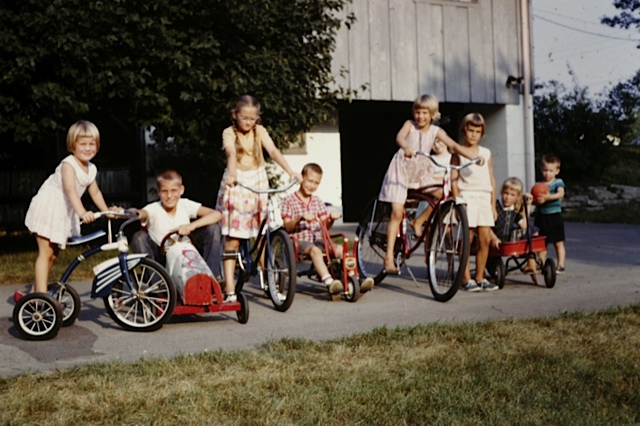
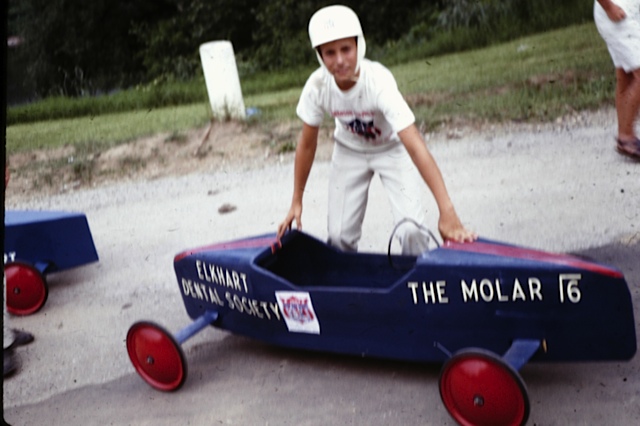
e.g. To make the competition fair, each Soap Box Derby racer went twice against an opponent, switching sides after the first run. Unfortunately, the driver on the right side lost on both sides, that’s me.
In my defense, it wasn’t fair that most of the cars were built by the dads while mine was completely me. Later, I found out that some engineer dads knew about aerodynamics, alignment and wheel camber, axle flex, no-play steering methods, slick lubrication, etc. So their cars tracked straight.
My cable steering system apparently never got tightened enough, so my ride was a bit more interesting, if not as fast.
4. Fair- Open to legitimate pursuit, attack or ridicule
e.g. When the whistle blows, it is all fair game with this motley crew of Lehman cousins.
5. Fair- Not stormy or foul.
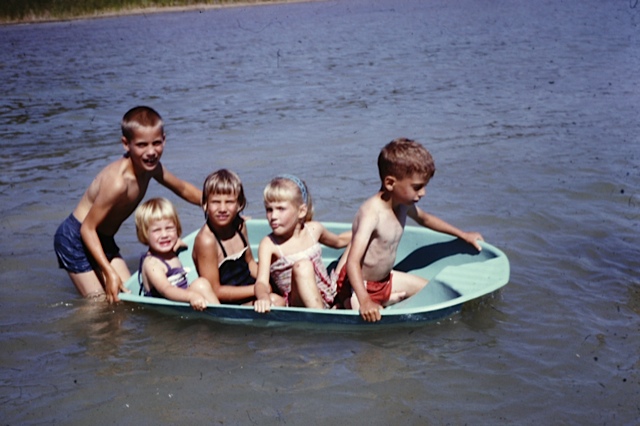
e.g. The weather is fair, but the chance of coming back dry is not so much. Here cousin Paul Smucker joins my sisters, Jane, Margaret and Mary in the boat as I push them into harms way.
6. Fair- to join so that the external surfaces blend smoothly
e.g. It took endless hours of sanding to fair the hull.
Building furniture, the skill I brought to the boat building process, did not prepare me for all of the work after building the wood parts. When I made a chest of drawers, I final sanded it and took it to a local finish shop for a coat of sealer and lacquer topcoat. The bottom of the boat is a different matter entirely.
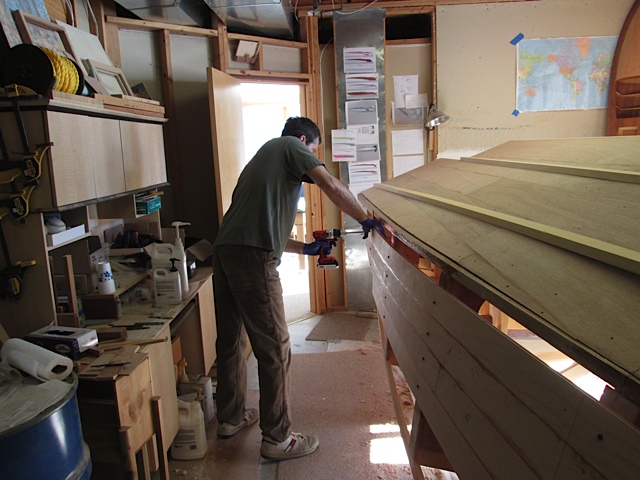
To have a beautiful hull, the frames underneath have be right. As I was placing the planks, I did some shimming and trimming on the frames so the hull planks follow smooth curves. Having made them fit to each other with a tongue and groove joint also helped fair the curve and blend them side to side.
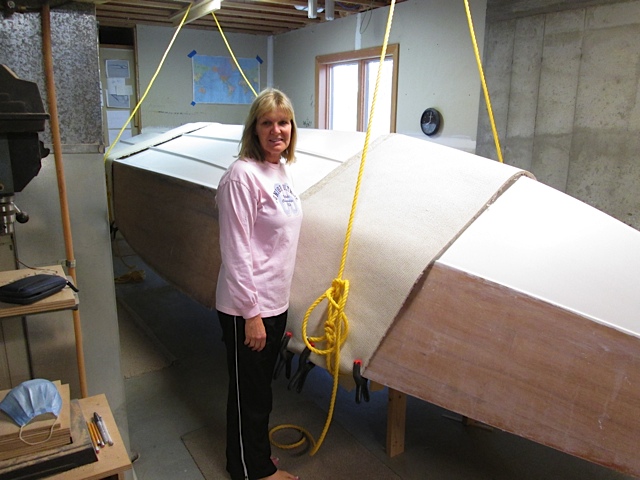
After the hull planks were epoxied in place, the next step was to blend the surfaces together. At first, where there were offsets from one plank to the next, I started with a belt sander. This requires careful work, to prevent the sander from digging in too deeply somewhere not intended, and then having to add filler.
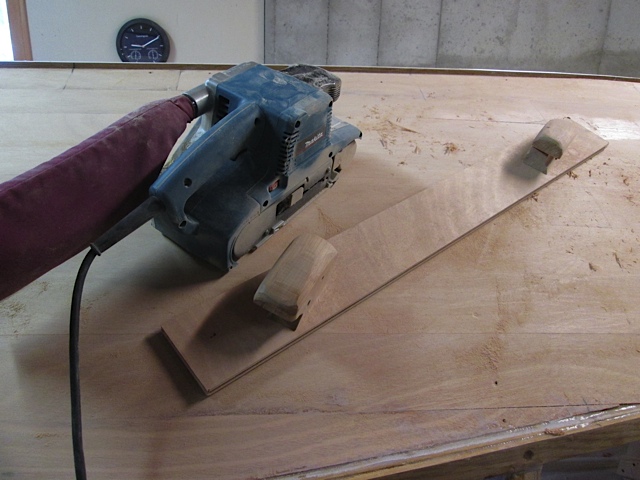
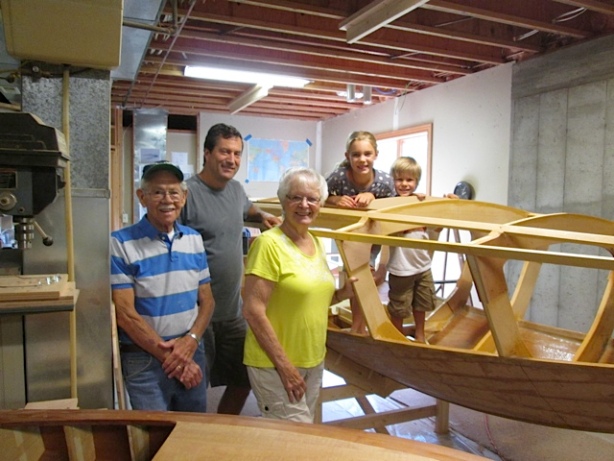
One of the next tools used is the long board sander. I made this one of 1/2″ plywood so it would flex a bit, with two homemade handles. On the bottom, I cut parts of 80 grit sanding belts and attached them with contact cement, to change them when needed. Below is Jeff Margush, putting some muscle into smoothing the hull.
In other areas, especially along the keel or the stringers, the hand plane is the best tool. Below are some photos of a low angle smoothing plane and a high angle smoother, making their signature curls of oak and cedar. This is quiet work, beautiful in the process as well as in the result.
For detail smoothing, a scraper is the right choice. It is a bit temperamental, and difficult to get and keep a sharp edge, but when it is right, it gets to the area needed without tearing up long grain.
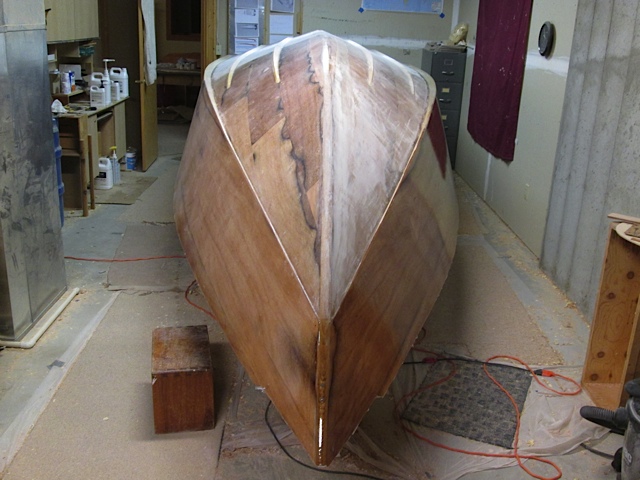
As the surface improves, the eye is the best inspector for the edge lines and a hand the best sense for surface smoothness. After hours of planes, scrapers and long sanders, the hull came to a elegant, blended shape, ready for adding the fiberglass fabric and epoxy.
Below is the photo of the hull, showing areas where the first layer of plywood was sanded through to get smooth.
As hard as it is to fair a boat, it is even more difficult to make life come out right. According to Oscar Wilde, “Life is never fair, and perhaps it is a good thing for most of us that it is not.”
Fortunately, God offers forgiveness through Jesus Christ for our wrongdoings, and even provides redemption to turn our missteps along the way into something wonderful. That is fair enough.
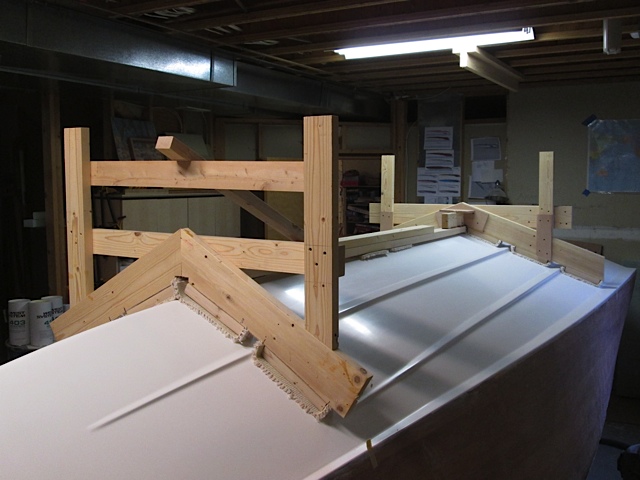
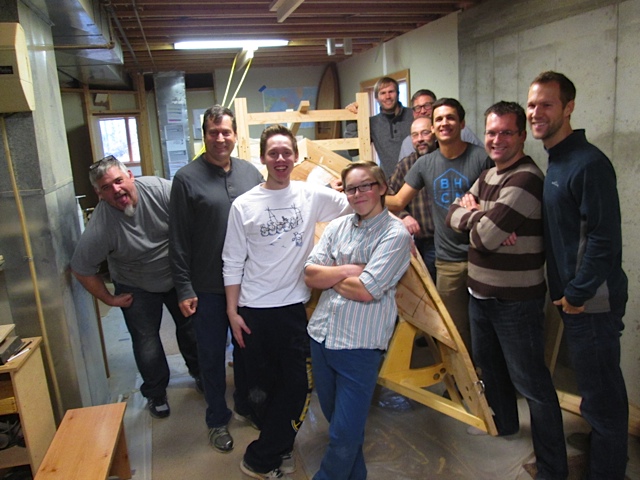
After turning the boat over, back to upside down, it was time to give attention to the final shape of the bottom. The first task was to close in the back holes where I had extended the stern sides to fix the front-to-back balance problem. It was more fully described in the post Roadblocks.
I needed to add hull plank pieces to join the ones that were cut off at the previous end of the stern.
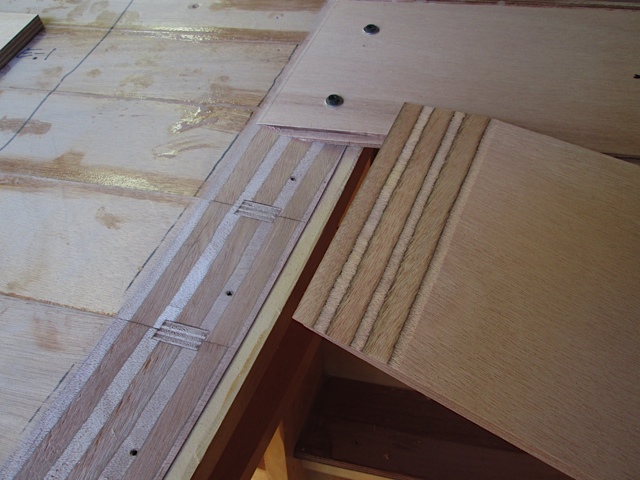
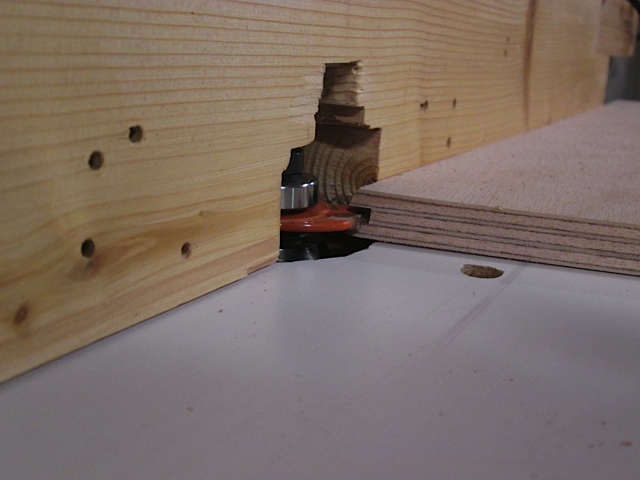
The first bit of preparation was cutting an angle on the existing hull shell to spread the adhesive over a larger area and strengthen the future joint. I used a 1:8 ratio, cutting a 4″ scarf on the 1/2″ piece of marine plywood. The best way I could figure out was to make an angle jig for my router, which produced a fairly consistent surface as I moved it up the line.
The replacement pieces were not very large, but difficult because apart from the parallel sides, no other angle was square. I first cut the plank to width, and then took it to the bandsaw to free hand a rough angle cut. This is not so safe, but works out well if you hold the piece steady and don’t change the angle much.
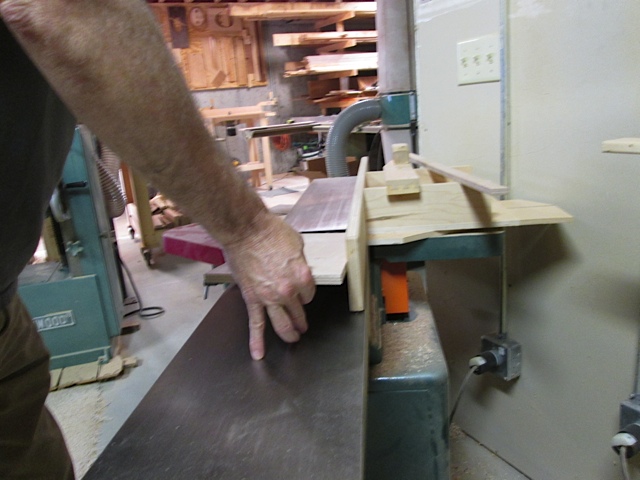
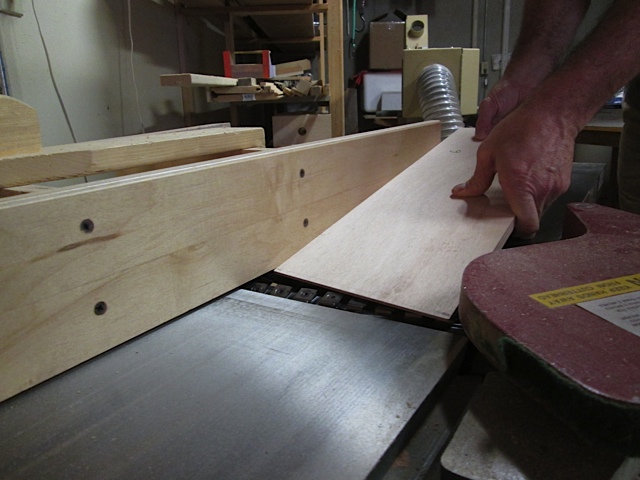
This cut defined the end that would fit against the existing hull, so then I took it to the jointer to cut the 1:8 ratio scarf. This could be done with a hand plane, a belt sander, or router but I decided to experiment with the jointer, for its precision. This is definitely dangerous.
It must be done patiently, a small angle at a time until the full angle is cut. After a few trial cuts, my extended finger eventually gave the right finishing angle.
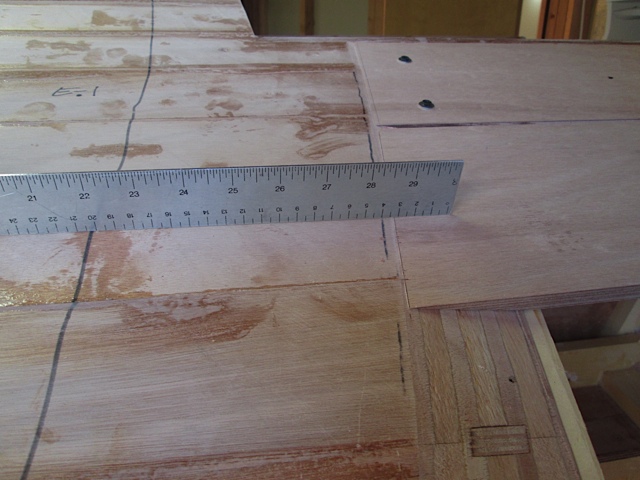
Then, it is back to the hull, to see if the end angle still fits and the scarf angle conforms to the previous router cut area. I checked with a metal ruler to see if it was the same height as well.
When this was all done, I added the tongue and groove to the sides to make each piece join to the next in the strongest way. It also contributes to making sure the neighboring pieces are level to the next one.
After that piece was done and temporarily screwed in place, the same process was repeated to finish the ten needed to fill the hole. When they were epoxied to the hull, they became just as strong as any other part of the surface, and will be invisible to inspection shortly.
By now, they are already covered with the next layer, and will never be seen again. Still, I enjoy putting my best effort into each piece, so that the boat has a good chance of functioning well and lasting a long time.
It is satisfying to imitate the Master builder who put us together in our mother’s womb, and knows the smallest details of our lives. As Eric Lidddel said in Chariots of Fire, “I believe God made me for a purpose, but he also made me fast. And when I run I feel His pleasure.”
On November 10, after hiking up Clingman’s Dome to see the panoramic view of the Smoky Mountain National Park, I was ready to leave Newfound Gap, when coming down the trail was the unmistakable look of a through hiker. First, I saw the slight bend forward from the load of survival pack. He wore his story, coming on with an unhurried, steady walk, showing a ragged beard over a tired face, long hair coming out under a stocking cap, and the dirty clothes to match.
As he approached, I introduced myself and asked him some typical trail questions. His handle was Sardine, and he had two more weeks to finish at Springer Mountain, Georgia. Just looking at the worn and cut-up tennis shoes alone could have separated him from the rest of us tourists.
Then a young girl came up to join us, carrying the through-hiker pack, with the trail handle “Chin Up.” She was also wearing the high mileage hiking boots that spoke of rock cuts and scrapes, mud and water crossings, and going the distance.
Shoes are like that, telling much about a person and where they are going. In the fall of 1974, instead of going back to college for my sophomore year, I signed up for a year in Mennonite Voluntary Service. This took me to Frontier Boys Village near Colorado Springs, a group home for behavior problem boys. VS did pay $15 a month besides room and board, so I saved for two months and added to it the $20 cash that I brought from home. (This was long before college students had credit cards.) But then I went shopping.
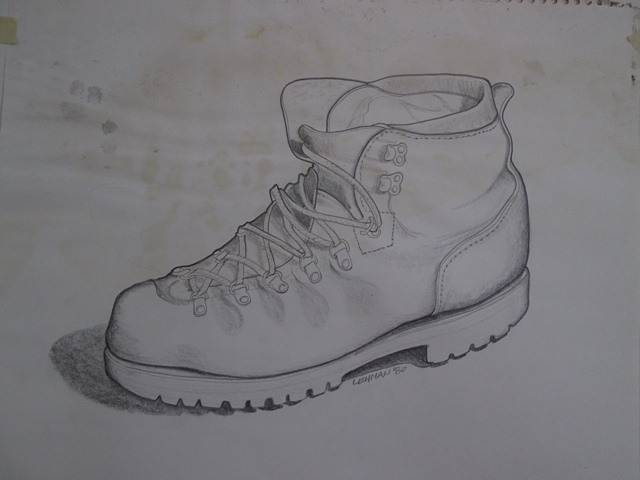
I already had the basics: a couple of flannel shirts, blue jeans, and a coat, but I needed some Colorado shoes. I went to the Red Wing Store and found some gorgeous leather hiking boots for $48.95. That was expensive in the 70’s. I liked them so well I drew a picture of them:
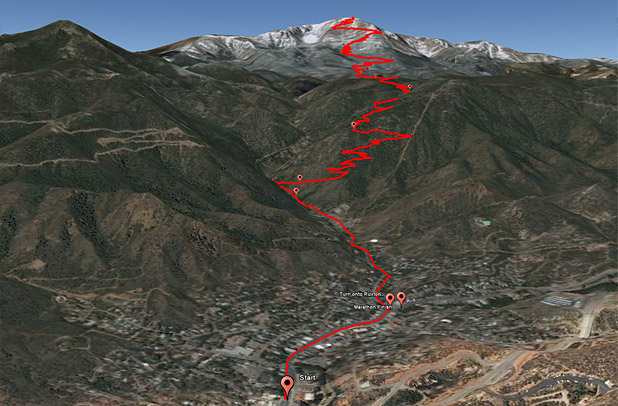
I was itching to do a real climb so I wore the boots everywhere to break them in, and oiled them up to make them water proof. It was already October, which is late in the season to hike because of the unpredictable mountain weather on Pike’s Peak. A friend dropped me off in Manitou Springs near the base of the cog railway. I was wearing Levi’s jeans, a T-shirt and a wool sweater, with a jean jacket over the top. My small pack was filled with a couple of ham sandwiches, bananas, peanuts and raisins, a canteen, knife, matches, and a sleeping bag.
It was a cloudy day, 46 degrees and misty. I put on my stocking cap and leather gloves, and started up from the Barr trail head. I had the irrepressible curiosity of a kid, the invincibility of a teenager, with the energy of a distance runner.
Many of the miles I had run in preparation for track, cross country, and the climb, were done in the shoes below, favorites from my high school days. In 1970, you pretty much had only two choices for running shoes: Puma or the three stripes of the Adidas. This pair was green and yellow:
I didn’t get started until 4:00 in the afternoon, but I hiked quickly for the first few miles, through the mountain forests, and across a few streams. I went alone, apparently with something to prove to myself, which never seems quite as obvious or necessary to parents and friends. I did not see any one coming down. This, in retrospect, should have been a clue. My goal for night was to stay at Barr Camp, about 7 miles up the 13 mile one-way hike to the top.
Around mile 4, the mist started changing to snow. I was warmed from the exertion and enjoying the beauty of the scenery, so I kept steadily moving upward. The mountain meadows were extraordinary in the evening light on the remaining yellow aspen leaves.
The temperature was dropping, and my hands were getting colder, but by the middle of the evening I arrived at Barr Camp. I looked around for some kindling and firewood, but it was all wet. Still, I tried to get some pine needles started on fire, but did not succeed. Soon I realized my fingers were too cold to hold a match any more, and I remember a chill of fear crossing my mind. I wondered briefly if I should turn back and run down.
Instead, I got my sleeping bag untied from my pack, mostly with my palms and my teeth, and settled it into the most protected corner of the drafty shelter. Then, since I couldn’t work my fingers, I just climbed into the bag, muddy boots, coat and all. A few minutes of sit ups and covering my head, the intensity of the body shivers was reduced. By around a half hour later, I got my boots untied, took them off and went to sleep.
The sun comes up early on the east face of Pike’s Peak, and I woke up around 6:00 am. The sky was beautiful, and the snowfall had just been a light dusting. I got my boots back on as quick as I could, and continued upward the trail. By mid morning, the temperature had risen to around 50 degrees, melting the snow, and making the hike comfortable again. When I climbed above tree line, the view opened to 30-50 miles of panorama of other snow covered peaks of the Rampart Range. Around 11:00, I made it to the top and had lunch with the drive-up tourists.
Going down was a breeze and the redemption of the difficult climb. It was the long sunny view out onto the Colorado plains, the drama of the cliffs and gorges, the whisper of wind in the mountain pines, and the trickling, tumbling, glistening streams. By 4:00, I was back to Manitou Springs, which, depending on your point of view, might still not be considered civilization, but there were lots of people around.
Building the boat calls for some special shoes also. They have to be comfortable on concrete floors, and yet agile enough to climb in and out of the boat innumerable times, without doing damage to some fragile wood parts. Some of my old favorites, the Concord High School green and white original Converse All-Stars, and the Puma track shoes had gotten thrown away over the years. But, I guess, I don’t follow the rule that you should get rid of anything you haven’t worn in the past year. So I still had plenty of options in my closet to choose from.
I tried my old Red Wing leather work boots, but they were a little clunky. Fortunately, I had hung on to an old pair of Tommy Hilfiger leather tennis shoes from the 80’s. They still had a little time between broke in and worn out, and I found myself favoring them, until by now they are the “boat shoes.”
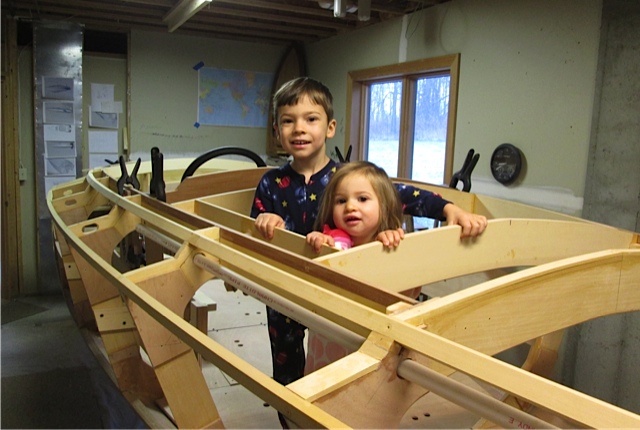
They are not to blame for the slow progress as of late. That relates more to having gone on a family tour for nine days through the southeast. Below, Austin and Brayden are doing a live test of the cockpit dimensions and the steering wheel position.
Recently, I have researched and bought most of the hardware items I will need: navigation lights, wiring harness, throttle control, gauges, steering wheel, etc. The first set of gauges were bought a month ago, but one was back ordered and another had an off-center face so I returned them. The next Tachometer had damage on the stainless steel ring (also returned), so I expect to pick up the last set next week.
The back navigation light required an angled mounting base, shown below.
I made a special track for the wire harness so it would be easy to access for any future repairs. It will be covered by a removable shelf and the fabric covered cockpit panel.
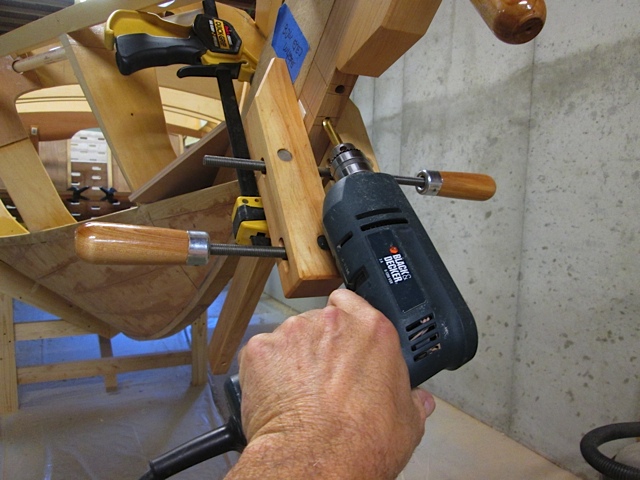
The bow eye is a small thing, with an important function of keeping the boat tied up. I had to devise a special drilling jig to get the holes accurately positioned in the front. It will eventually be epoxied into the white oak keel stem, which is the strongest wood in the framework.
Back in the early 70’s, inspired by the craft work of the surviving hippies, I decided to make some leather sandals of my own. I made a pattern from my foot and cut sole pieces and strap to fit. Then I took them to an Amish harness maker and he stitched them up for me. They went many miles and eventually got retreaded, adding two more leather layers to the bottom. They make me think of the messenger Isaiah spoke of, who may have worn sandals like these:
“How beautiful on the mountains are the feet of him who brings good news, who publishes peace, who brings good news of happiness, who proclaims salvation, who says to Zion, “Your God reigns.”
Isaiah 52:7


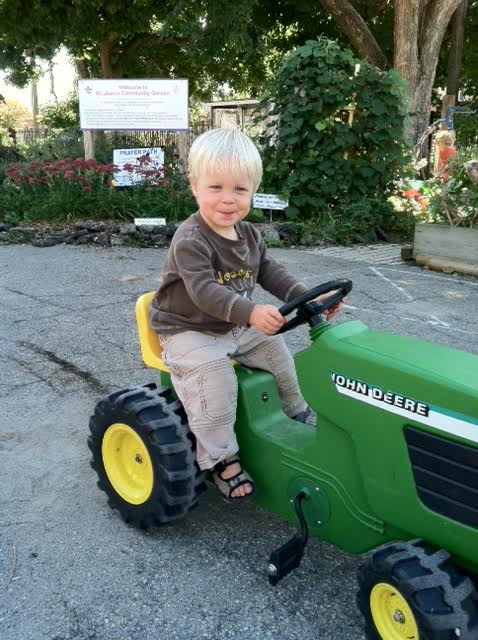
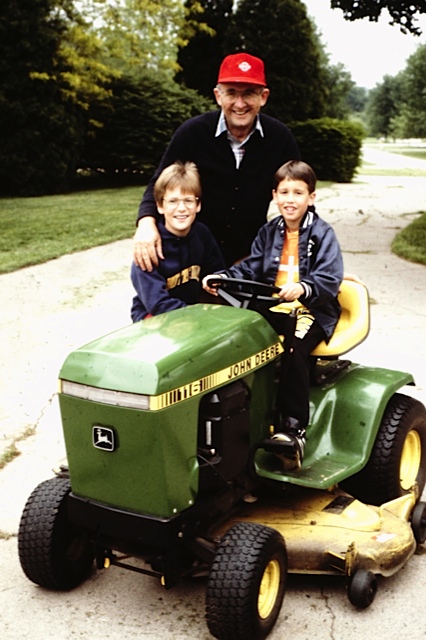
The Driver’s seat has a magnetic pull on even the youngest boy, it seems. Maybe it is being connected to all of the control knobs, or the potential noise and power at your feet making a “big machine” operate. Maybe it is the exhilaration of speed or the adrenalin rush from being close to the edge of out of control. According to my Uncle Russ, it may be Liechty genetics. Whatever it is, you can just watch my grandson Chapman beam with pleasure on the tractor toy.
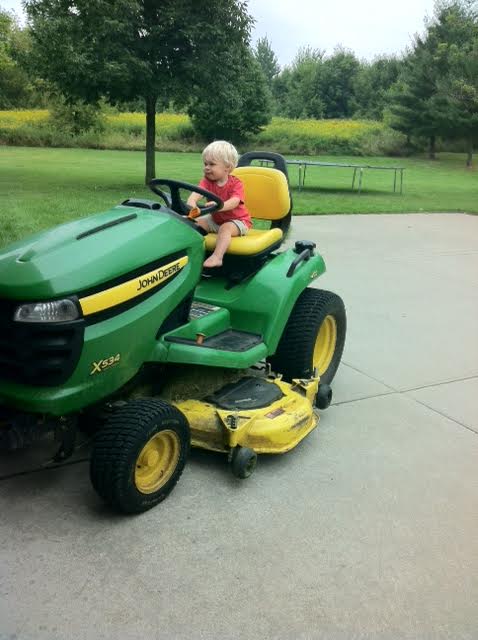
He was one and a half when he figured out how to climb up and get behind the wheel of the real John Deere lawn tractor all by himself.
The four year olds, Brayden and Hudson are no longer contented with going to Lowes to sit still on floor model tractors. They want to drive the John Deere with Grandpa, or the neighbor Don Florea’s electric four wheelers. Clay and Emma have graduated to a different level of speed and excitement, but are still drawn to the moving and driving. It won’t be long before the teenage compulsion to get their driver’s licenses sets in.
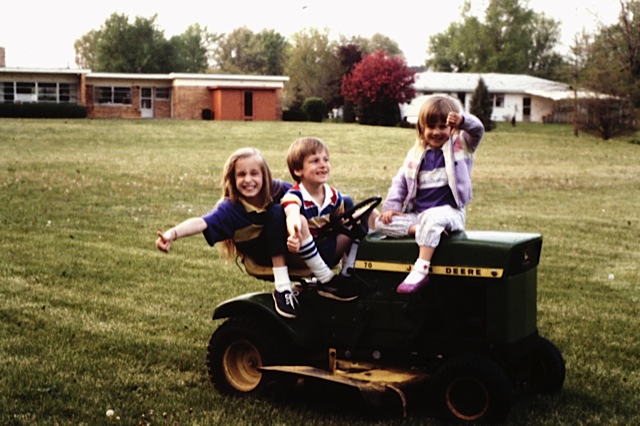
It goes back along time in the family. Adrienne, Austin and Amanda were also drawn to the the John Deere.
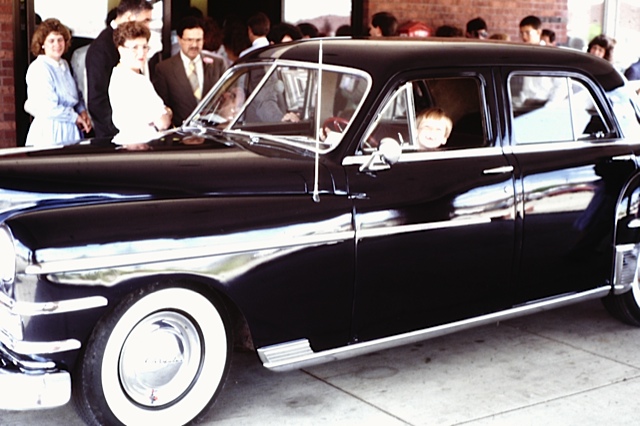
Austin couldn’t decide between classic automobiles and touring motorcycles. Here he is in Uncle Russ Liechty’s 1949 Midnight Blue Chrysler Windsor.
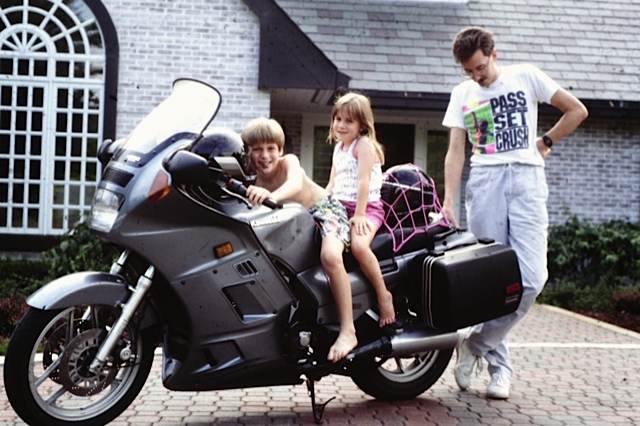
Here he is with Amanda on Dave Yoder’s motorcycle.
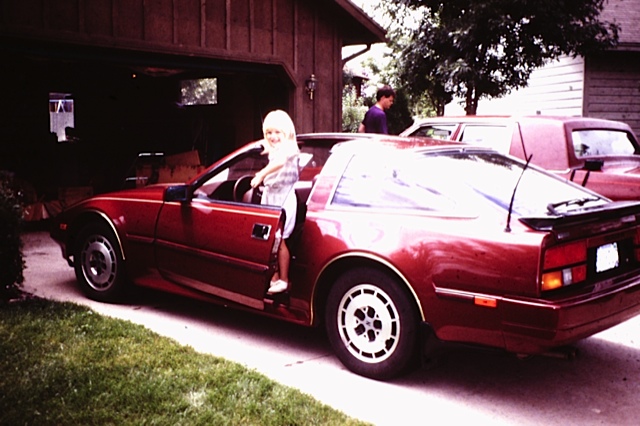
Audra was thinking more of the sports car variety for a driver’s seat.
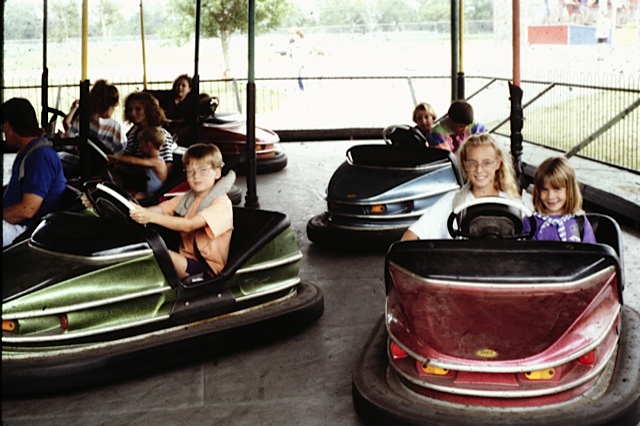
Then they graduated to bumper cars.
Grandpa Ed Neufeld loved driving also, and did lots of road trips to Indy and Nashville to see the grandchildren. Below he had a lot of help driving the tractor from Austin and Aaron.
His daughters Jan, Martha and Patty want to get behind the wheel I think mostly so they can control the music. Oddly enough, even back seat driving is popular in our family.
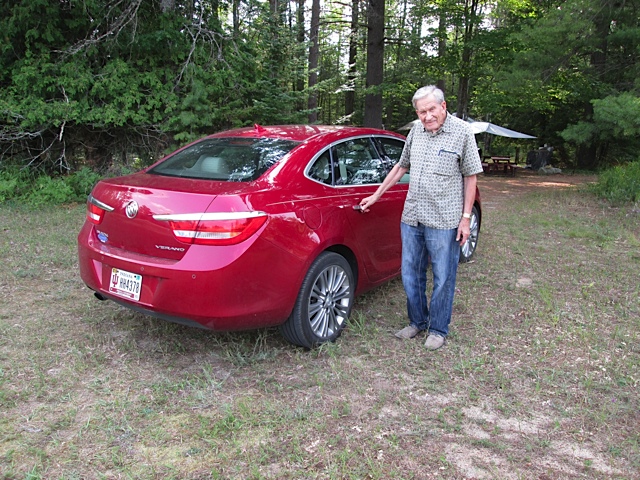
My dad is 88, and he still likes to take the familiar pilgrimage back to Fairview, Michigan, where he lived as a child. The pleasure of driving is one of the things older people are often most reluctant to give up. Here is Dad with his new Buick Verano.
Growing up at an early age, I remember bugging him to let me sit in the front seat and steer the car. Then I wanted to drive by myself to the end of the drive. It seemed a shame that I had to push the lawn mower, but finally when I was twelve, I did get to race in the Soap Box Derby.
My dad took me to an introductory meeting where he bought a standard kit. It had four wheels, two axles, and a steering wheel, with some rules and instructions. I started with a 2 x 12 for the bottom, and used lathe strips which could be nailed and glued into the side form. Then I glued another 2 x 12 on the top. Then I had a lot of sanding before brushing on a coat of blue paint.
It did not compare so favorably to the elegant fiberglass and spray-painted cars built by the engineer and designer dads, but I might have won the “Build It Yourself” class if there was such a thing. My dad did jump back into the process to name it the “Molar 6” and show sponsorship. I raced twice and got beat two times, and then retired the racer to our home hill at 4333 (now 23905) Myers Avenue, Dunlap, Indiana.
Around age 15, I bought a seriously used Go-Cart with a 5 Horsepower Briggs and Stratton four-cycle motor. Fortunately my neighbor, Jim Kuhn, was an expert fix-it man and he helped me with some basic welding and mechanics. It didn’t accelerate so well because of the gear ratio, but when the leaves were wet on the Concord Junior High parking lot in the fall, it was a high speed donut city.
About the same time, my sister Anne was learning to drive the car, and we started with the family blue VW bug. We both had our share of jerky starts and stalls, before mastering the German clutch.
Then, in college days I bought a used 1967 Datsun 2000 Roadster for $1300 which was the precursor of the Nissan 240Z. It was silver and had a convertible top. When the weather was good, and on the days it ran well, I felt pretty cool. The night I tried to change the water pump was not so fun though, as the small engine compartment always seemed to have other parts in the way of what ever bolt or nut I needed to get to. If you can imagine the following car, with rust and no roll bar, you have it.
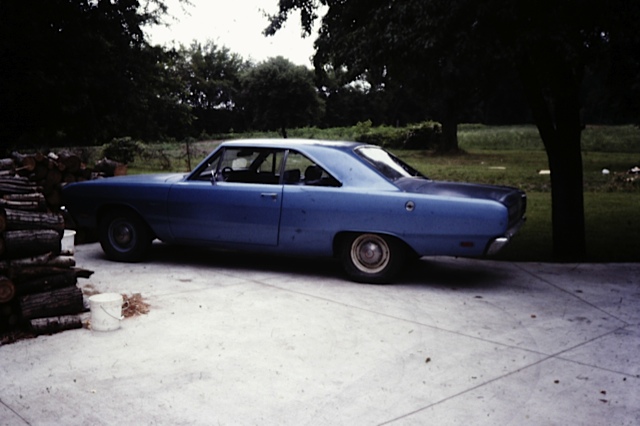
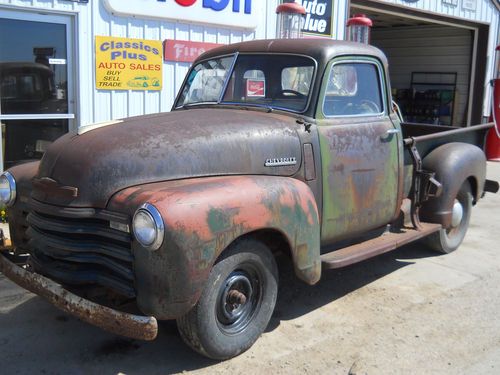
Then there was the ’49 Chevy Pickup I bought (used again) for $425 from a friend of Grandpa Frank Neufeld when we were in Inman, Kansas for Thanksgiving in 1983. It had the original blue paint, with much fade and a few dents, but what an attitude. I had to leave it at Wien’s Garage to have some repairs done, but the following spring, Jan and I went back to drive the truck home. This is also not the true original truck, but the degree of wear and tear is very accurate.
That was another adventure, on par with the scooter trip. Play in the steering system, with old tires made for curvy tracking, especially on the rutted county roads of Kansas. Vacuum windshield wipers did not do much good for the rain either. I didn’t have the money or time to fix it up right those days, and sold it a few years later. I wish I had known what a regret it is now.
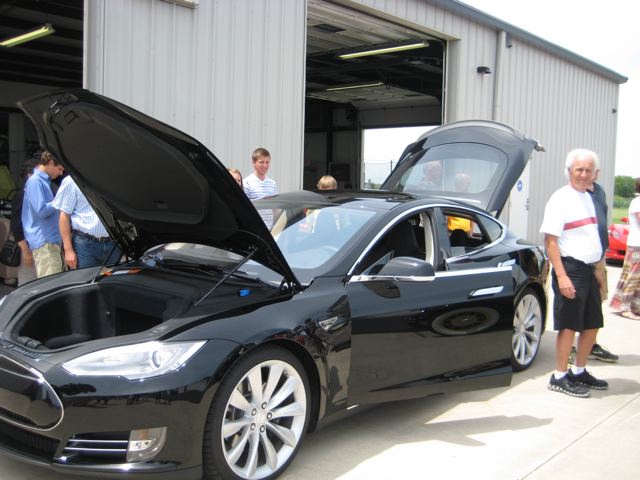
This summer at a Liechty family reunion in Archbold, Ohio, provided another driving experience. My cousin, Steve Wise, was showing us some of the Corvettes in his collection, and pointed out a black four-door sedan sitting out in front with the hood up. He said it was “running quietly’ and could be taken for a spin.
I got in the electric-drive Tesla coupe behind Joe and Dan Liechty, and after a few miles headed out in the country, I asked if I could drive her on the way home. The Tesla was reported to go 0-60 mph, faster than a Corvette. Also, since it has a low center of gravity with the batteries under the floor, it was supposed to handle like a Porsche. Being a man of science, I am not one to idly accept assertion without the evidence from testing.
We quickly found out that the speedometer needle did indeed pass 60 mph right around 3.2 seconds, and in way less than a country mile, it crossed 100 mph. It stops really fast also. I feel comfortable reporting that the factory claims are accurate. Thanks for the ride, Steve. I hope to trade you for one in the boat someday.
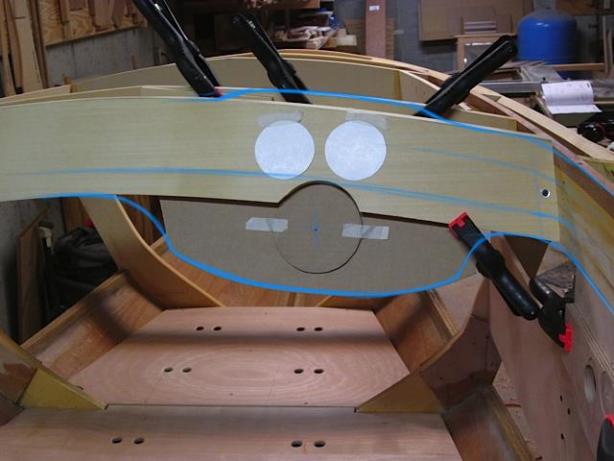
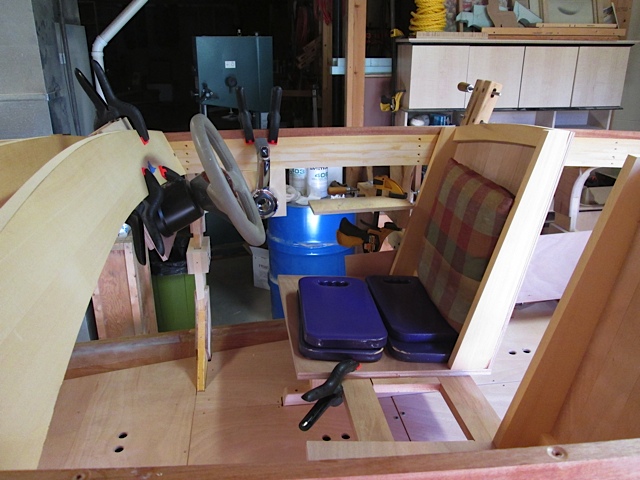
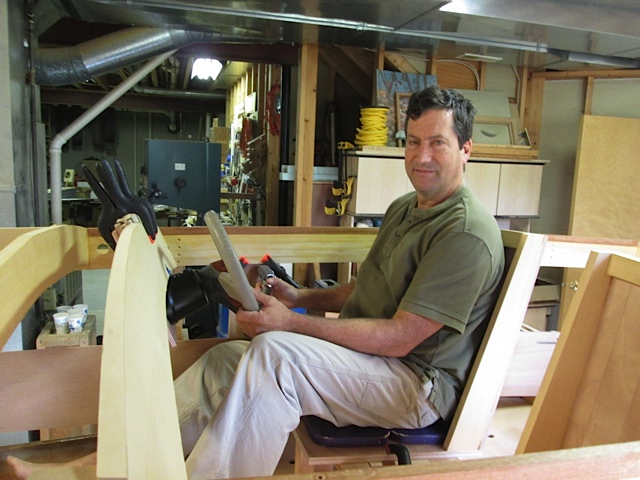
The driver’s seat in the modern car has to be comfortable for a wide variety of people, which is why there are an infinite number of settings. Building a wooden boat does not lend itself to such easy adjusting, so I am just making it to fit a generic adult man, and especially me. The actual mounting of the steering wheel and control lever is not so hard, but finding the perfect place is the challenge.
Below are shown several of the photos of mocking up the positions of the seat, wheel and throttle. Thanks goes to Brad Collins for loaning me a boat wheel, and shift levers to play with.
The routine is to clamp or screw the wheel, shift and seat in place, look at it for balance and lines, and then get in. Yesterday, I climbed up three steps on the ladder, swung my left leg over the side and hurdled the right to get in the boat at least two dozen times. It is an inspiring place. Closing your eyes can take you to a warm sunny day on Portage Lake or out through the channel to see the sunset.
Not every idea creates something great, but all great things start with an idea.

“Sitting pretty” is not so much a video as it is a snapshot, a moment of satisfaction, success or honor after a significant accomplishment. It is the County Fair Queen parading in the convertible, catching the big frog for the jumping contest, the robin preening on the branch, the sailboat tethered to the buoy at sunset, having a fresh box of Rise ‘n Roll donuts arrive unexpectedly at the office, the light bulb moment in math class, or graduation from dental school.
“Getting pretty,” on the other hand takes a lot of time and hard work, as seen in the mirror of a teenage girl preparing for school, studying for the Oral Pathology test, high school football preseason, designing a house, or working your way through college.
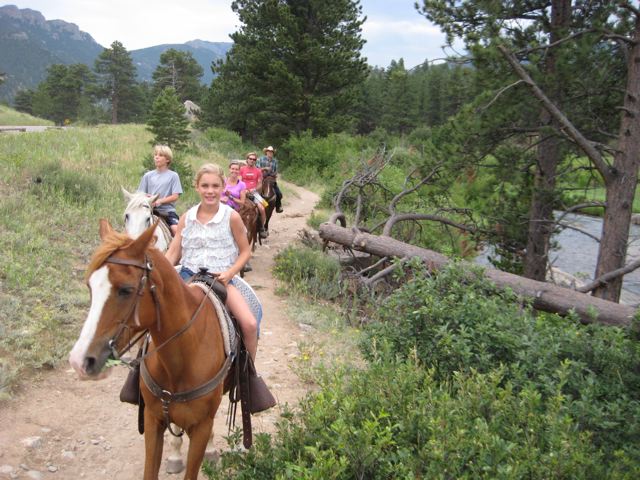
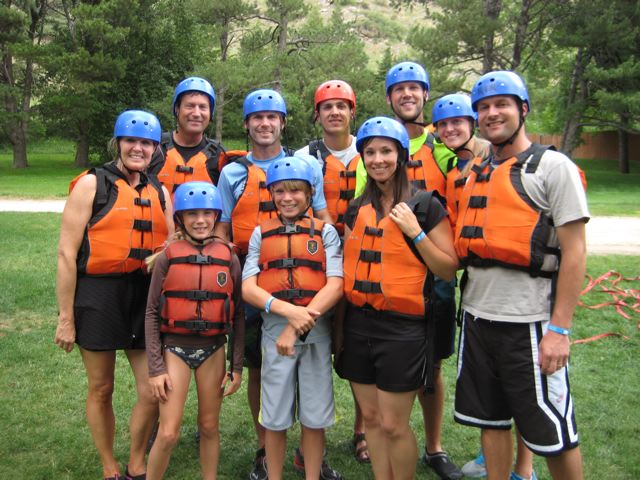
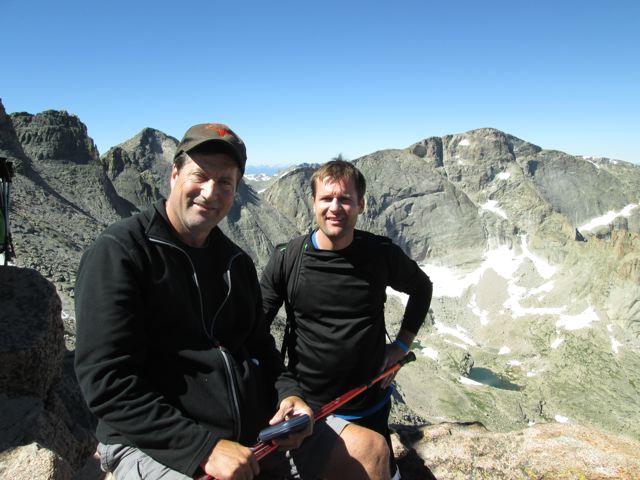
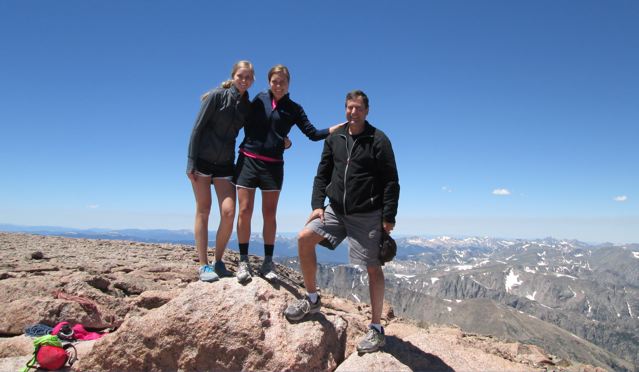
In July, our family went to Colorado to the YMCA of the Rockies, near Estes Park. It was full of “sitting pretty” moments like the family picture against the backdrop of Rocky Mountain National Park, riding horses along the mountain ridge, church under God’s cathedral, and cresting a wave on the raft trip.
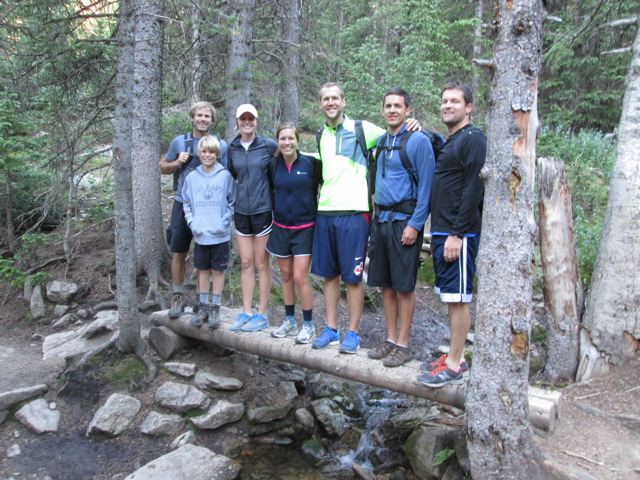
But the most anticipated event was the repeat climb up Long’s Peak. Austin and I had climbed the mountain 20 years before, when he was 12. We set out at 6:00 am up on the 15 mile round trip trail. Below is the crew soon after starting: Jeff and son Clayton, Audra, Amanda, LT, Danny and Austin.
We hiked awhile to a rest stop where Jeff challenged us invite God to be part of the journey and to listen for His purpose. Then Audra prayed for our day, for encouragement and blessing. After a couple hours of hiking, we made it to tree line, and continued on through the alpine meadows with wild flowers like the Columbine, Colorado’s state flower.
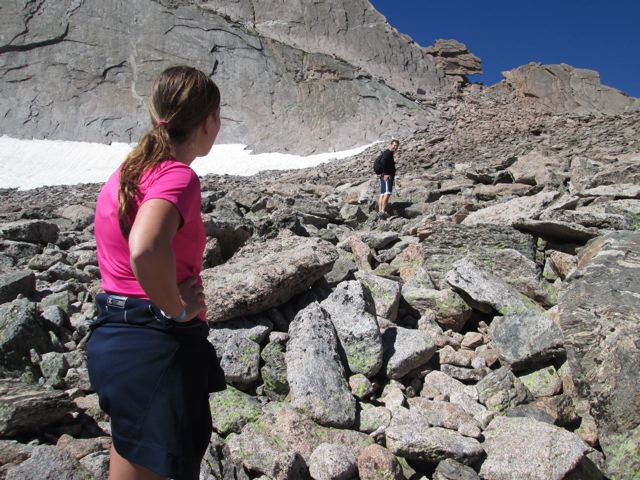
In a couple more hours, we were making our way across the Boulder Field on the way to the Keyhole.
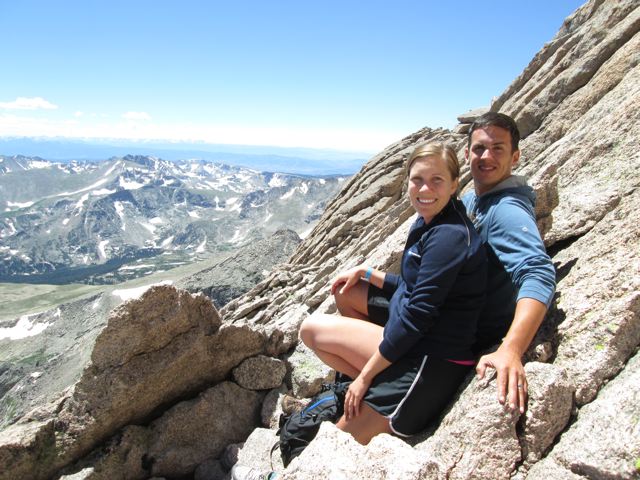
Beyond the Keyhole was another 1.5 miles of ledges, big rocks and steep inclines where the route was marked only by periodic bulls eyes. This was vertical scrambling that tested the edges of our concentration and endurance. Yes, it had elements of danger, a lot like every day living. One wrong decision and the consequences can be dire. Sitting pretty was seriously earned here.
Austin and I did some casual reminiscing about our previous trip 20 years earlier and were surprised that we did not remember how tough it was. We did not forget the beauty around us though.
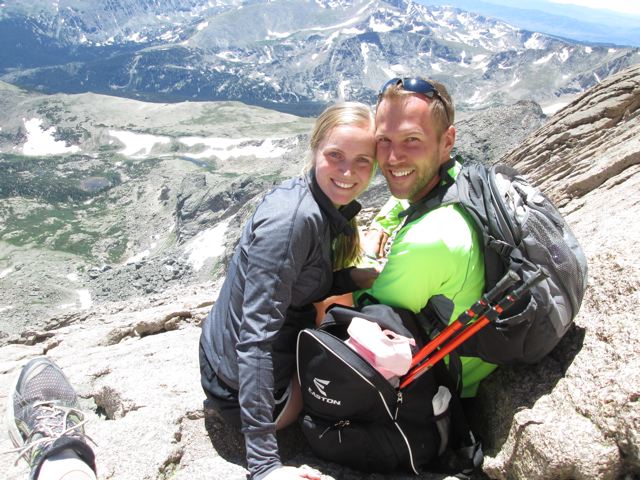
We eventually split up into two groups, and around noon, we climbed across the rim of the summit. At 14,265 feet, it seemed like the top of the world.
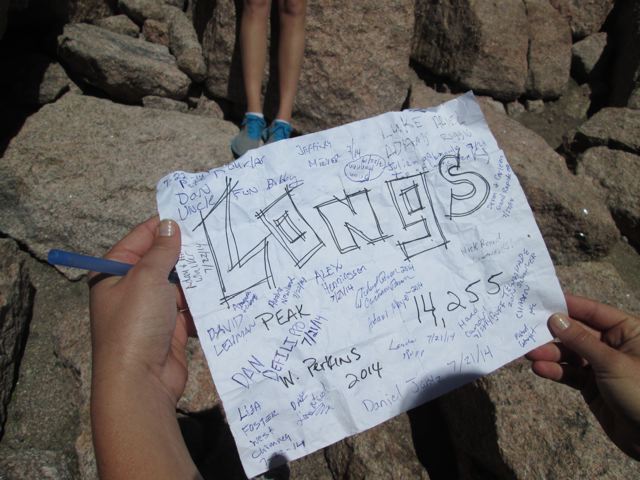
We signed the ledger and looked around a bit. There we felt the combined sense of euphoria from the beautiful distant views of snow capped mountain peaks, and the danger of exposure to the elements, the steep descent and thin air. We marveled at God’s creation for a short time and started back down.
Currently, the boat is in the long, hard preparation stage for “sitting pretty.” At this point, I am working on the frame and support parts for the seats.
Below are the base supports for the front seats. They wouldn’t have to be curved, but then it looks so sweet that way, and it is a boat…
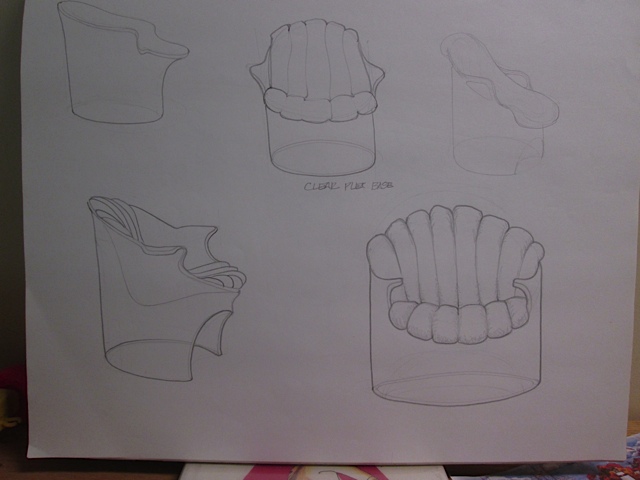
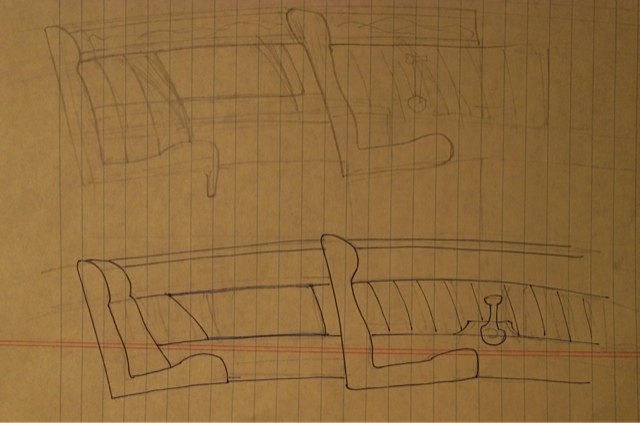
As usual, the next step is figuring out something, this time it’s the front seat shapes. Drawings on paper followed by full size patterns usually give the best design guidance.
I am not on top of this boat building mountain yet, but the long view of the seats is starting to come into view. As Austin said during the climb, “Determination still counts for something.”
P.S. The old scooter that I abandoned at the beginning of my second “annual scooter trip,” stayed the week with the man who was mowing in his front yards. He turned out to be trustworthy, and I went back the next week to pick it up. It had moments of play, mostly in the yard over the next couple of years and then it disappeared…