
First Turn – July 2023 to Right Side Up
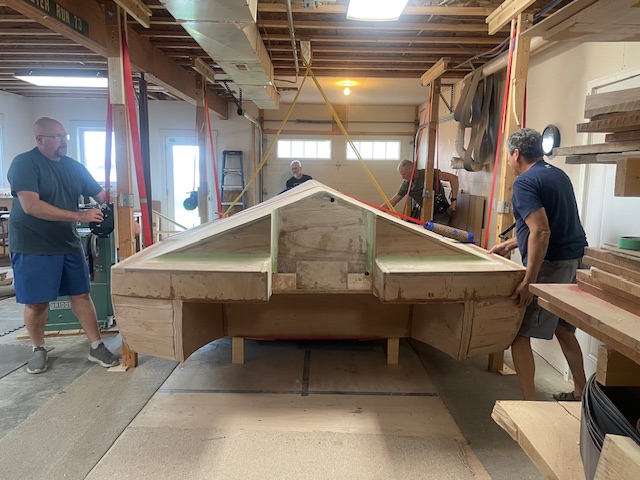
The construction of this 20′ speed boat started around January 2023 and by July the cross frames were connected with the keel, long stringers, and the hull planks on the bottom. It probably weighed 400 pounds and was a fairly easy job for a dozen relatives and friends to turn. We used two heavy nylon rope loops held by 2 x 4s, screwed to the ceiling joists to support the weight. It just took a little muscle to settle it on to the custom cradles made specially to fit the bottom.

Then, I went ahead with some interior work: mounting spaces for gas tank and battery, floor parts, seat framework, and top trim lines. It was ready to turn again.

Second Turn – February 2024 to Upside Down
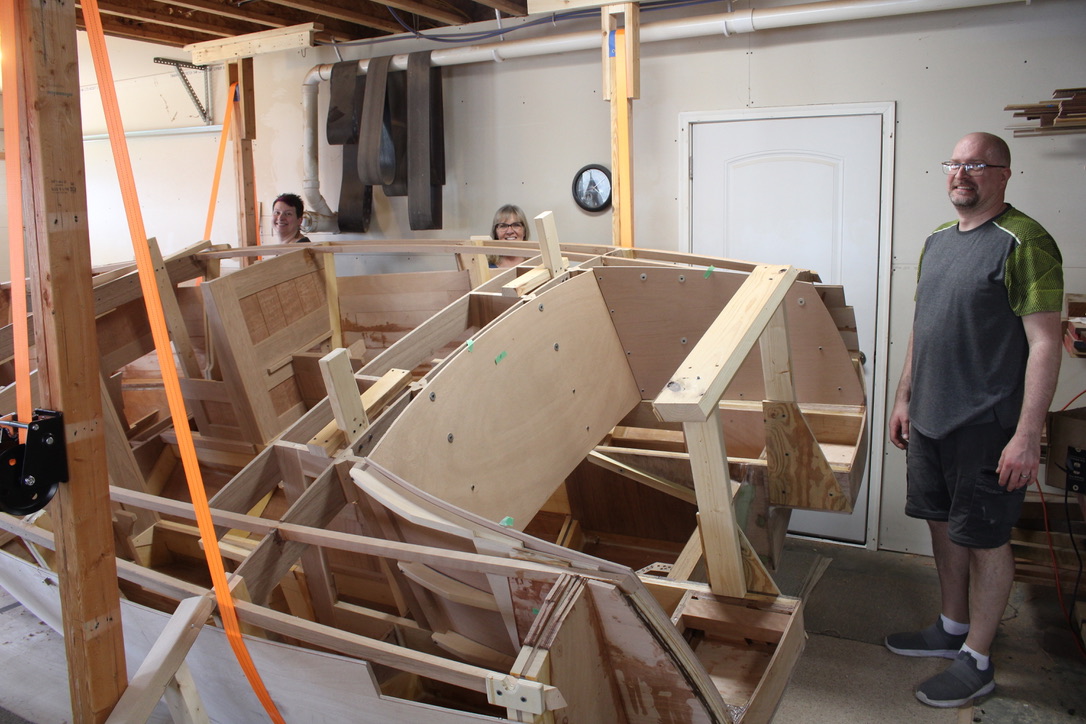
For this turn, we added a couple of 8:1 Block and Tackle pulleys and some extra rope loops to help rotate the added weight, which I estimate was then around 600 pounds. Andrew Alger and Jeff Margush are studying the situation.

The pulleys barely did the job, and required a fair bit of supplemental muscle from all, Steve Rimes and Todd Lederman, among others, below.

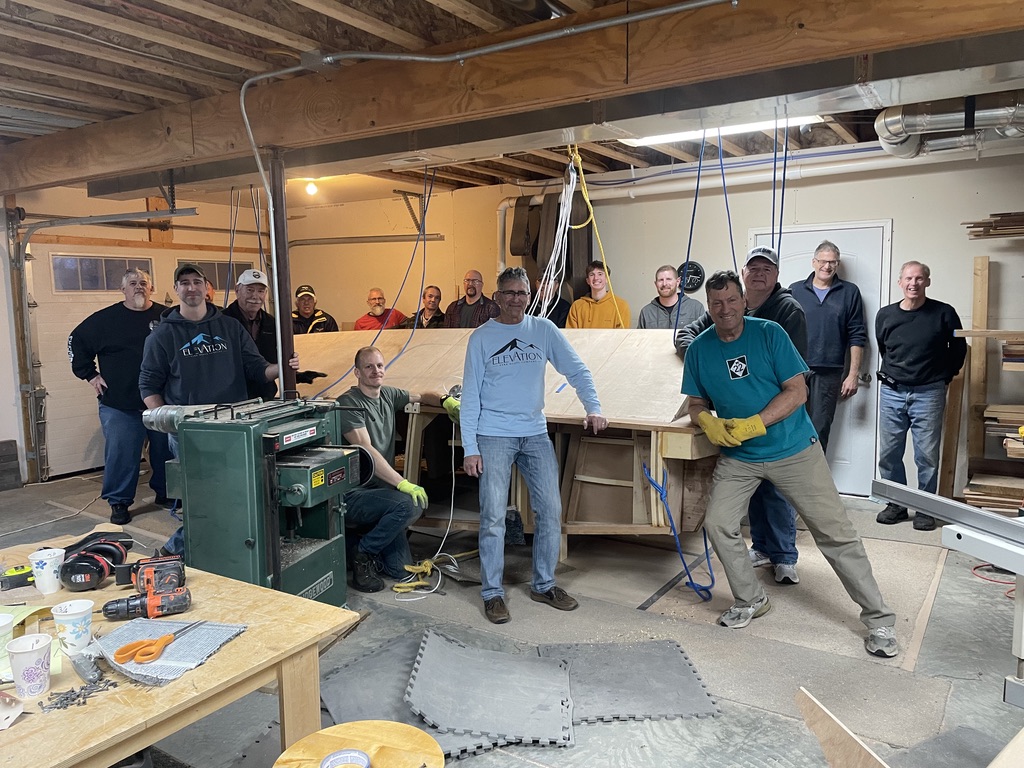
Here is the satisfied crew that got it done.
With the boat upside down, I added a second plywood layer to the bottom, and fit the side hull planks. Knowing the trouble we had with the last turn, and that it was heavier now, Andrew Alger engineered a new system of four posts and winches to carry to load.
Third Turn – April 2024 Back to Right Side Up
For the new process, I made four posts which rested on the floor, and were temporarily screwed to a mount plate at the ceiling joists. They had blue plastic covers from table placemats, to reduce sliding friction of the strap across the top. The winches were bolted on at a comfortable working height.
The boat was on fairly high cradles, and the system worked quite well, turning the 20′ wooden speed boat back to right side up with only a few people helping.
After that, I built out the stern extensions at the back, finished the side planks and added more interior framework. This added more weight than we anticipated. Jeff Margush adds his thoughts . . .

Fourth Turn Attempt -Failed Try to Upside Down – August 2024
Then it was time to flip it upside down again. This time just three of us, Andrew, Jeff and I tried to make the turn. My first impression was that the winch handles seemed more difficult to rotate than how I remembered from before.
On the first try with the post assembly, I just put plastic strips across the post tops to help reduce friction for the nylon strap to slide. It had worked well as we were rotating a side down, with the center of gravity going down also.
But, this time, pulling the boat upward, the orange strap got really tight, pulled the blue plastic strip off and wedged itself between the post and the side guide.

The boat was now a couple hundred more pounds heavier, and the extra force required to the winch handles, pulled them out of alignment. That folded the strap, increasing friction there as well.

In addition, when we tried to get the boat lifted on one side, the low center of gravity caused the boat to resist rotation and made the boat slip on the straps.
We did get the left side rotated up about 1/3 of the way, and then turning the cranks got so hard we had to stop the attempt. We reversed and gently let the boat down to the floor.
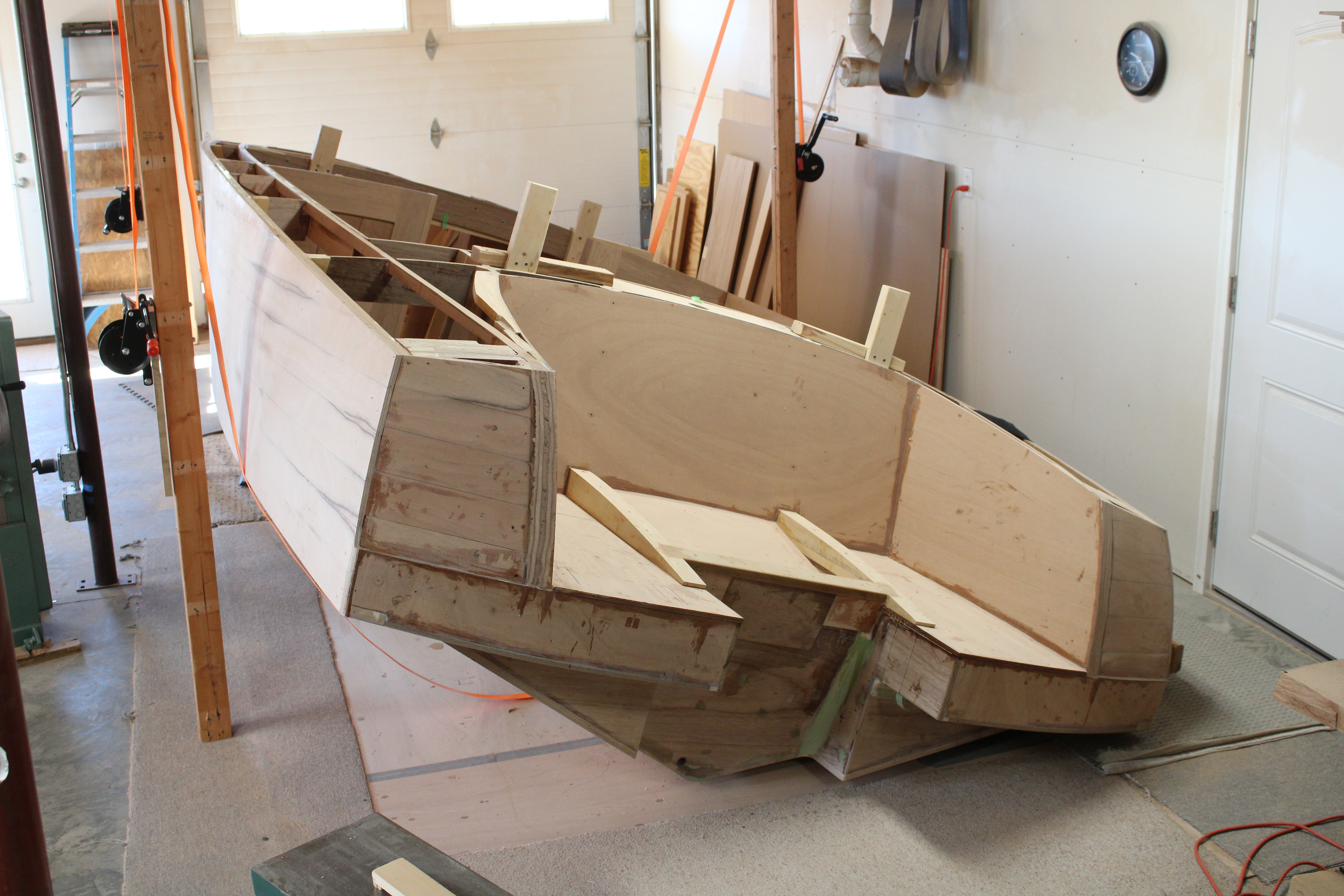
Note: the back right post is already removed after the failed attempt and the boat is peacefully resting on the floor.
Fifth Turn Attempt – 2nd Failed Try to Upside Down– September 2024
To improve the system, Andrew made some heavy duty rollers, with large washers welded to the metal cylinders, spinning on 1/2″ bolts. The flanges helped to prevent the strap from getting caught on the side of the post, and the metal cylinder turned so freely as to almost eliminate the friction.

However, the weight of the boat at this point still overwhelmed the capacity of the winches and straps. Also, the boat kept slipping when we tried to raise one side, and it look like a risk of falling over too fast if we did get it rotated past the vertical position.
There was a little head scratching before we quit this attempt and lowered it to the floor.

Sixth Turn Attempt – Successful 3rd Try to Upside Down September 2024
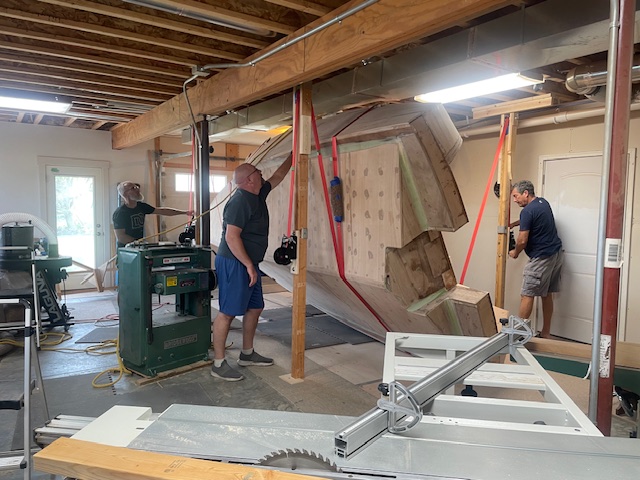
Once again, Andrew helped to improve the turn system, and suggested new heavier duty winches. They also had an improved gear ratio of 8:1 which made turning them easier. This time, instead of just having the strap across the bottom, I also fully wrapped the strap all the way around the boat, which helped reduce slipping.
Below shows the tweaking needed to avoid hitting a light or dragging hard on the floor, but this time we succeeded in getting the boat turned over.
On the short legs again, it is now ready for final fiberglass and epoxy coating on the bottom, and then primer and paint. This is hopefully the last time it will ever be upside down.
Below is the response from friend David Beale when hearing about the delays:
“I’m guessing difficulties in flipping the boat during the build process probably never made it into your time calculations when starting off on the build – which would make it similar to so many of my own projects. Moving something of that size is clearly not easy!”
True enough. David speaks from experience as he is an adventurer extraordinaire. Besides mountain and wilderness exploration, he built and worked a beautiful 19th century farm without fossil fuels for a decade and a half. You can read about some of his amazing adventures on https://haymanfarm.blogspot.com/
Next up is finishing the bottom of the hull with epoxy over fiberglass fabric to prepare for painting. . .
 Building Redemption