
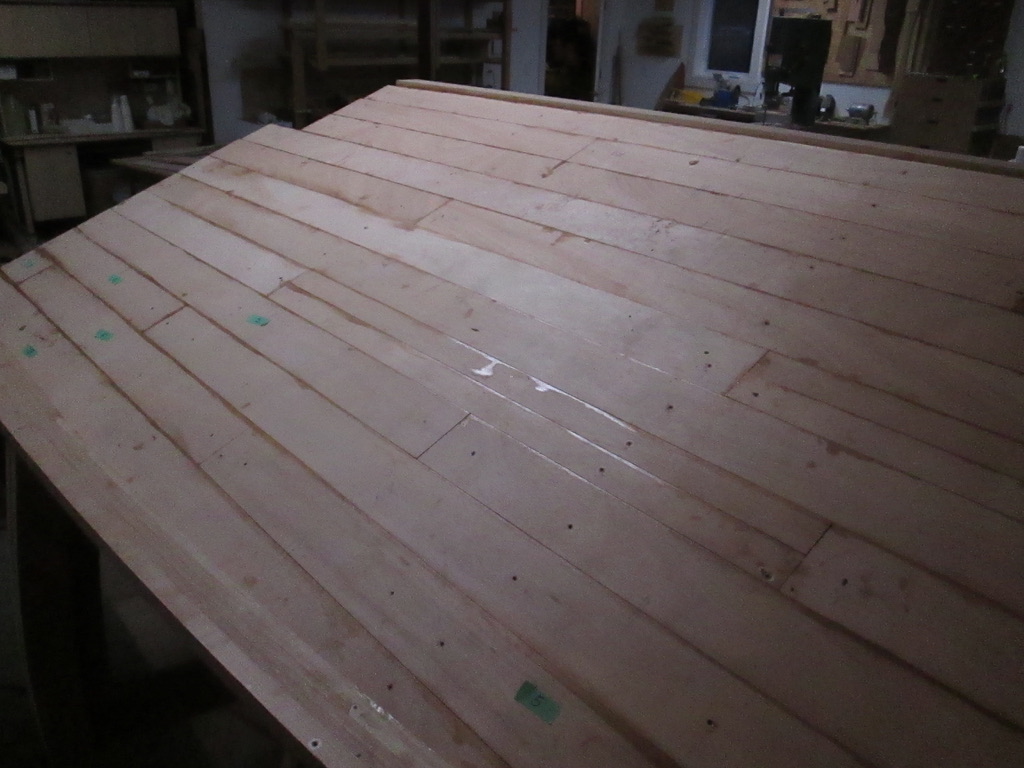
All of the cross frames, and longitudinal moldings and support parts just serve to build support for the shell of the boat, in this case the hull. The intention for the back 6-8 feet is that the surface should be flat for most efficient planing. At first glance the surface below looks flat, and it is pretty close, based on preparation faring work on the frames and stringers.
The tools of the trade for this task are the straight edge, a plane or two, these from Lie-Nielson, and the home made long sanding board.

Pencil marks show where the hull was slightly high, and the block plane or the low angle jack plane start to flatten the area.


Then some sanding with the long board, to only hit the high spots, eventually tames the mildly lumpy surface to a happy, fair curve.

When you are hitting a ball, you have to keep your eye on it, and you might be able to play music by ear. But the if you are testing how well the hills and valleys of a surface are “faired,” the final judge is the hand. You could do it with you eyes closed.

 Building Redemption