
As usually happens with detours, you don’t see them coming. That is the problem with big ideas, it is hard to know in advance where the next bottle neck will get the progress slowed to a trickle.
Once awhile back, I heard that if you don’t know what to do next, clean the shop. I did that, not perfectly, because a boat just collects debris, but it did prevent making a mistake to compound the problem. The next applicable advice goes along the lines that “a journey of a thousand miles, starts with the first step.”
The problem of so much bend and twist required in the surface change near the front of the boat had me stuck. So, I started a “first step” experiment by cutting my typical 4″ hull planks into half, to see if they could be clamp and screwed through the angular bends required. It did show me that the 2″ widths of the 1/2″ marine plywood could be forced to fit. Had this not worked, I would probably have tried using a 1″ strip building method.

The next challenge, and the most important was how to make it look good. The best shapes that I observed were only concave in one direction. Even though there will be an up and down concavity, all of the lines going front to back can have a slight outward curve, as shown above. In other words, a bowl shaped depression at the corner is not a functional or visual strength.
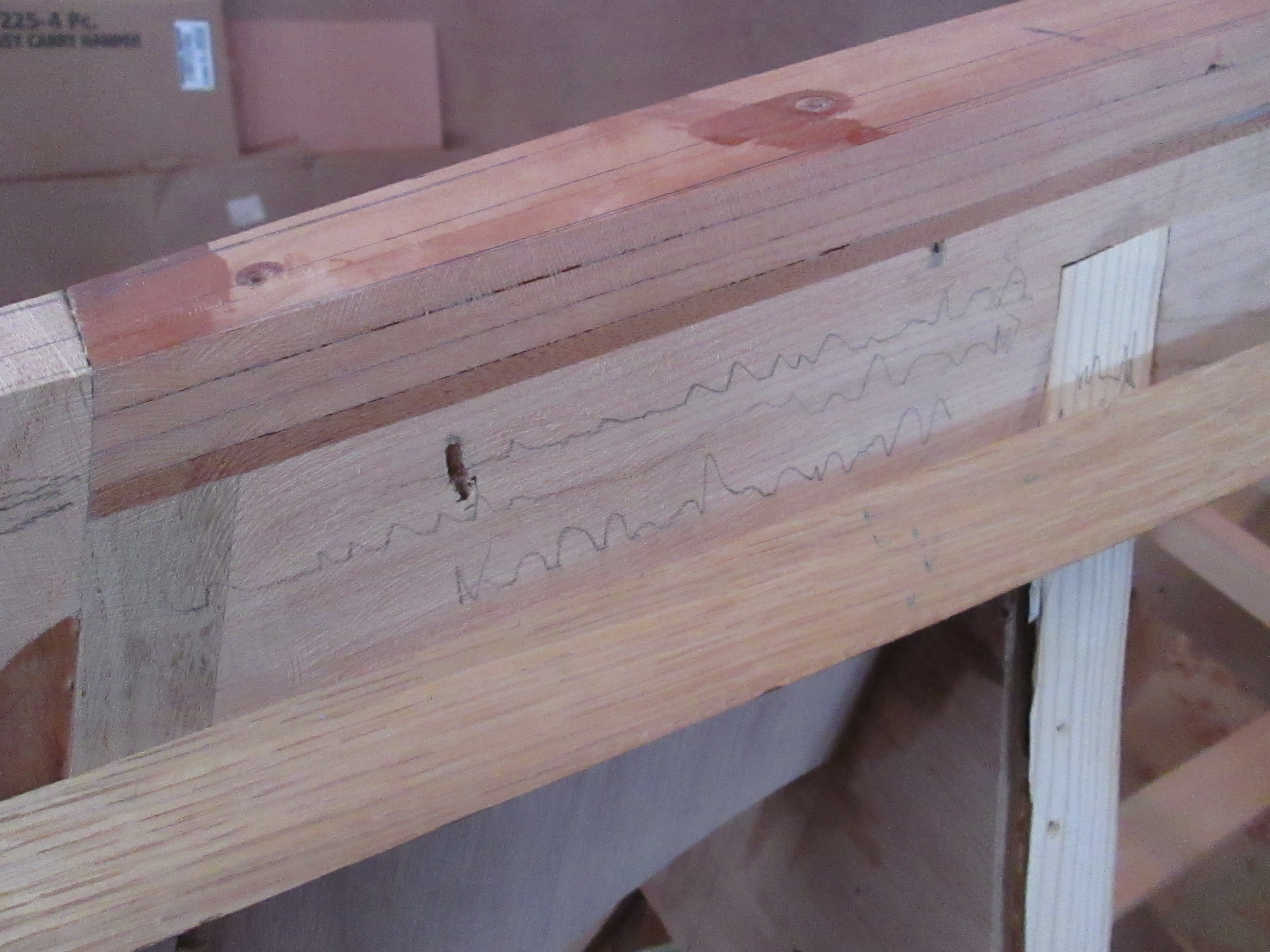
To attack this problem, I prepared a 10′ long, straight grain white oak stringer, about 3/8″ by 1-1/2.” This was attached by one screw at the distant cross frame, so it could be moved up and down at the front. As shown below, I was pencil marking the high spots as the long fairing guide moved down.
Then, it took some judicious grinding by this trusty Craftsman body grinder with 36 grit heavy duty sand paper. This is not a tool for the faint of heart, or the imprudent craftsman. It took a fair bit of practice, but eventually it was tamed as I understood the nuance of a gentle touch with the proper angle of action.

After multiple pencil marks and careful grinding of the high spots, I arrived at the surface below. In most cases I was cutting wood away, but the light colored filler stick was glued to the first frame where it was low. After working the top area, the fairing stick was unscrewed at the distant axis, and repositioned about 5-6″ down, only to repeat the process for the next zone down.

It feels like the right direction, but confirmation will only come as the shell is installed.
Meanwhile, some encouragement continues to trickle in: Bob Cross asked about when it would be done and how many hours a week I work on the boat. My answer was two more years and I average about 15 yours a week.
This is mainly due to the vacuum of time gained from retirement, getting filled by even more time consuming activities in the near and far reaches of the world. Bob said, “If you worked more hours a week, maybe you could get it done sooner.” That deserves a serious consideration . . .
 Building Redemption