Intuitive Boat Hull Design

The physics and math of fluid flow across a hard surface is pretty complicated, but taking a common sense approach can bring a good bit of direction to a new boat design. The first main decision is whether the boat is supposed to go slow or fast.

Slow, displacement boats when moving, stay nearly at the same depth as a rest. Speed limits are defined mostly by the length of the object, and the length-to-width ratio. The row boat below is beauty in motion, although quite slow.

This God designed hulk of a whale is a far more efficient displacement machine. Even though it has to push its full girth through the water, It has a super slick motion, with speeds exceeding 20 mph for short distances.

Wood boats can’t begin to replicate all the whale’s body mechanics of flex and fin stroking. But, human engineers have done some of their most successful design work, imitating performance seen in nature.

Another group of boats are called semi-displacement, for their ability to go efficiently at a slow cruise, and still go beyond displacement speed with more power. Generally, the more pointed the front, the less effort to go forward. A catamaran uses two hull halves to make even narrower parts, with sharper entries.

At the back of the boat, the deeper it sits, the more wake it produces, and the less efficient the power-to-speed ratio. Below is a fine design of a semi-displacement hull. The front of the hull is a cutting edge; the water flows to the side and under the boat. By the time it gets to the transom, the water returns almost up to the original water line. That leaves very little turbulence, or wake drag.

But that’s all academic if you want the boat to go fast, with grab rails! Fast boats are designed to ride on top of the water, and have to be powered strong enough to push the hull up on plane. Then the water touches a much smaller friction pad, generally the back half the bottom or even less.

The contact area is smallest on a flat bottom like some of the old traditional woodies, but that gives the most pounding ride on choppy water. Ocean racers like the beauty below use a steeper dead rise angle from the bottom to the side, up to 24 degrees, giving a more stable and comfortable ride for aggressive wave hopping. By the time they power up their twin 450’s, they may have only the back third of the boat hitting water, some going over 100 mph.
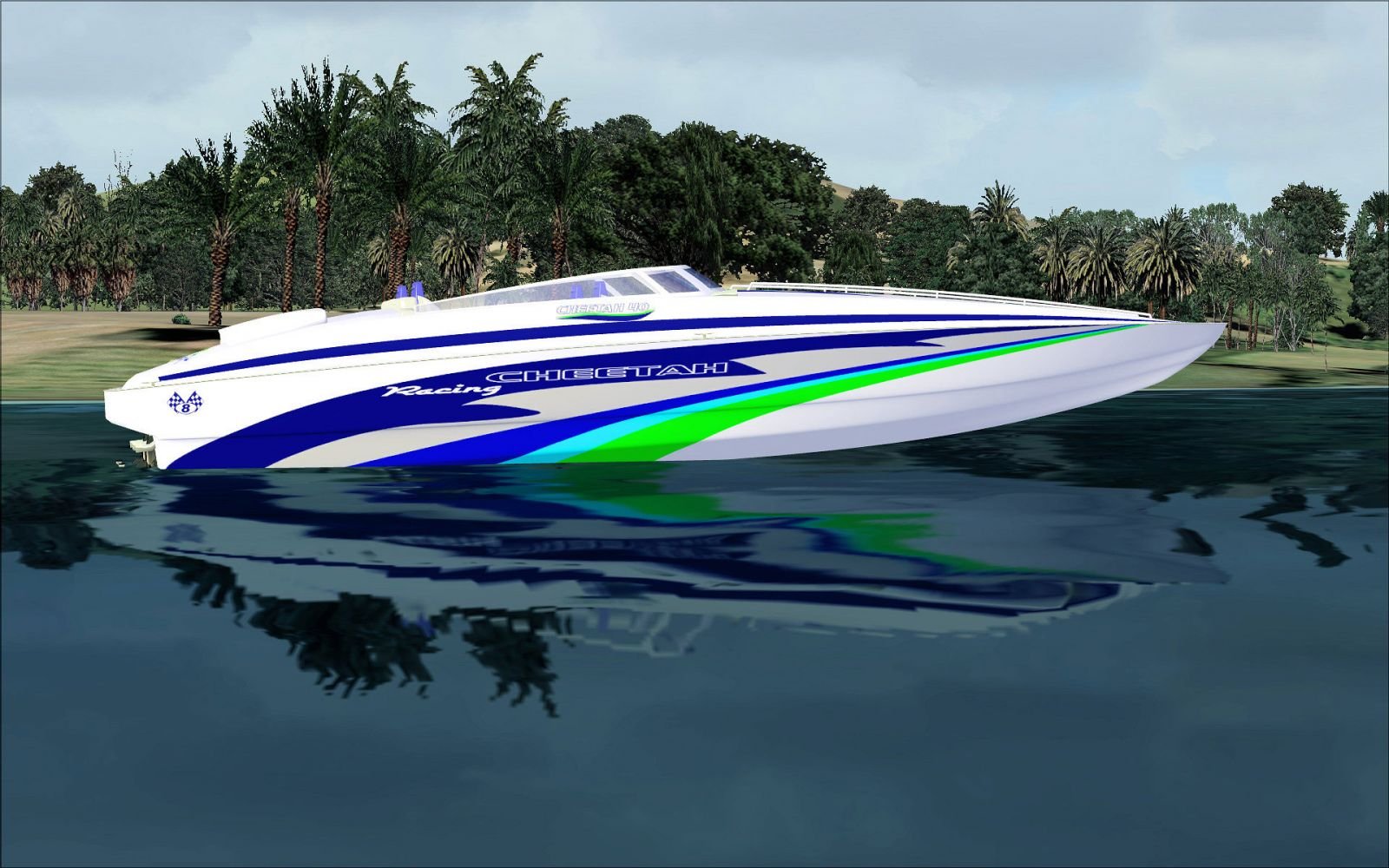
Principle 1 of intuitive design: Define your speed goals and imitate success! I have reinvented the wheel enough times to realize a bike really cannot steer from the back tire, for example.

Principle 2: slow boats are usually wider to their length, and fast boats get narrower. The ocean racers generally are at least 3:1 length to width. My first boat was 20 ft. long and 6.5 ft. wide for a slightly more than 3:1. However, for a smaller boat, it gives up some lateral stability, and overall carrying capacity. The new boat will be 20 ft. to 7.6 ft wide or 2.6:1. This will provide the extra buoyancy for a few more grand kids to jump on.
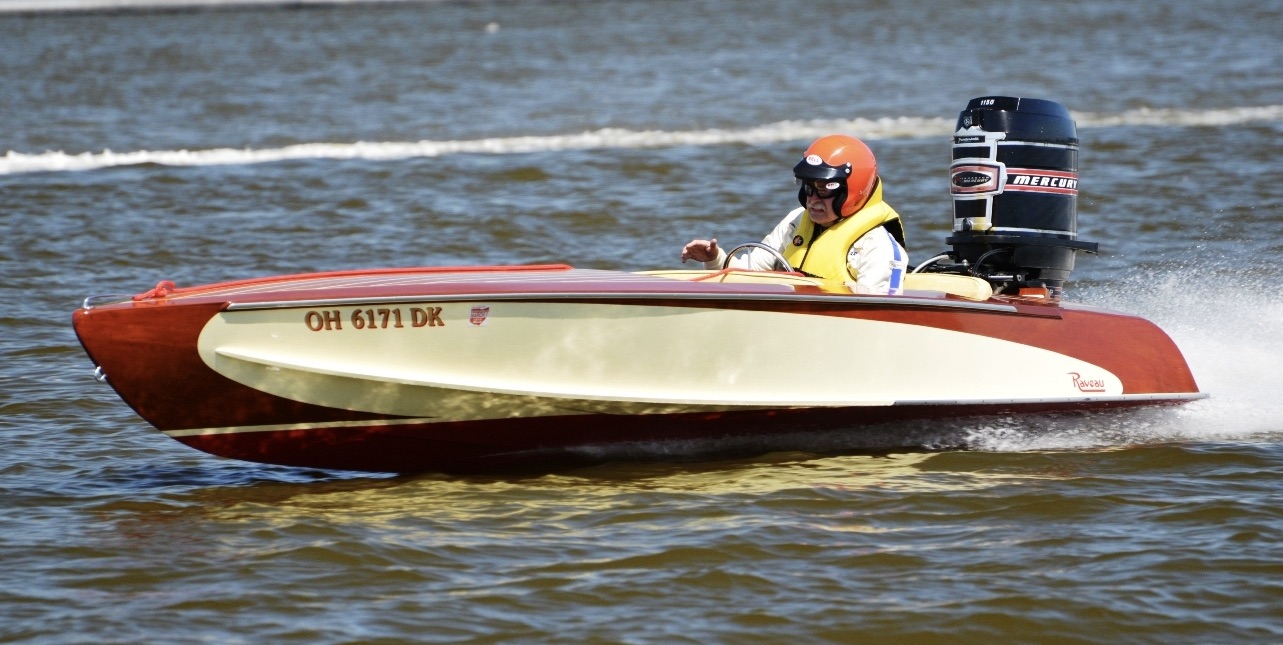
Principle 3: the dead rise angle. The Raveau Racer above, built by Bob Walwork, has a flatter bottom angle. It is a single purpose boat, run mostly in calm water, as the Raveau drivers tend to be addicted to speed.

For my boat, I have narrowed down to a more general purpose speed boat, with 20 degrees dead rise, which seems to be a pretty good mix of a comfortable ride on flat water or some more choppy conditions. it is some guess work, but some things in life don’t have mathematical answers.

If you look at the bold black outline, you can see slight tip in at the transom, or stern. This “tumble home” is a consistent characteristic that will make it feel comfortable around the old classics. Nearer the middle of the boat, the green Number 3 cross frame, shows that the outside of the hull has a slight outer tip. The light lines show this tip out angle increases more towards the front of the boat, to keep water spray out.

Do a little research, weigh the options, try to evaluate the pros and cons, and then there comes a moment of decision.

More to come. . .
Speed Boat Design 1

A new boat! The original 2016 LC20 “Redemption” was a grand learning curve, and a great success in many ways. The first boat was more like a sports car, where “look good” and “go fast” were pretty much the key intentions. But Jan had some bigger functional parameters of her own, along these lines:

“Well, maybe enough comfy space for a few of my friend groups, like 10-12, or 15 if mostly grandkids?”

“Maybe some drink holders and a cooler, a little party table?”

“How about an easy way to get back on the boat, if we do “diaper dipping,” a form of swimming with an upside down life jacket?” Should I even encourage that?

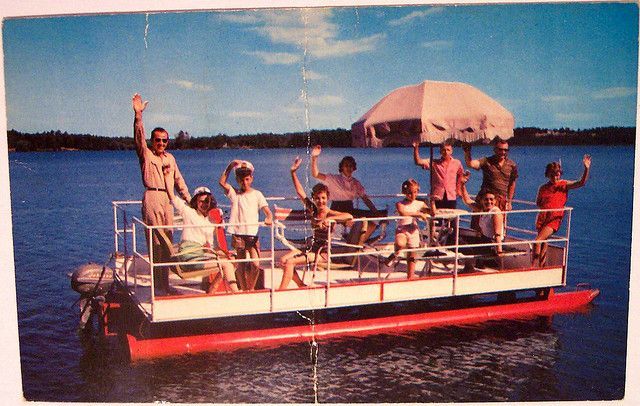
“Honey, it sounds like you are wanting a “Pond Tune” boat!” I said. “I am sure I don’t have room in the basement for that size of a boat, and I have never seen one done as a “Woodie.” The Kansas relatives above, Marge back left and Ed, second from right seem to be having a great time on Pete’s Puddle, if my reimagination serves me right.

Well then, Jan asks, “How about at least putting a few grab bars near the shotgun seat in case of mild turbulence?” Okay . . . there was the one time, we went for a slow cruise on the wooden boat, and a monster wave surf boat came cruising by, pushing up a four foot wake.

Instinct from driving a 16′ Marlin Scorpion speed boat in the 70’s took over, and I might of goosed it a bit just as we neared the edge of the wake, on an angled approach. The neighbors said we went airborne, including the motor, and Jan went from sitting high at the peak, to disappearing under the dash into the front cuddy on reentry to planet earth.

Being the doting and sensitive husband, I noted the important take away: add some grab bars!!!

A second accommodation for the new boat was drawing a wider beam, going from 6’6″ wide to around 7’8.” This design change adds extra carrying capacity, for that 8-10 plus chatty friend or family group, and will create better side to side stability.

The first wood boat, shown above, was modeled after the ocean racers, with a more pointed bow line. On the sketches for the new boat, e.g. below, I tended to draw a more vertical bow line.

This leans more along traditional lines, but some contemporary boats have used a near vertical front as well, and I find this example quite inspiring.

This time a windshield will be in the plan . . . stay tuned.

Boat Building Wood 2

Besides the Alaska Yellow Cedar, here are my observations about several more of the wood species popular in boat building:

White Oak – This is a tough, hard, strong, and rot resistant wood. It even has fashionable flavors. If you prefer, you can get the contemporary quarter sawn straight grain without the flake decoration. The market price is reflecting that popularity right now, as it is used in much furniture. You can visit a nice example of this style in the blog titled Butler Desk.

If you appreciate the flake pattern of the quarter sawn variety, it is a common trademark of the historic Craftsman Style furniture. In either case, quarter sawn white oak is very dimensionally stable and useful in boats. Since it is also quite heavy, I used white oak for the keel of my first boat, and other parts near the bottom to keep the center of gravity lower.

White oak is a good wood to steam bend, but as a general rule, I don’t like steam bent parts. They don’t follow perfect curves, as knots or grain variation affect the result. Much more satisfactory for me, is to cut the wood in slices which can dry bend the curve I need. With a three or more piece lamination, they self correct and create a beautiful curve without much need for additional fairing. The photo shows the three oak pieces making the chine stringer.

White oak might even be my favorite wood if hadn’t been for leading the entire field of wood entries in the competition for poking splinters into my hands.

Mahogany is next up. It is beautiful, strong, works well and is rot resistant. So many woods go by the name mahogany, including most of the souvenirs you might buy in a foreign country, that it gets confusing. For me, it needs to be the red brown variety, most likely from Africa, more dense with not so much grain porosity, and beautiful figure. This prime wood is expensive, but worth it in the most demanding circumstances, as shown by the number of classic boats it covers.

The Mahogany below, on my first boat, came to me a long time ago from a Swartzendruber Hardwood Creations garage sale of unused boards. It stayed in my shop 10 years or so before I had it sliced into 3/16″ veneer and put on the boat. The lighter top veneer planking is Curly Maple, which is does not compete well in boat building categories, except beauty.

Marine Plywood is most commonly available in two species, Okume and Meranti (Hydrotek), and an integral part of contemporary wood boat building. It has meet International standards for glue strength, water resistance, and having no internal voids.

Plywood is much more dimensionally stable than any solid wood, and as the inner core of a composite layer, it can make an exceptionally strong, curved surface. In my first boat, I used tongue and groove marine plywood hull planks, covered inside and out with fiberglass cloth embedded in epoxy.

There are no leaks and not much water ever gets in the boat, so rot resistance of interior parts is not a problem as in the old woodies. I prefer Okume plywood for its light weight, but used Meranti, (Hydrotek), for the cross frames, as it is cheaper.

I will return to Okume for hull planks this time, as I find it easier to fair with hand tools, and sanding boards. However, using T & G planks gives a self fairing head start.

This time around, I am looking around my shop, using some inventory hanging around for awhile, and buying the rest locally in Northern Indiana. The interior will likely be mostly Cherry. It is medium in weight, strength and shock resistance, but good for bending and it works so well with machines and hand tools very well.

The decision for the deck wood is still uncertain, but if I find a particularly gorgeous curly spalted maple plank, I might ignore the rules . . .

Boat Building Wood 1

The design of a new wooden boat requires thinking about the choices of wood. Trying to keep the water out of the floating space takes a combination of strength, stability, toughness and endurance. Western Red Cedar, Alaska Yellow Cedar, Sitka Spruce, cypress, teak, ash, white oak, and mahogany are some of the most highly prized woods for the beautiful traditional wooden boats of the last century. 

Some physical properties that matter most for the wood in a boat are: strength, density, hardness, stiffness, bending properties, moisture resistance, and dimensional stability. From a practical standpoint, some of those factors may be overridden by cost, being able to source them close by, and working ability. With all of that in mind, here is one of my personal favorites:

Alaska Yellow Cedar – It is not cheap, in 2023 around $10-15 / board foot rough. But everything else about yellow cedar is amazing. Mine came in generous 4/4 thickness 1″ x 6″ x 16 feet long with no knots. The prime vertical grain boards are straight, lay flat, are very stable and weather resistant. It is very light weight, and has an exceptional strength to weight ratio which is great for boats or airplanes. The distinctive aroma advertises its unique personality, which is like your Grandma’s cedar chest, spiced up a bit. 

But it really shines when you actually pull it off the rack and put it to work.

Alaska Yellow Cedar cross frames and stringers.

The tight consistent grain cuts so consistently and smoothly, that it makes hand tools seem like a good idea. A bonus is that it over a few years working with Alaska Yellow, it has never once given me a splinter. I love this wood.

Perhaps you can imagine how sorry I am, that the original stash I bought in 2013 to start the first boat is coming to the end.   But, there are other wonderful wood choices . . stay tuned.